
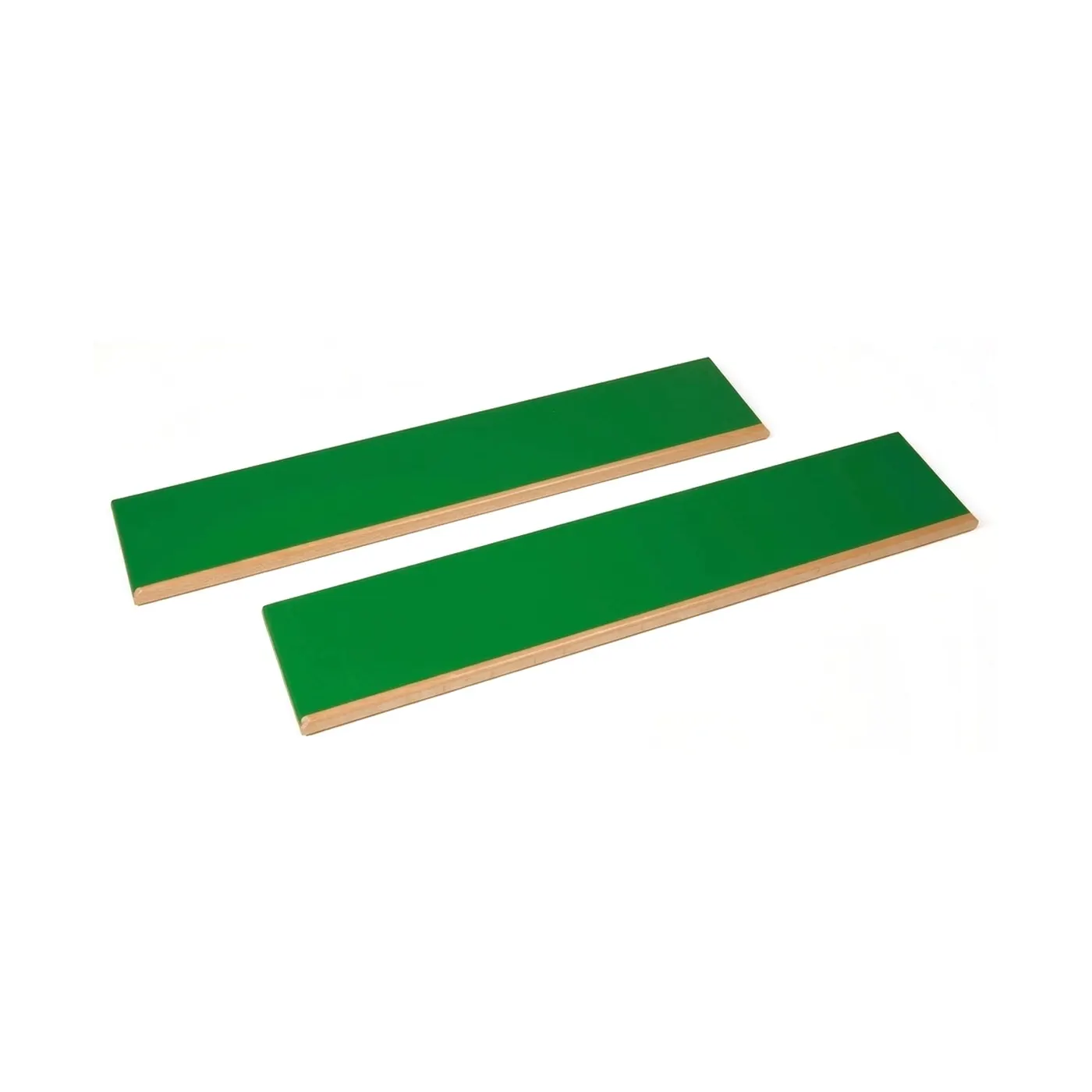
Fraction Circles (Nienhuis)
The first photo is the maker's own. The other shots are illustrative.
Inv. no. NIE-011400
- Maker
- Nienhuis Montessori, since 1929
- Approval
- AMI
- Primary Material
- Metal
- Colour
- In green and red
- EAN
- 8719924006563
€326.90
Final price incl. VAT. Free delivery.
On backorder. Expected back in stock 25 December 2026. You can order now, we ship the moment it arrives.
1
30 daysto return
Advicebefore and after
Invoicefor companies
Advice, warranty and returns are handled by us.
The original
Why it costs €326.90
Behind the price of the original are things you can check yourself.
AMI approval
The material is approved by the Association Montessori Internationale (AMI). Nienhuis has made Montessori materials since 1929.
A verifiable original
The EAN 8719924006563 is on the box. It is the maker's number, not ours.
What the child does
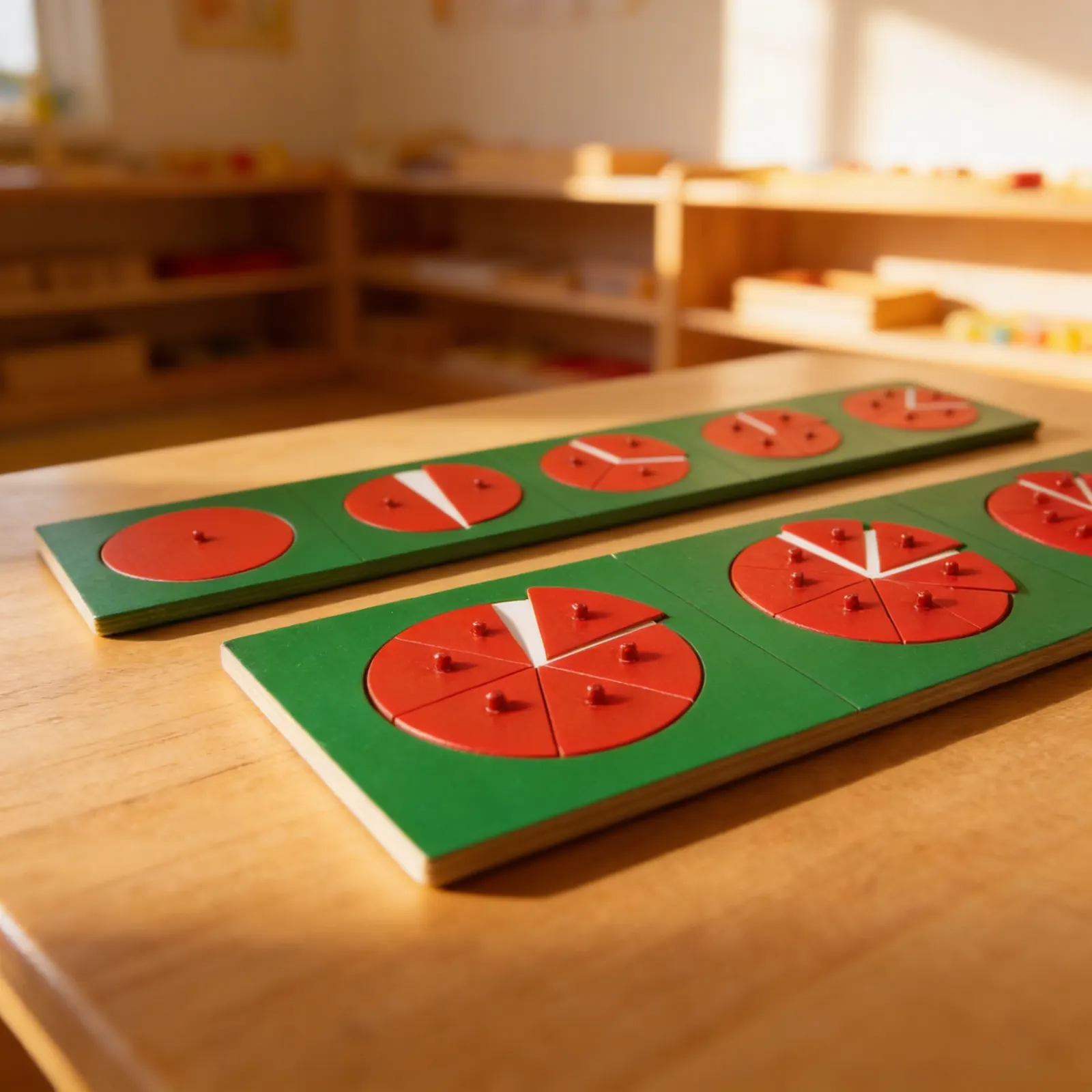
Fraction Circles (Nienhuis) in a child's hands
Circles divided into equal parts, from the whole down through the family of fractions, in frames a child can lift the pieces out of. The material carries far more than naming: correct terminology first, then equivalency, then the four operations with fractions, then conversion to decimals, and eventually measurement of angles, because a circle divided into parts is also a protractor waiting to be noticed. Few materials stretch that far, which is why this one stays on the shelf for years. Metal in green and red, for ages 6 to 12.
Mathematical Foundation
Builds concrete understanding of fractions as parts of a whole through visual and tactile exploration
Visual Discrimination
Develops ability to recognize and compare different fractional parts through clear divisions
Abstract Thinking
Bridges the gap between concrete materials and abstract mathematical concepts through hands-on manipulation
Activity Guide
How to present it
Place the fraction circles in their frames on a table mat. Arrange the frames in order from whole to smallest divisions. Have a soft cloth ready for handling the circles.
- 1Begin with the whole circle, tracing its edge with two fingers while saying 'This is one whole circle'
- 2Move to the circle divided into halves, trace each half separately saying 'This is one half' for each piece
- 3Remove one half and place it beside the frame, then replace it, noting how two halves make one whole
- 4Continue with thirds, removing one piece at a time and counting how many pieces make the whole
- 5After exploring each circle separately, compare pieces from different circles by placing them side by side
3 tips for parents
- Practice fraction language during meals: 'Let's cut this apple into halves' or 'We'll share this pizza in quarters'
- Avoid rushing to symbolic notation (1/2, 1/3) - let the concrete understanding develop fully first
- Support your child's work by asking 'How many pieces make the whole circle?' rather than telling them the answer
From the same makerNienhuis
Accessories
Why it is in our selection
If you are not sure it suits your child, we answer in person.
Norbert Kovalčín, founder of Faborino · write to him
There is no review here yet. We will ask you for one after you buy. Write the first review
Details
What's in the Box
- Fraction Circles: Circles divided into equal parts, made of metal, in green and red
- Frames: Frames the child lifts the pieces out of
Size and material
| Packaging | 15 × 15 × 15 cm |
| Primary Material | Metal |
| Colour | In green and red |
| Recommended Age | 6-12 years |
Care
Wipe with slightly damp cloth, dry immediately
Frequently Asked Questions
What age is most appropriate for introducing the Fraction Circles?
While suitable for ages 3-6, most children benefit from this material around age 4-5 when they have developed fine motor control and can understand the concept of parts and wholes. Earlier exposure can focus on sensorial exploration of the circles.
How do children progress through the Fraction Circles material?
Children begin by exploring whole circles, then progress to halves, thirds, and quarters. They trace the divisions, remove and replace pieces, and eventually compare different fractions. The material naturally leads to naming fractions and understanding equivalence.
What mathematical concepts do Fraction Circles teach beyond basic fractions?
This material introduces equivalence (two halves equal one whole), comparison of fractions, the relationship between division and fractions, and prepares children for later work with fraction operations and decimal conversions.
How does this material differ from other fraction teaching tools?
Montessori Fraction Circles provide precise, hands-on manipulation with clear visual representation in green and red. The material isolates the concept of fractions without symbols, allowing sensorial understanding before abstract notation is introduced.
What activities can children do with the Fraction Circles?
Children can trace divisions, build and rebuild circles, compare different fractions, create equivalent fractions, play matching games, and eventually create their own fraction problems. The material supports both individual exploration and small group activities.
Product safety
Manufacturer: Nienhuis Montessori, Anders Celsiusstraat 15, 7442 PB Nijverdal, Netherlands
Fraction Circles (Nienhuis)
€326.90