
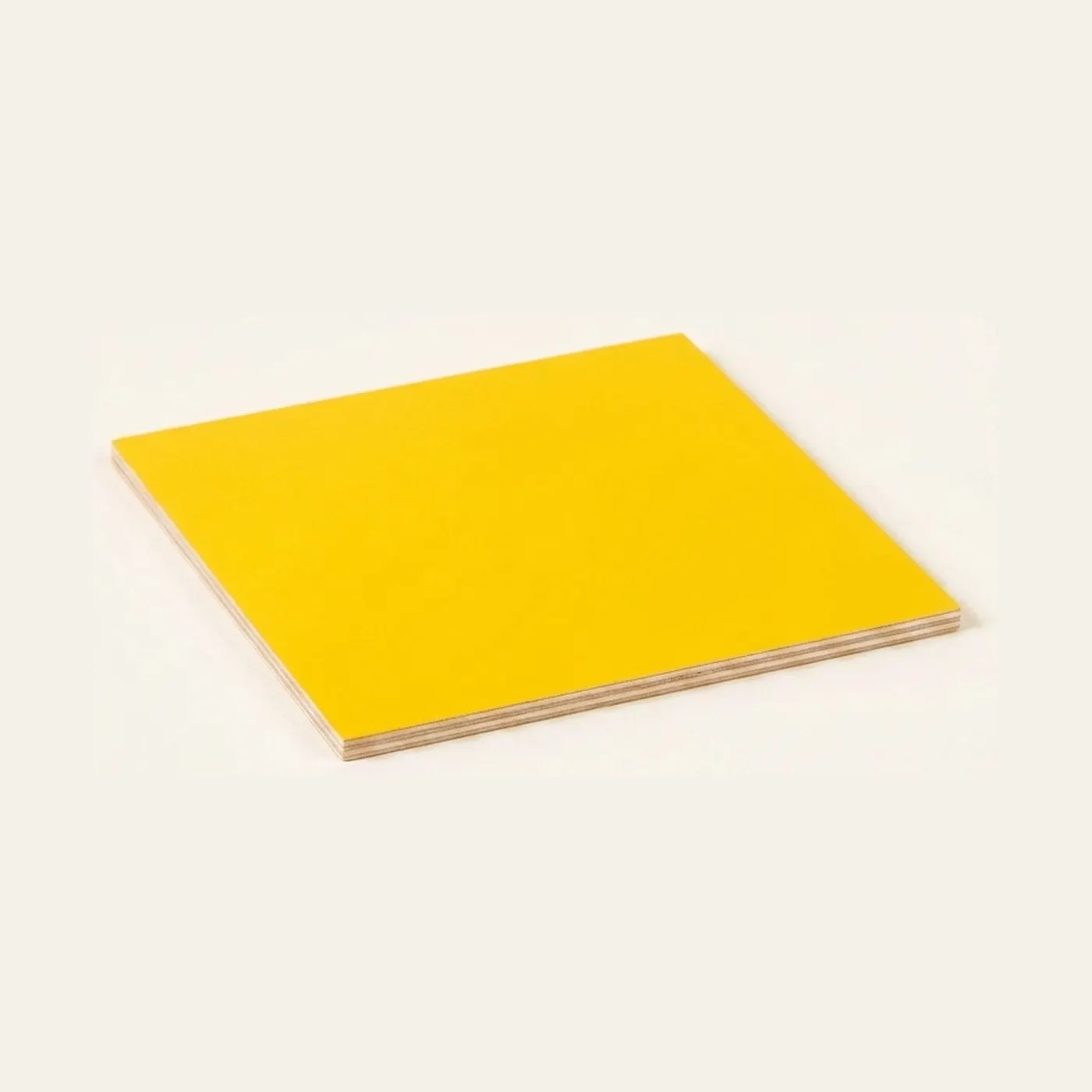
Geometric Cabinet Inset: Blank Square
Made by Nienhuis Montessori · shipped by Heutink International (Netherlands) About the maker
A blank square inset for the geometric cabinet, sold as a single piece. It has no shape cut into it, which is the whole job: it fills a space in a drawer where no figure belongs, so the drawer presents a complete surface rather than a hole. A gap in a tray reads to a child as something missing, and a child who thinks a material is incomplete stops choosing it. This is the part nobody notices until it is gone. The geometric cabinet is a separate item.
“The senses, being explorers of the world, open the way to knowledge.”
The Geometric Cabinet Blank Inset creates the foundation for sophisticated geometric exploration by providing children with an unmarked yellow tracing surface that challenges their spatial reasoning abilities. This blank inset demands that children recall and reproduce geometric forms from memory, transforming passive recognition into active creation.
- Develops spatial memory by requiring recall of geometric shapes without visual reference on the blank inset
- Refines fine motor control through precise tracing movements on the smooth yellow surface
- Strengthens visual discrimination abilities by reproducing geometric forms from memory on the blank inset
- Builds foundation for geometric understanding through active shape construction rather than passive recognition
Read More
The smooth yellow surface of this blank inset allows pencils and fingers to glide effortlessly, enabling children to focus entirely on the precision of their geometric reproductions. Unlike the filled geometric insets, this blank inset requires children to internalize shape characteristics before attempting to trace, deepening their understanding of geometric properties. The yellow finish of this blank inset provides optimal contrast for pencil work while maintaining the visual consistency children expect from their Geometric Cabinet exploration. This blank inset bridges the gap between concrete manipulation and abstract geometric understanding, as children must visualize complete shapes before drawing them. The blank inset challenges children to move beyond simple shape identification toward active geometric construction, preparing their minds for advanced mathematical concepts that require spatial visualization and precise motor execution.

How to present it
Follow the Montessori method of presentation for optimal child development.
Place the blank inset on a table mat alongside one geometric inset from the cabinet. Have tracing paper and colored pencils ready in a small tray.
- 1
Invite the child to carry the blank inset with two hands to the work area
Model slow, deliberate movements to emphasize care of materials - 2
Place a geometric shape inset on top of the blank yellow surface
The yellow background provides visual contrast for better shape discrimination - 3
Demonstrate tracing around the outer frame with two fingers
Use dominant index and middle fingers together for stronger muscle memory - 4
Remove the shape and trace the negative space on the blank inset
This reinforces the concept of positive and negative space - 5
Invite the child to repeat with different geometric shapes
Allow ample time for repetition - this builds concentration
Every Child Is a Little Creator

Heritage
Since 1929

In classrooms
Around the world

European brands
Nienhuis, GAM, Educo
Geometric Cabinet Inset: Blank Square
