Geometric Cabinet Cards: Shape Nomenclature Three-Part Cards
Made by Nienhuis Montessori · shipped by Heutink International (Netherlands) About the maker
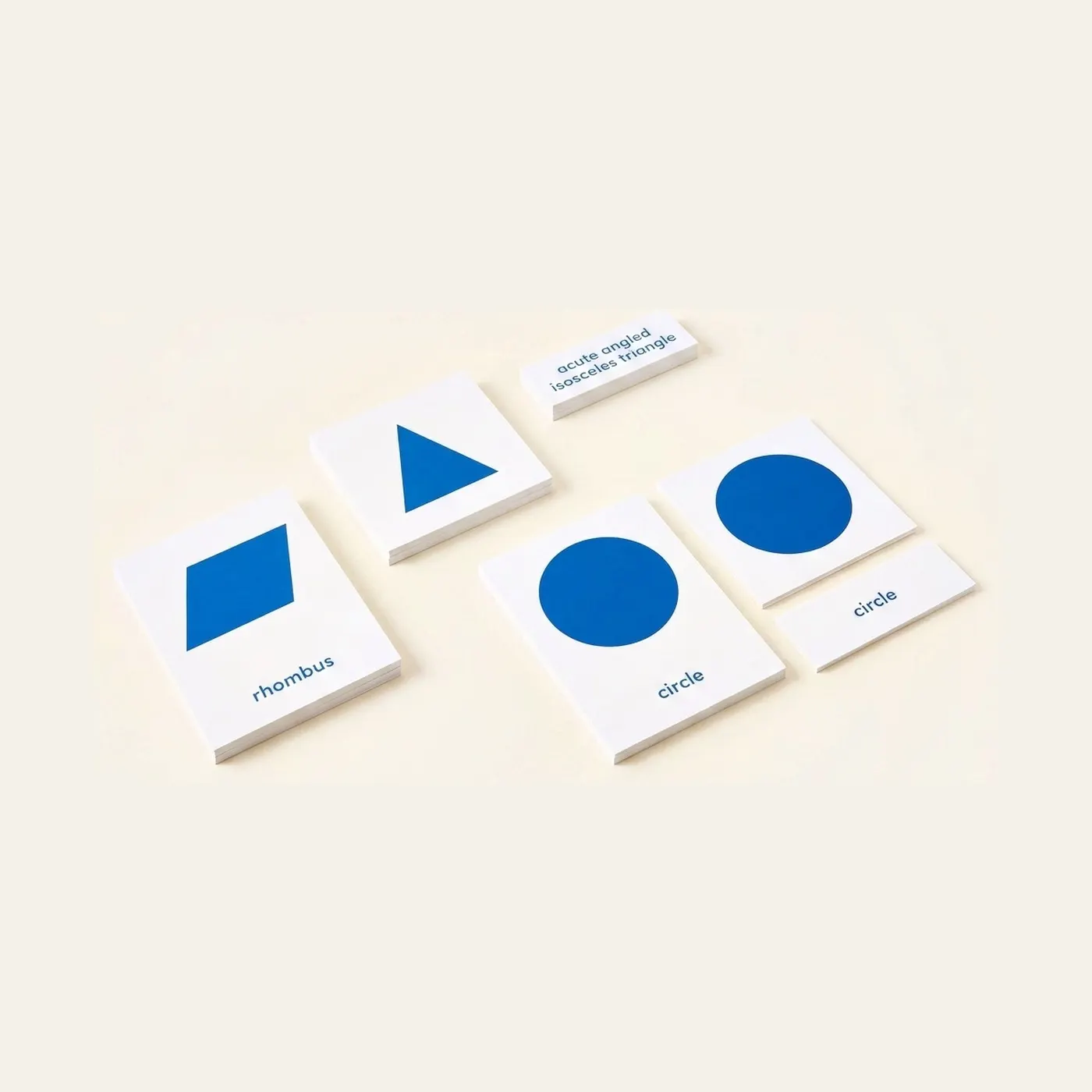
Two sets of nomenclature cards for the geometric cabinet, one with separate labels for matching and one control set labelled at the bottom, printed in blue on white card stock. Blue is not decorative here: the cabinet's own insets are blue, so a card and its inset read as the same object in two states. The control set is what makes the work independent, since nobody has to be asked whether a scalene triangle is a scalene triangle. Card stock, for ages 3 to 6.
“Education is a natural process spontaneously carried out by the human individual, and is acquired not by listening to words but by experiences upon the environment.”
The Geometric Cabinet Nomenclature Cards embody Montessori's principle of isolating difficulty by presenting one concept at a time - the name of each geometric form.
- Precise geometric vocabulary acquisition (triangle, pentagon, hexagon, etc.)
- Visual discrimination and matching skills refinement
- Reading readiness through symbol-to-shape association
- Classification and categorization abilities
Read More
Following the three-period lesson structure, these cards bridge the gap between the child's sensorial exploration with the Geometric Cabinet and their emerging ability to categorize and name abstract concepts. The material respects the child's need for repetition and self-correction, allowing independent practice of newly acquired vocabulary. By providing the exact language at the moment of readiness, we support the child's natural tendency toward precision and order. The cards serve as keys to language during the sensitive period for vocabulary enrichment, transforming sensorial impressions into conscious knowledge that can be communicated and shared with others.
How to present it
Follow the Montessori method of presentation for optimal child development.
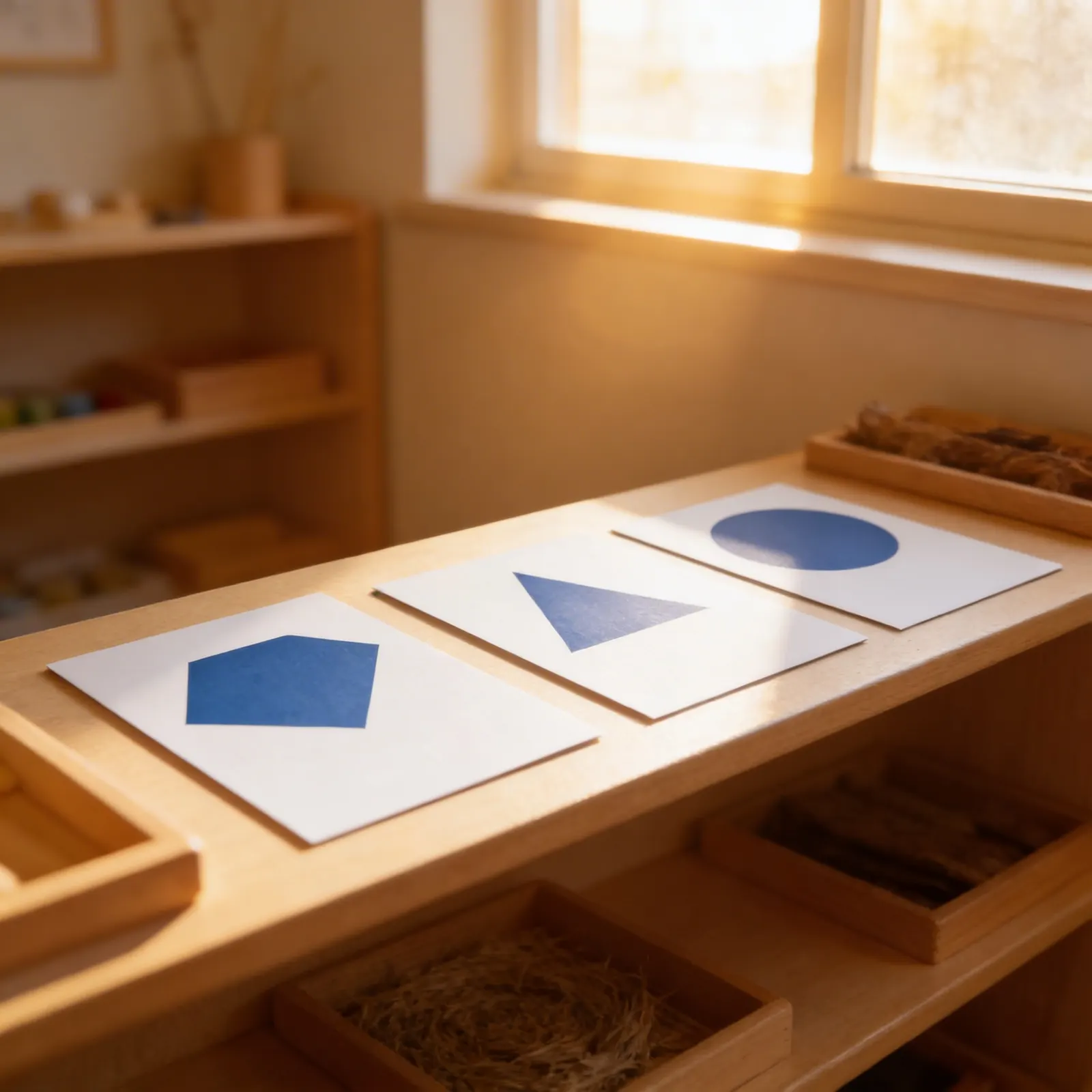
Place the reading cards in a basket on the shelf near the Geometric Cabinet. Ensure the child has worked extensively with the cabinet drawers. Choose one drawer's shapes for the initial presentation.
- 1
Invite the child and bring one drawer with its corresponding cards to a mat
Start with the drawer the child knows best, often the circles or triangles - 2
Remove shapes from drawer, placing them in a row. Take out matching picture cards and place below shapes
Move slowly and deliberately, allowing the child to make visual connections - 3
Introduce reading labels using three-period lesson: 'This is the pentagon'
Only introduce 3 new terms per lesson to avoid overwhelming the child - 4
Mix labels and have child match to pictures: 'Can you place the label under the pentagon?'
If child struggles, return to picture-shape matching before adding labels - 5
Child practices independently, matching shapes to pictures to labels
Observe from a distance; child will self-correct by comparing to the control cards
Every Child Is a Little Creator

Heritage
Since 1929

In classrooms
Around the world

European brands
Nienhuis, GAM, Educo

AMI approved
To the association standard
Geometric Cabinet Cards: Shape Nomenclature Three-Part Cards
