
Geometric Cards: Basic Shape Recognition with Blue Triangle
Made by Nienhuis Montessori · shipped by Heutink International (Netherlands) About the maker
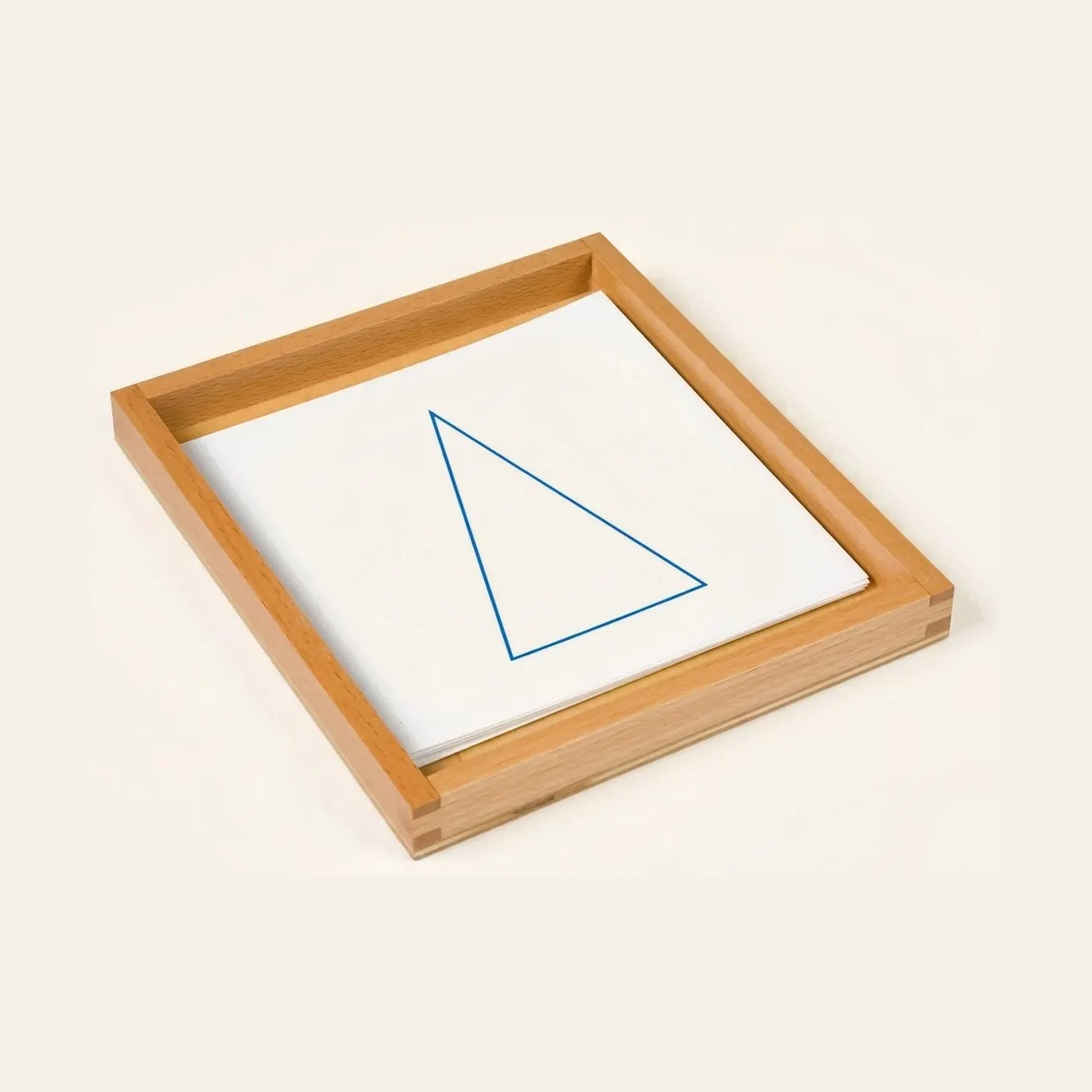
A set of seven geometric cards in plastic, the shapes drawn as thin blue lines. Thin lined is the last of the three degrees: a solid shape is almost the inset itself, a thick outline still has presence, and a thin line is nearly nothing at all. Recognising a shape from a thin line is the point at which a child can read a diagram, which is the whole reason the sequence exists. Plastic, for ages 3 to 6.
“The child is both a hope and a promise for mankind.”
The Geometric Cards embody Montessori's principle of isolation of difficulty by presenting each shape in its purest form - a simple blue outline on white background.
- Visual discrimination of geometric shapes and their properties
- Development of mathematical vocabulary (triangle, square, circle, etc.)
- Preparation for geometry through understanding of angles and sides
- Refinement of visual perception needed for reading readiness
Read More
This material serves as a crucial bridge between the concrete experience of the Geometric Solids and the abstract understanding of two-dimensional shapes. Through this work, the child's mathematical mind is nurtured as they develop visual discrimination and begin to perceive the geometric patterns that exist throughout their environment. The cards support the child's natural tendency toward order and classification, allowing them to organize their understanding of shapes systematically. This material also prepares the child indirectly for later geometry work and develops the visual perception necessary for reading and writing, as letter recognition requires similar shape discrimination abilities.
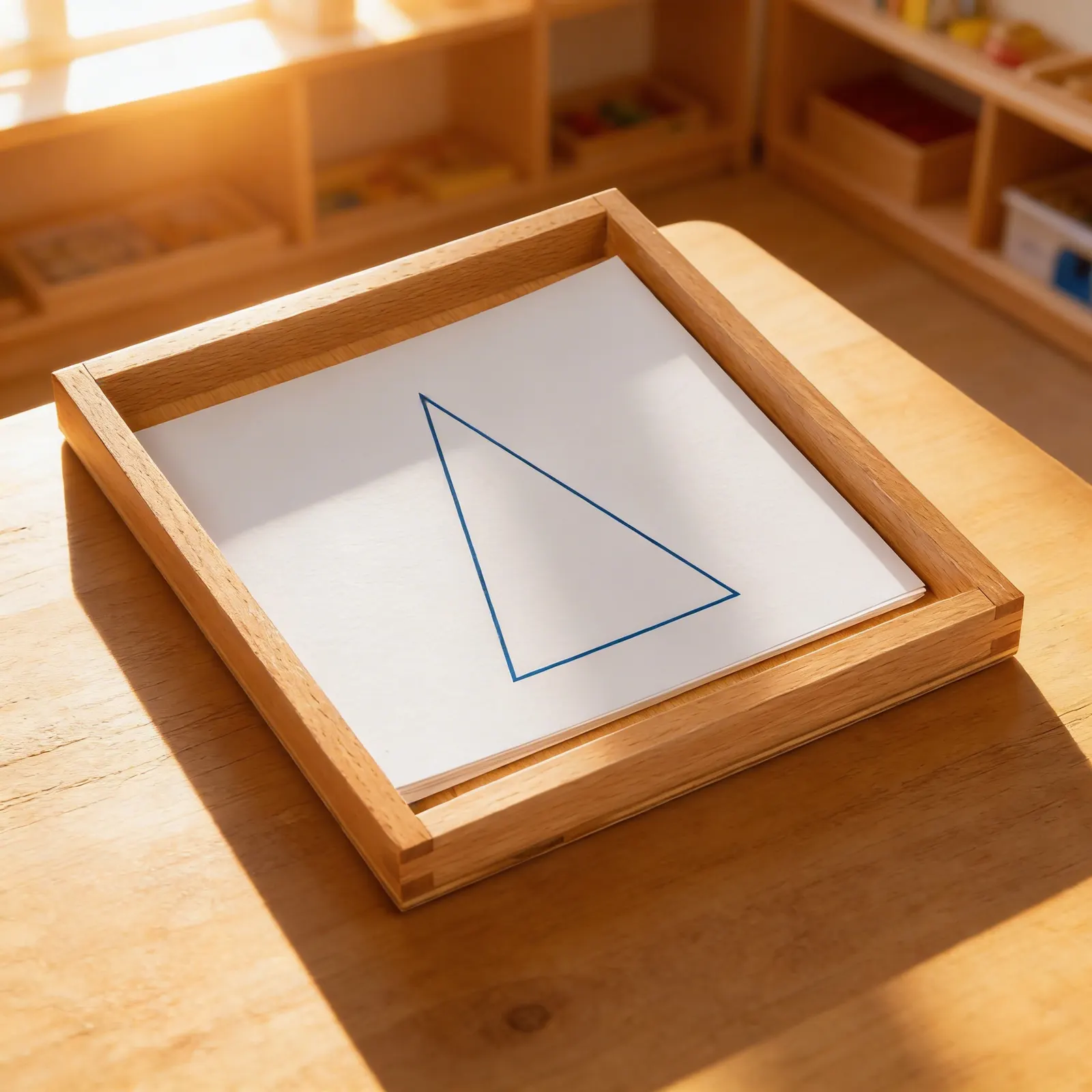
How to present it
Follow the Montessori method of presentation for optimal child development.
Place the wooden frame on a mat with cards arranged in order. Start with three contrasting shapes (circle, triangle, square). Ensure clean hands and a calm environment.
- 1
Remove one card slowly with a three-finger grip, place it centrally on the mat
Model careful handling to show respect for the material - 2
Trace the blue outline with your index finger, moving slowly and precisely
Use dominant hand for tracing, supporting hand holds card steady - 3
Give a three-period lesson: 'This is a triangle' (naming)
Wait for child's attention before naming, speak clearly - 4
Continue with recognition: 'Show me the triangle' and recall: 'What is this?'
Only progress to next period when child masters the current one - 5
Invite child to trace the shape, observing their finger movement
Allow self-correction rather than intervening directly - 6
Return card to frame before introducing next shape
Maintain order to support the child's sense of sequence
Every Child Is a Little Creator

Heritage
Since 1929

In classrooms
Around the world

European brands
Nienhuis, GAM, Educo

AMI approved
To the association standard
Geometric Cards: Basic Shape Recognition with Blue Triangle
