
Geometric Form Cards: Three-Part Visual Discrimination
Made by Nienhuis Montessori · shipped by Heutink International (Netherlands) About the maker
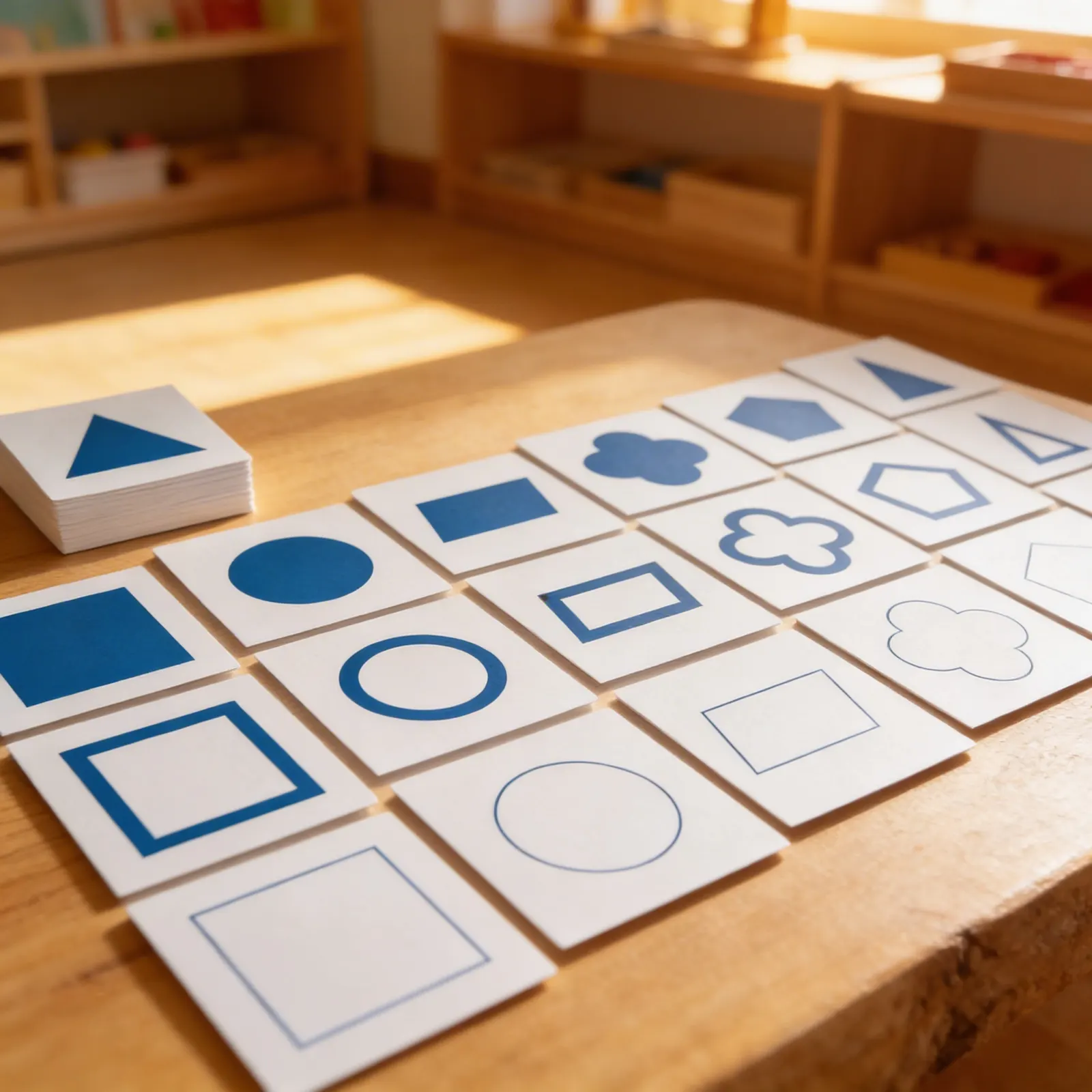
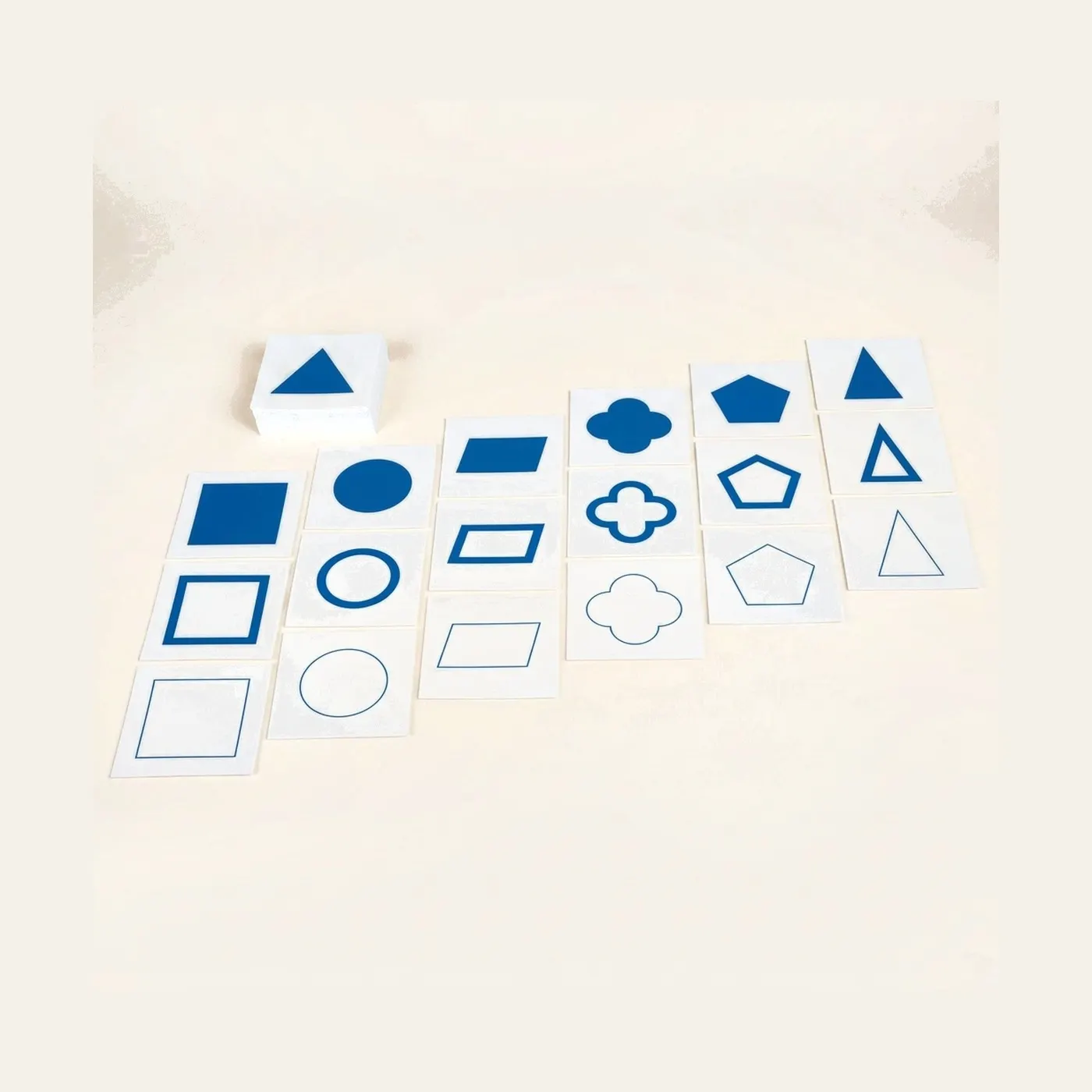
Three series of thirty five plastic cards matching the figures in the geometric cabinet: seven of each shape as a solid silhouette, seven with a thick outline and seven with a thin one. The progression is the material. A solid blue shape is almost the inset itself; a thin line is nearly nothing, and recognising a shape from it is the abstraction that makes a printed diagram readable years later. Cabinet sold separately. Plastic, for ages 3 to 6.
“The hands are the instruments of man's intelligence.”
The Geometric Form Cards embody Montessori's principle of isolating difficulty, presenting one concept, geometric form, through progressive abstraction.
- Visual discrimination of geometric forms and their properties
- Development of figure-ground perception through filled and outlined shapes
- Preparation for geometry through understanding of shape relationships
- Refinement of visual memory and concentration
Read More
This material bridges the concrete experience of the Geometric Cabinet with more abstract representations, supporting the child's natural progression from sensorial to cognitive understanding. Through repeated matching activities, children internalize geometric forms not through memorization but through visual discrimination and muscular memory from handling the cards. The three-part card format respects the child's need for order and classification while developing the visual perception essential for later mathematical work. This material exemplifies Montessori's insight that geometry begins as a sensorial experience before becoming an intellectual study, allowing children to absorb geometric concepts through their absorbent mind during the sensitive period for order and visual discrimination.
How to present it
Follow the Montessori method of presentation for optimal child development.
Place the control cards (filled shapes) in a column on the left side of the work mat. Stack the matching cards separately.
- 1
Introduce 3-4 control cards, naming each shape precisely
Start with contrasting shapes like circle, triangle, and square - 2
Mix the corresponding filled shape cards and invite the child to match them to the controls
Let the child self-correct by comparing cards side by side - 3
Once mastered, introduce the outlined form cards for the same shapes
Point out that 'this is the same triangle, just the line' - 4
Progress to matching all three forms: control, filled, and outlined
Arrange horizontally to emphasize the relationship - 5
Gradually increase the number of shapes as the child shows readiness
Observe for signs of fatigue or frustration
Every Child Is a Little Creator

Heritage
Since 1929

In classrooms
Around the world

European brands
Nienhuis, GAM, Educo

AMI approved
To the association standard
Geometric Form Cards: Three-Part Visual Discrimination
