
Geometric Hierarchy of Number: Mathematical Relationships Through Solids
Made by Nienhuis Montessori · shipped by Heutink International (Netherlands) About the maker
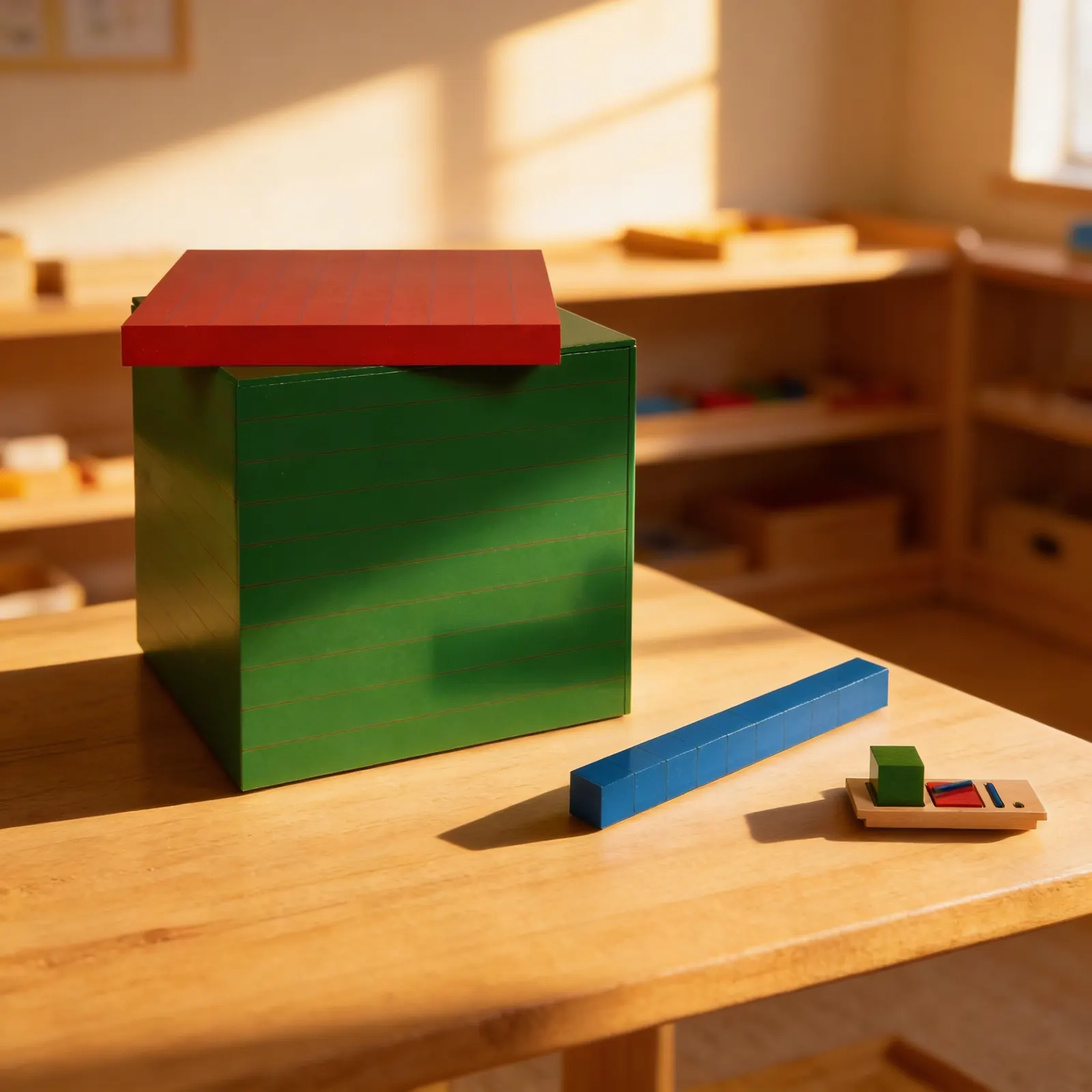
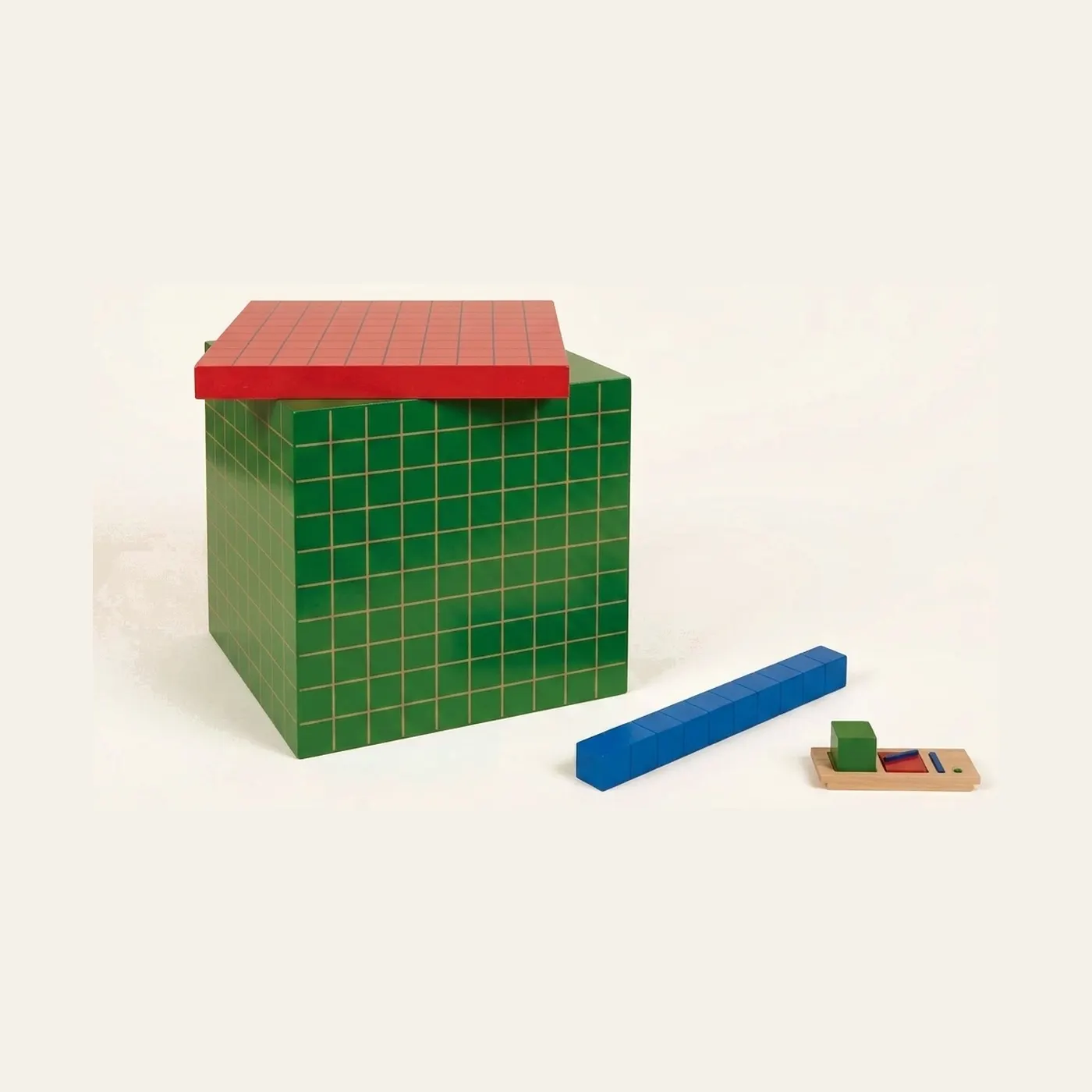
The hierarchy of number made visible: the same quantity that is a small cube at one becomes a bar at ten, a flat square at a hundred, a large cube at a thousand, and the pattern then repeats upward. Seeing a million beside a unit does what no row of zeros can do, it gives the child a felt sense of how vast each step really is, and why the decimal categories fall into families of three. Colour coding carries the family relationship across every level. Hardwood with non toxic water based paint, for ages 3 to 6.
“Children display a universal love of mathematics, which is par excellence the science of precision, order, and intelligence.”
The Geometric Hierarchy of Number perfectly embodies Montessori's principle of moving from concrete to abstract learning.
- Understanding dimensional progression from units to thousands
- Visual discrimination of size relationships and proportional thinking
- Preparation for decimal system and place value concepts
- Development of mathematical vocabulary and spatial reasoning
Read More
Through graduated geometric solids, children physically experience mathematical relationships before encountering abstract numbers. The material's sensorial nature allows children to internalize dimensional concepts through touch, sight, and manipulation. Each geometric piece represents a specific numerical value - the small cube as one unit, the long rectangular prism as ten, building to thousands - creating a tangible foundation for decimal understanding. The color-coding and size progression support the Montessori emphasis on self-correction and independent learning. Children naturally discover patterns and relationships through exploration, fostering intrinsic motivation rather than external instruction. This material honors the child's mathematical mind by presenting complex concepts in their simplest, most concrete form, allowing natural mathematical thinking to emerge through sensorial experience.
How to present it
Follow the Montessori method of presentation for optimal child development.
Place the material on a neutral work mat in a quiet area. Ensure all pieces are clean and properly arranged by size on the wooden tray.
- 1
Invite the child to explore each piece individually, feeling the weight and examining the dimensions
Allow plenty of time for sensorial exploration before introducing mathematical concepts - 2
Demonstrate building the hierarchy by placing pieces in order from smallest to largest
Move slowly and deliberately, letting the child observe the visual progression - 3
Guide the child to rebuild the sequence independently, emphasizing the size relationships
Use descriptive language like 'next size' or 'ten times larger' naturally during the process - 4
Encourage the child to experiment with stacking and arranging pieces in different configurations
Resist correcting immediately - let the child discover relationships through trial and error
Every Child Is a Little Creator

Heritage
Since 1929

In classrooms
Around the world

European brands
Nienhuis, GAM, Educo

AMI approved
To the association standard
Geometric Hierarchy of Number: Mathematical Relationships Through Solids
