
Geometric Stick Material: 2D & 3D Construction Set
Made by Nienhuis Montessori · shipped by Heutink International (Netherlands) About the maker
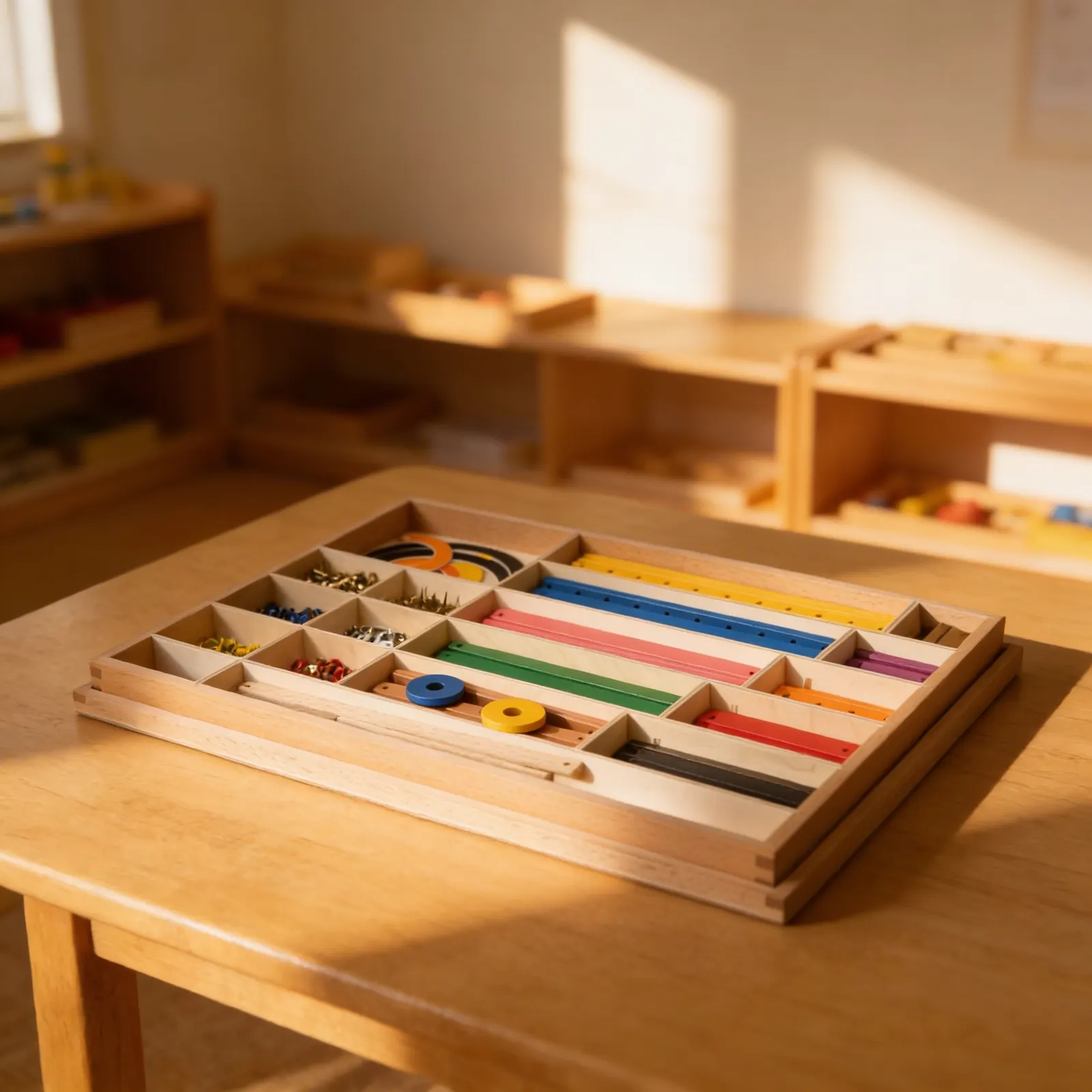
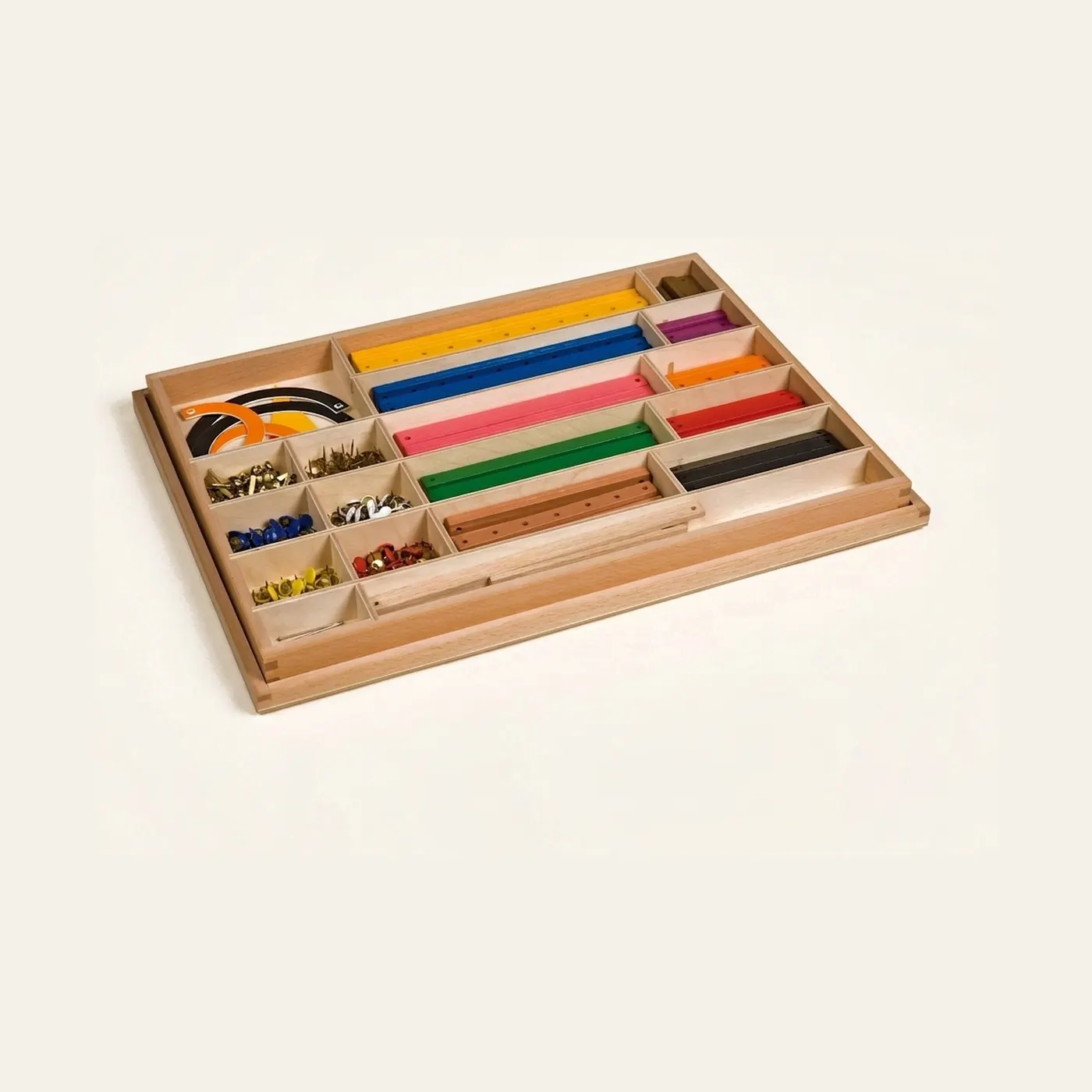
Great for independent study, this Geometric Stick Material enables children to construct two- and three-dimensional geometric forms through concrete manipulation. The carefully organized compartments contain precisely built wooden sticks in graduated lengths with pre-drilled holes, paired with metal connectors, allowing students to build complex geometric structures while developing spatial reasoning and mathematical understanding.
“Children display a universal love of mathematics, which is par excellence the science of precision, order, and intelligence.”
The Geometric Stick Material embodies Montessori's principle of concrete to abstract learning, allowing children to physically construct geometric forms before abstracting mathematical concepts. This material bridges the sensorial experiences of early childhood with the mathematical mind of the elementary child, supporting the transition from perceiving geometric shapes to understanding their properties and relationships. Through manipulation and construction, children develop what Montessori called 'materialized abstractions', concrete representations of abstract geometric principles. The material respects the elementary child's reasoning mind and need to understand the 'how' and 'why' of the universe, while maintaining the hands-on exploration essential to deep learning.
- Spatial reasoning and three-dimensional visualization skills
- Understanding of geometric properties including angles, edges, and vertices
- Development of mathematical vocabulary for 2D and 3D shapes
- Problem-solving through structural engineering challenges
Read More
It serves the cosmic education curriculum by revealing the mathematical order underlying natural and human-made structures.
How to present it
Follow the Montessori method of presentation for optimal child development.
Place the material on a large work mat with ample space. Organize stick compartments by length, keeping connectors in their designated section. Ensure the child has completed preliminary work with geometric solids and geometric cabinet.
- 1
Begin with constructing familiar 2D shapes: triangle, square, pentagon
Start with equilateral triangles to establish the concept of equal sides and angles - 2
Progress to 3D forms, beginning with a tetrahedron using triangular faces
Count vertices and edges aloud to reinforce mathematical vocabulary - 3
Explore the relationship between 2D faces and 3D solids by building a cube
Have children identify how many squares form the cube's faces - 4
Challenge students to create more complex polyhedra like octahedrons or dodecahedrons
Provide geometric solid models as visual references initially - 5
Investigate architectural forms: pyramids, prisms, and compound structures
Connect to cultural studies by exploring geometric structures in different civilizations
Every Child Is a Little Creator

Heritage
Since 1929

In classrooms
Around the world

European brands
Nienhuis, GAM, Educo

AMI approved
To the association standard
Geometric Stick Material: 2D & 3D Construction Set
