
Globe Of Continents: Coloured Geography Introduction
Made by Nienhuis Montessori · shipped by Heutink International (Netherlands) About the maker
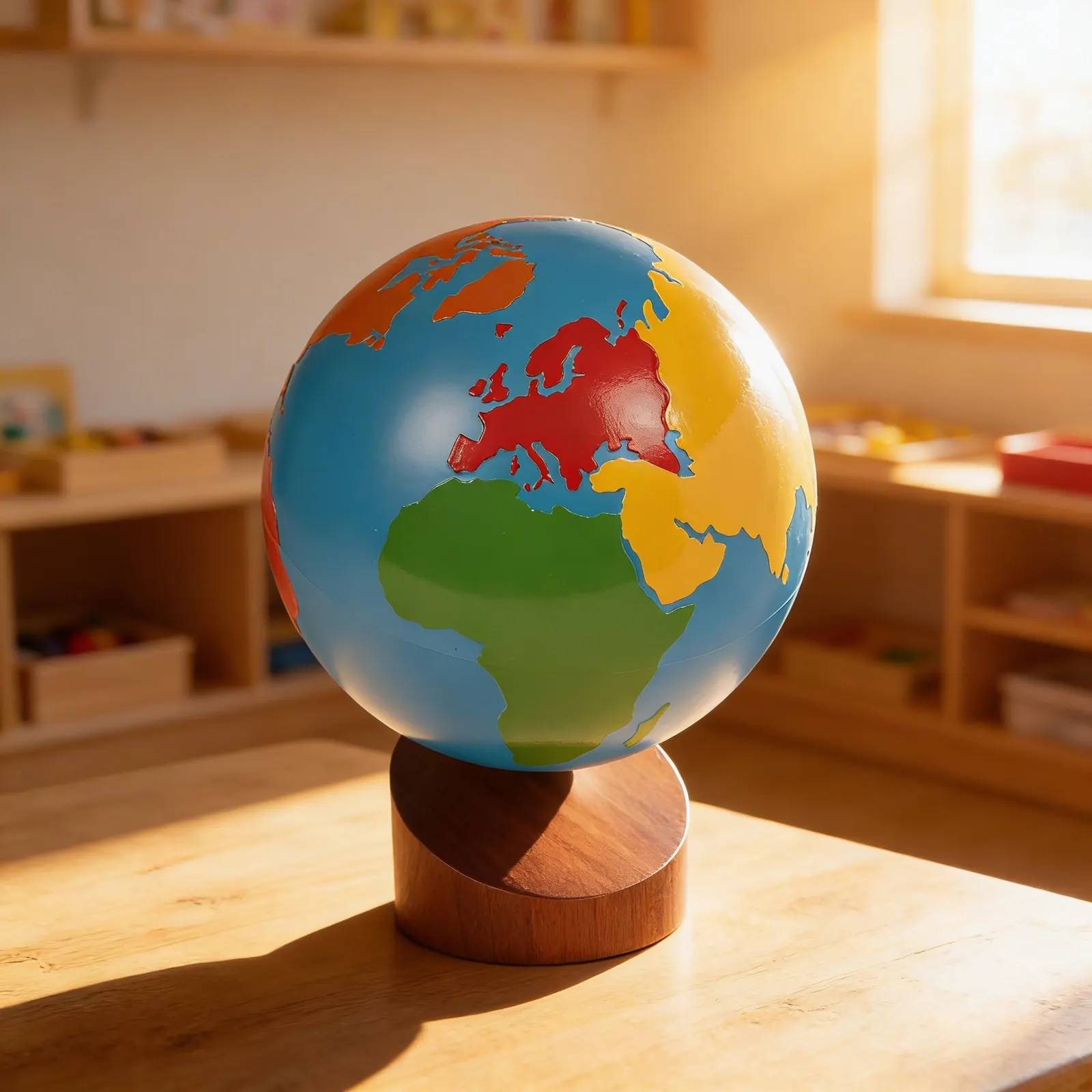
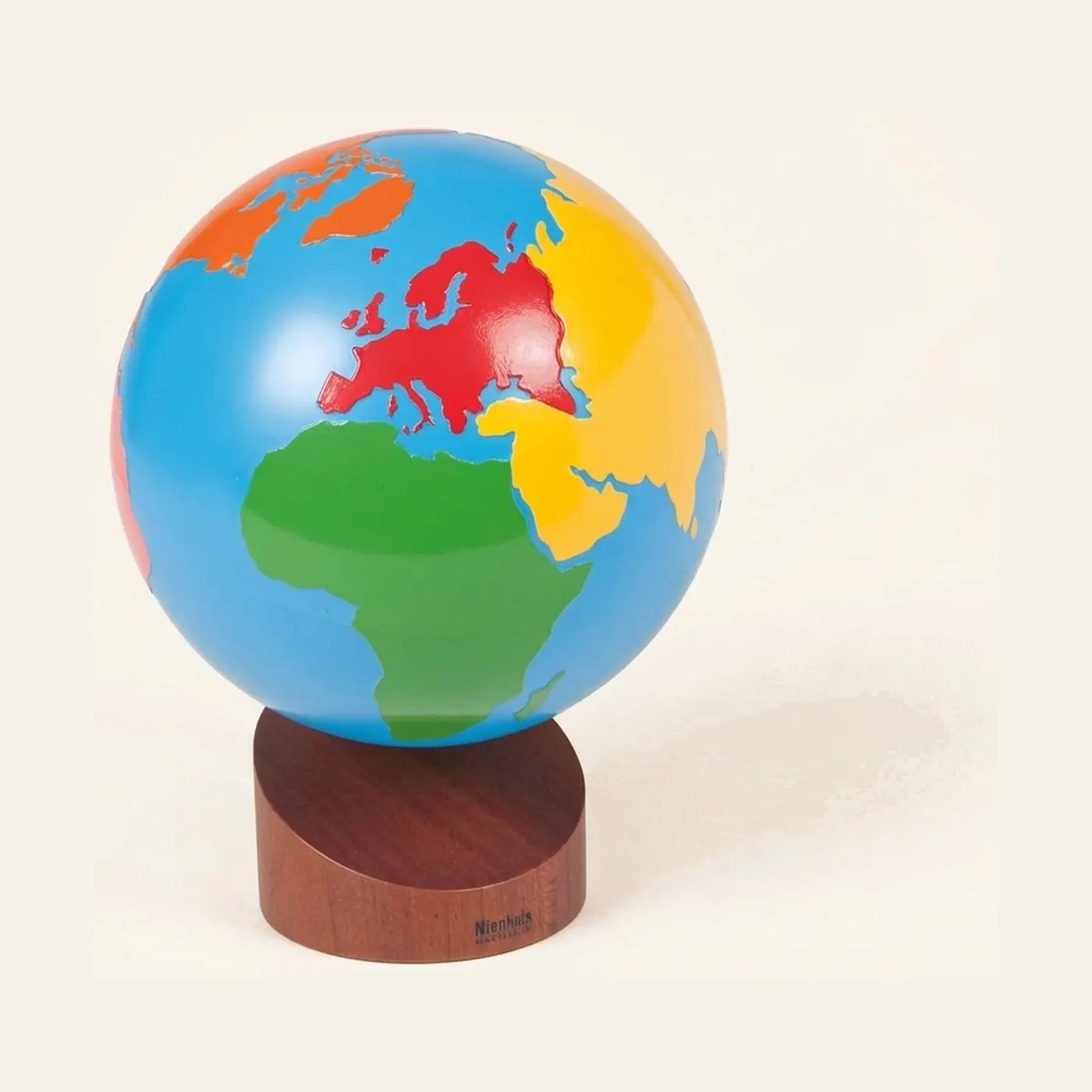
This Globe of the Continents lays the groundwork for understanding the physical geography of our world through color-coded continents on a smooth, tactile sphere. Each continent is distinguished by a specific color following traditional Montessori conventions, so that children develop spatial awareness and begin their journey in cultural studies. The globe rotates freely on its wooden base, inviting exploration through touch and sight.
“The hands are the instruments of man's intelligence.”
The Globe of the Continents embodies Maria Montessori's principle of cosmic education, introducing the child to their place in the world through concrete, sensorial experiences. This material bridges the sensorial and cultural areas, allowing the child to explore geography through touch and sight before abstract understanding.
- Development of spatial awareness and three-dimensional thinking
- Recognition and identification of the seven continents by color and shape
- Refinement of visual discrimination through color-coded geography
- Foundation for cultural studies and global awareness
Read More
The color-coding provides a visual key that isolates difficulty, enabling the child to focus on continental shapes and positions without the complexity of political boundaries. Through manipulation of this beautiful, scientifically accurate material, children develop spatial intelligence and begin to understand Earth as our shared home. The globe's three-dimensional nature offers a true representation of our planet, unlike flat maps, supporting the child's developing mathematical mind and preparing them for more complex geographical studies.
How to present it
Follow the Montessori method of presentation for optimal child development.
Place the globe on a table at the child's eye level. Ensure hands are clean and dry. Have a soft cloth nearby for dusting if needed.
- 1
Invite the child, saying 'I'd like to show you our Earth.' Demonstrate carrying the globe with two hands, one supporting the base, one steadying the sphere.
Model slow, careful movements to emphasize respect for the material - 2
Once seated, gently rotate the globe, letting your fingers trace over the smooth blue water. Say 'This is water' while touching the blue areas.
Use minimal language initially, allowing sensorial exploration to predominate - 3
Slowly trace one continent with two fingers, saying its name clearly: 'This is Asia.' Repeat for 2-3 continents in the first presentation.
Choose continents that are visually distinct and well-separated initially - 4
Invite the child to feel the water and land, noticing the smooth painted surfaces and the raised continental areas.
Allow ample time for tactile exploration without rushing to name all continents - 5
In subsequent lessons, introduce remaining continents, always reviewing previously learned ones first.
Follow the child's interest - they may be drawn to specific continents
Every Child Is a Little Creator

Heritage
Since 1929

In classrooms
Around the world

European brands
Nienhuis, GAM, Educo

AMI approved
To the association standard
Globe Of Continents: Coloured Geography Introduction
