
Golden Bead Material Activity Set
The first photo is the maker's own. The other shots are illustrative.
Inv. no. NIE-060001
- Maker
- Nienhuis Montessori, since 1929
- Approval
- AMI
- Storage Box
- Wood
- Activity Cards
- Cardstock or laminated paper
- EAN
- 8719924012960
Final price incl. VAT. Delivery €5.90, €79.10 to go for free delivery.
Advice, warranty and returns are handled by us.
Why it costs €69.90
Behind the price of the original are things you can check yourself.
AMI approval
The material is approved by the Association Montessori Internationale (AMI). Nienhuis has made Montessori materials since 1929.
A verifiable original
The EAN 8719924012960 is on the box. It is the maker's number, not ours.
Golden Bead Material Activity Set in a child's hands
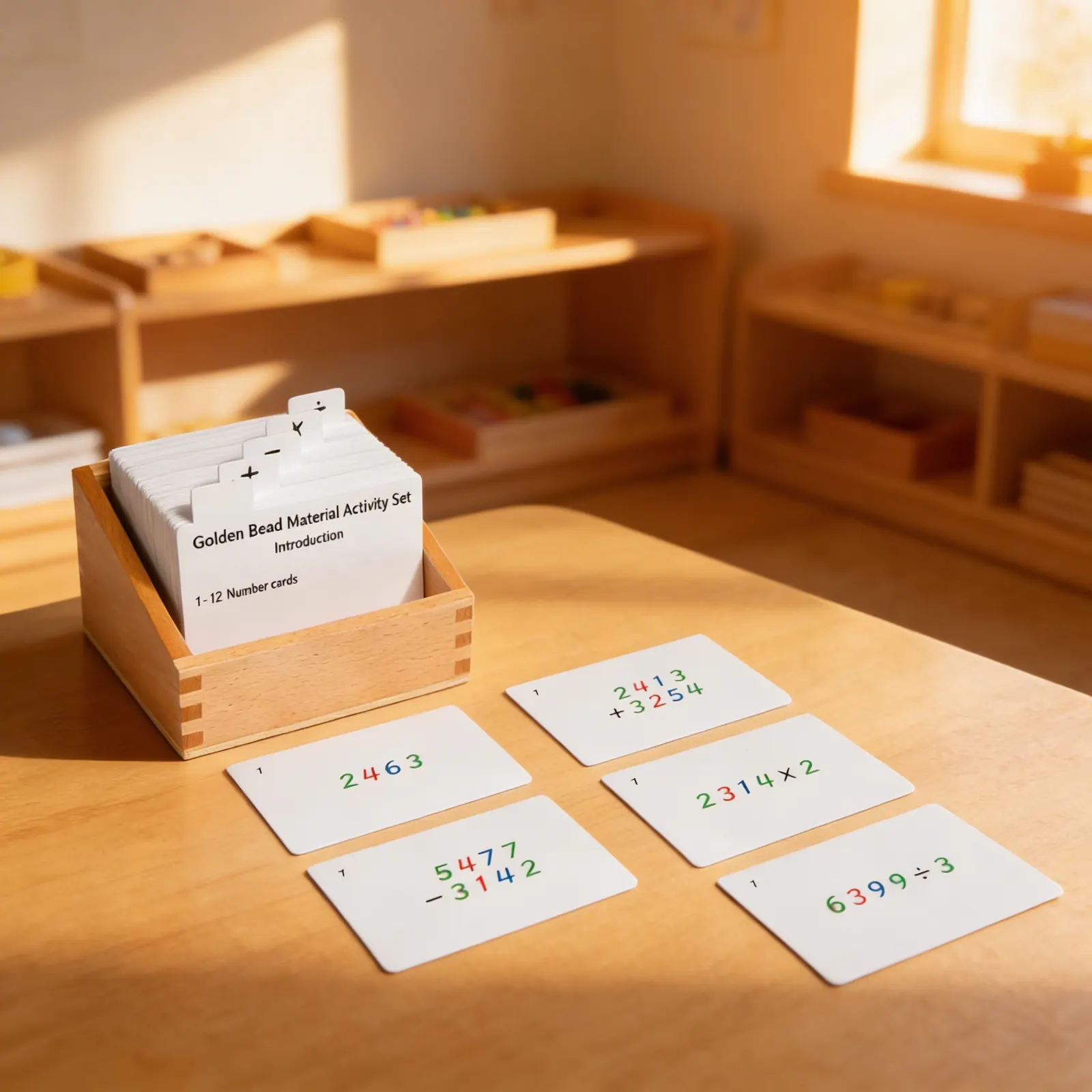
Part of the Decimal System collection, this Golden Bead Material Activity Set provides structured exercise cards to guide children through fundamental mathematical concepts using the golden bead materials. The numbered cards present progressive activities for exploring place value, the decimal system, and basic operations, while the handcrafted wooden storage box keeps materials organized and accessible in the Montessori mathematics area.
Mathematical Understanding
Progressive exercises guide children through concrete manipulation of quantities to abstract numerical concepts using the golden bead materials.
Sequential Learning
Numbered activity cards provide a clear progression path, supporting independent work and self-directed mathematical exploration.
Order and Organization
The structured presentation teaches children to organize their work systematically while developing concentration and focus.
How to present it
Place the wooden storage box on a mat. Arrange golden bead materials nearby: unit beads, ten bars, hundred squares, and thousand cubes. Select the first numbered activity card from the sequence.
- 1Read the activity card with the child, identifying the mathematical task presented
- 2Gather the golden beads specified on the card, counting each category separately
- 3Perform the mathematical operation shown on the card using the beads
- 4Verify the answer by counting the final quantity of beads
- 5Return materials to their designated spaces before selecting the next card
3 tips for parents
- Practice skip counting by tens and hundreds during everyday activities to reinforce place value concepts
- Point out four-digit numbers in daily life (addresses, prices) and discuss their place values
- Create simple addition problems using household objects grouped in tens

If you are not sure it suits your child, we answer in person.
Norbert Kovalčín, founder of Faborino · write to him
There is no review here yet. We will ask you for one after you buy. Write the first review
What's in the Box
- Wooden storage box: with solid construction
- Activity cards: approx. 6 numbered exercise cards
- Color-coded sections: for different mathematical operations
Size and material
| Packaging | 13 × 12 × 11 cm |
| Storage Box | Wood |
| Activity Cards | Cardstock or laminated paper |
| Recommended Age | 3-6 years |
Care
Wipe wooden box with dry cloth; keep cards dry and flat
Frequently Asked Questions
What is included in the Golden Bead Material Activity Set?
This set includes numbered exercise cards with progressive activities for exploring place value, the decimal system, and basic operations. It also comes with a handcrafted wooden storage box to organize the materials. Note that the actual golden beads are not included and must be purchased separately.
At what age should children begin using these golden bead activities?
Children typically begin golden bead work around age 4-4.5, after mastering number recognition 1-10 and having experience with tactile materials like the number rods and sandpaper numerals. The activities progress through age 6 as children develop understanding of place value and operations.
How do these activity cards support learning the decimal system?
The cards guide children through structured exercises that demonstrate how units, tens, hundreds, and thousands relate to each other in base-ten. Activities include building quantities, exchanging between hierarchies, and understanding that ten of one category equals one of the next higher category.
What mathematical operations can children learn with these activities?
The progressive activity cards introduce addition first, typically with static (no exchanging) problems, then dynamic addition requiring exchanges. Subtraction, multiplication, and division activities follow in sequence, always moving from concrete bead manipulation to abstract understanding.
Why is the wooden storage box important for this material?
The wooden box maintains the prepared environment principle by keeping activity cards organized, protected, and easily accessible. This allows children to independently select appropriate work, return materials properly, and helps teachers track which activities each child has completed.
Product safety
Manufacturer: Nienhuis Montessori, Anders Celsiusstraat 15, 7442 PB Nijverdal, Netherlands
Golden Bead Material Activity Set