
Golden Bead MaterialIndividual Glass Beads for Decimal System
The first photos are the maker's own. The other shots are illustrative.
Inv. no. NIE-0083GC
- Maker
- Nienhuis Montessori, since 1929
- Approval
- AMI
- Primary Material
- Natural hardwood
- Secondary Material
- Golden glass beads
- EAN
- 8719924004613
Final price incl. VAT. Free delivery.
Advice, warranty and returns are handled by us.
Why it costs €876.90
Behind the price of the original are things you can check yourself.
AMI approval
The material is approved by the Association Montessori Internationale (AMI). Nienhuis has made Montessori materials since 1929.
A verifiable original
The EAN 8719924004613 is on the box. It is the maker's number, not ours.
Golden Bead Material in a child's hands
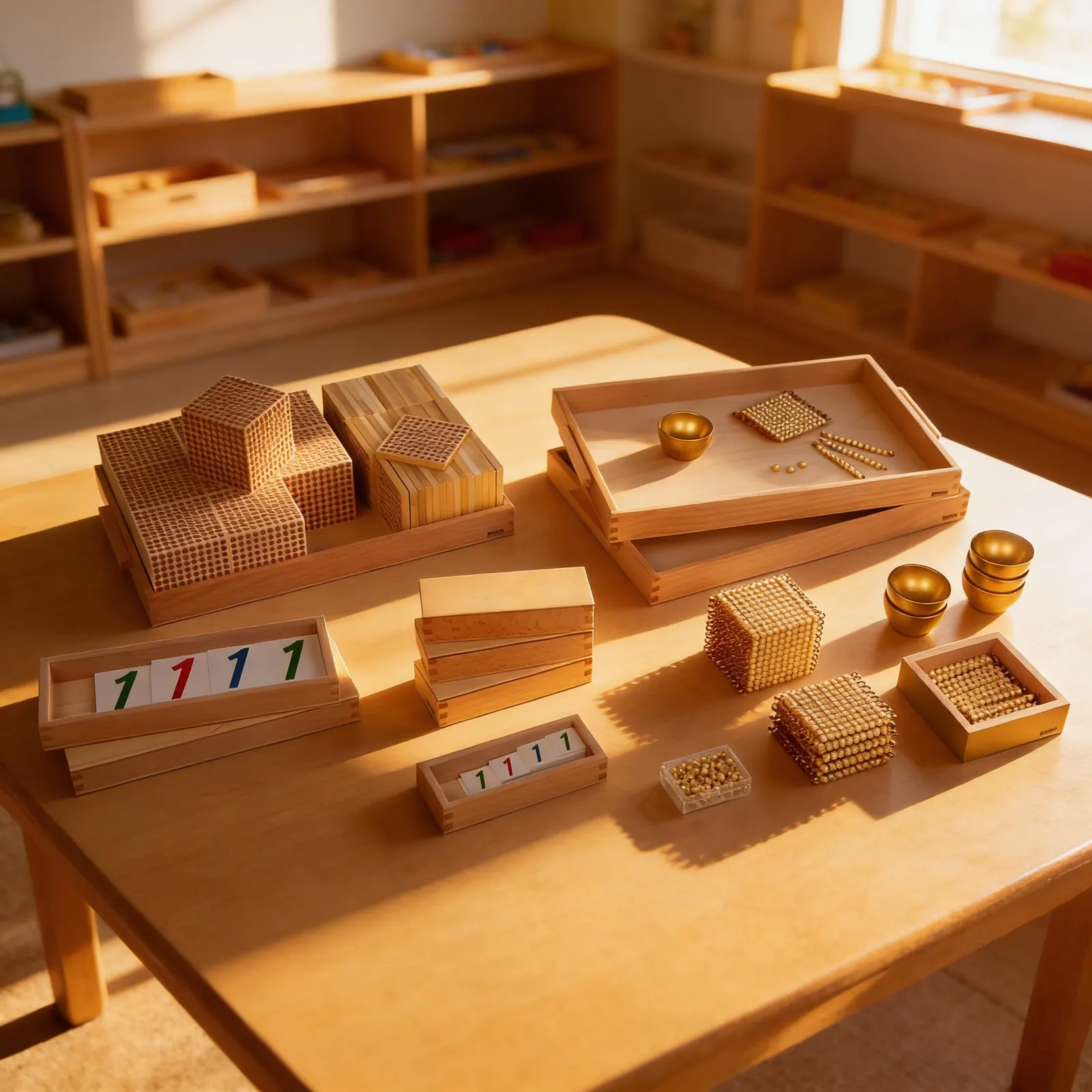
The golden bead material makes the decimal system something a child can carry. A unit is a single bead, a ten is a bar of ten, a hundred is a square of ten bars, a thousand is a cube of ten squares. Fetching one thousand and feeling its weight against a single bead teaches hierarchy in a way no written number can. Children build quantities, exchange ten of one category for one of the next, and arrive at addition and carrying as a physical act. Natural hardwood trays with golden glass beads, for ages 3 to 6.
Concrete Understanding of Abstract Numbers
Children physically manipulate quantities to understand the relationship between numbers and actual amounts, building a solid foundation for mathematical thinking.
Decimal System Comprehension
The hierarchical arrangement from units to thousands demonstrates place value concepts through visual and tactile experience with the base-10 system.
Mathematical Operations Preparation
Hands-on experience with these quantities prepares children for addition, subtraction, multiplication, and division using concrete materials before abstract symbols.
Sequential Learning and Order
The organized presentation in graduated trays develops logical thinking and understanding of mathematical sequence and progression.
How to present it
Arrange the golden bead trays on a low table or floor mat, ensuring each quantity type is clearly separated and accessible
- 1Present the unit bead, allowing the child to hold and examine it while naming 'This is one unit'
- 2Show the ten-bar, letting the child count each bead while explaining 'Ten units make one ten'
- 3Introduce the hundred-square, demonstrating how ten bars create one hundred
- 4Present the thousand-cube, showing the relationship to previous quantities
3 tips for parents
- Support learning by using mathematical language at home when counting everyday objects
- Encourage your child to share their discoveries about number relationships and listen actively
- Provide quiet, uninterrupted time for mathematical exploration and practice

If you are not sure it suits your child, we answer in person.
Norbert Kovalčín, founder of Faborino · write to him
There is no review here yet. We will ask you for one after you buy. Write the first review
What's in the Box
- Individual unit beads: Golden glass beads representing units 1-9
- Ten bars: Linear arrangements of 10 beads each
- Hundred squares: Square formations of 100 beads each
- Thousand cube: Cubic formation representing 1000
- Wooden storage trays: Multiple compartmentalized trays for organization
Size and material
| Packaging | 45 × 31 × 26 cm |
| Primary Material | Natural hardwood |
| Secondary Material | Golden glass beads |
| Recommended Age | 3-6 years |
| Skill Level | Beginner to Advanced |
Care
Wipe wood with damp cloth, glass beads with mild soap
Frequently Asked Questions
What age is the Golden Bead Material appropriate for?
The Golden Bead Material is designed for children ages 3-6 years. At age 3, children can begin exploring the concrete quantities and sensorial aspects, while older children use the material for mathematical operations. The material grows with the child, supporting their developmental journey from concrete understanding to abstract mathematical thinking.
Can the Golden Bead Material be used effectively at home?
Yes, the Golden Bead Material is excellent for home use. While originally designed for Montessori classrooms, dedicated homeschool families find it invaluable for teaching mathematical concepts. The material works best when parents understand the proper presentations, which can be learned through Montessori training courses or quality guidebooks.
Why are the beads made of glass rather than plastic?
Glass beads provide superior sensorial feedback essential for Montessori learning. The weight, texture, and sound of glass beads offer rich tactile experiences that support mathematical understanding. Glass also maintains its beautiful golden color over time, ensuring the material remains aesthetically pleasing and educationally effective for years of use.
How do I present the Golden Bead Material to my child?
Begin with simple quantity recognition, letting your child hold and count individual unit beads. Progress to showing ten-bars, hundred-squares, and the thousand-cube, emphasizing the relationship between quantities. The key is moving slowly, allowing the child to internalize each concept before advancing. Always follow the child's interest and readiness level.
What makes AMI-compliant Golden Bead Material worth the investment?
AMI-compliant materials meet strict standards for proportions, materials, and educational effectiveness established by Maria Montessori herself. This ensures the material provides authentic Montessori experiences that support optimal learning. The precision and quality of AMI materials create lasting educational value, often serving multiple children across many years.
Product safety
Manufacturer: Nienhuis Montessori, Anders Celsiusstraat 15, 7442 PB Nijverdal, Netherlands
Golden Bead Material