
Grammar Symbol - PaperParticiple (100)
The first photo is the maker's own. The other shots are illustrative.
Inv. no. NIE-0111M0
- Maker
- Nienhuis Montessori, since 1929
- Approval
- AMI
- Primary Material
- Cardstock paper
- Finish
- Matte gray
- EAN
- 8719924006488
Final price incl. VAT.
This material is no longer made
The manufacturer has withdrawn it, so we cannot order it in. The page stays here because the material itself is still worth knowing about.
Would you buy it if we could source it or make it ourselves? Enough people saying yes is what makes the attempt worth it.
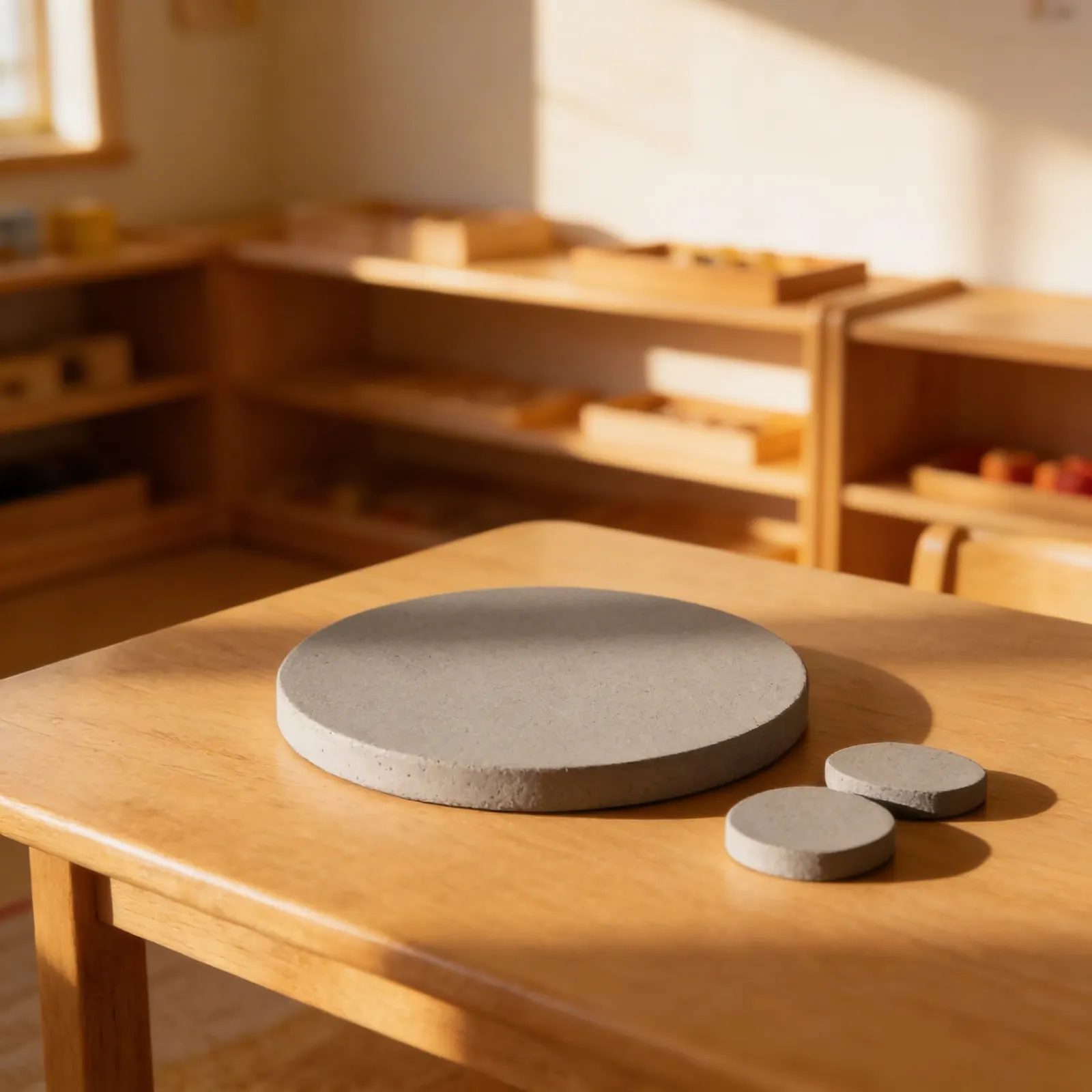
Grammar Symbol - Paper in a child's hands
One hundred paper participle symbols. The participle is the word that cannot decide what it is, half verb and half adjective, and a symbol set that includes one belongs to an album that takes grammar past the nine basic parts of speech. If your album uses it, the symbol has to be available in quantity like every other, since the whole point is that a child marks every word in a sentence. Sold in hundreds, for written work.
Advanced Grammar Understanding
Helps children recognize and analyze participles as verb forms functioning as adjectives in sentences.
Visual Language Classification
Gray circles provide consistent visual representation for identifying participle forms in written work.
Sentence Analysis Skills
Supports complex grammatical analysis as children progress to advanced language work.
Abstract Thinking
Develops ability to categorize and understand abstract grammatical concepts through concrete symbols.
How to present it
Prepare a grammar box with participle study cards and corresponding objects. Arrange the gray circle symbols in a small container. Have the moveable alphabet available for sentence building.
- 1Begin with a simple sentence containing a participle, such as 'The running horse is fast'
- 2Child reads the sentence and identifies the word that describes the noun while showing action
- 3Place the gray circle symbol above the participle 'running' to mark its special function
- 4Continue with additional sentences, identifying and marking participles with the gray circles
- 5Child creates own sentences using participles and marks them with the symbols
3 tips for parents
- Point out participles in everyday speech: 'Look at the falling leaves' or 'The baked cookies smell delicious'
- Play 'participle hunt' games while reading together, marking them with small gray stickers
- Support understanding by acting out participles: excited, tired, broken, singing

If you are not sure it suits your child, we answer in person.
Norbert Kovalčín, founder of Faborino · write to him
There is no review here yet. We will ask you for one after you buy. Write the first review
What's in the Box
- Participle Symbols: 100 gray circular pieces
Size and material
| Packaging | 12 × 8 × 1 cm |
| Primary Material | Cardstock paper |
| Finish | Matte gray |
| Recommended Age | 3-6 years |
Care
Wipe gently with dry cloth if needed
Frequently Asked Questions
What is the purpose of the gray participle symbols in Montessori grammar?
The gray circular symbols help children identify participles in sentences - verb forms that function as adjectives (like 'running' in 'running water' or 'broken' in 'broken window'). They're used in advanced grammar analysis work to build understanding of complex sentence structures.
At what age should children begin using participle symbols?
While labeled for ages 3-6, participle symbols are typically introduced around age 5-6 or in lower elementary, after children have mastered basic grammar symbols like noun, verb, and adjective. The child should already be reading fluently and familiar with simpler grammar concepts.
How are these participle symbols used with other Montessori grammar materials?
These symbols work alongside the Grammar Box exercises and sentence analysis materials. Children place the gray circles above participles when analyzing sentences, often used with other grammar symbols to show the complete structure of complex sentences.
Why are participle symbols gray in the Montessori system?
Gray represents the dual nature of participles - they derive from verbs but function as adjectives. The gray color helps children understand that participles are a special category, distinct from pure verbs (red spheres) or adjectives (dark blue triangles).
What size are these participle symbols and why does it matter?
Each symbol measures 5cm in diameter, specifically sized to work with standard Montessori sentence strips and grammar boxes. This size allows clear visibility during group lessons while being manageable for small hands during independent work.
Product safety
Manufacturer: Nienhuis Montessori, Anders Celsiusstraat 15, 7442 PB Nijverdal, Netherlands
Grammar Symbol - Paper