
Hollow Letter ShapesUS Cursive
The first photo is the maker's own. The other shots are illustrative.
Inv. no. NIE-005604
- Maker
- Nienhuis Montessori, since 1929
- Approval
- AMI
- Cards
- Wood backing with laminated surface
- Tracing Tools
- Solid wood stylus
- EAN
- 8719924003371
Final price incl. VAT. Delivery €5.90, €40.10 to go for free delivery.
Advice, warranty and returns are handled by us.
Why it costs €108.90
Behind the price of the original are things you can check yourself.
AMI approval
The material is approved by the Association Montessori Internationale (AMI). Nienhuis has made Montessori materials since 1929.
A verifiable original
The EAN 8719924003371 is on the box. It is the maker's number, not ours.
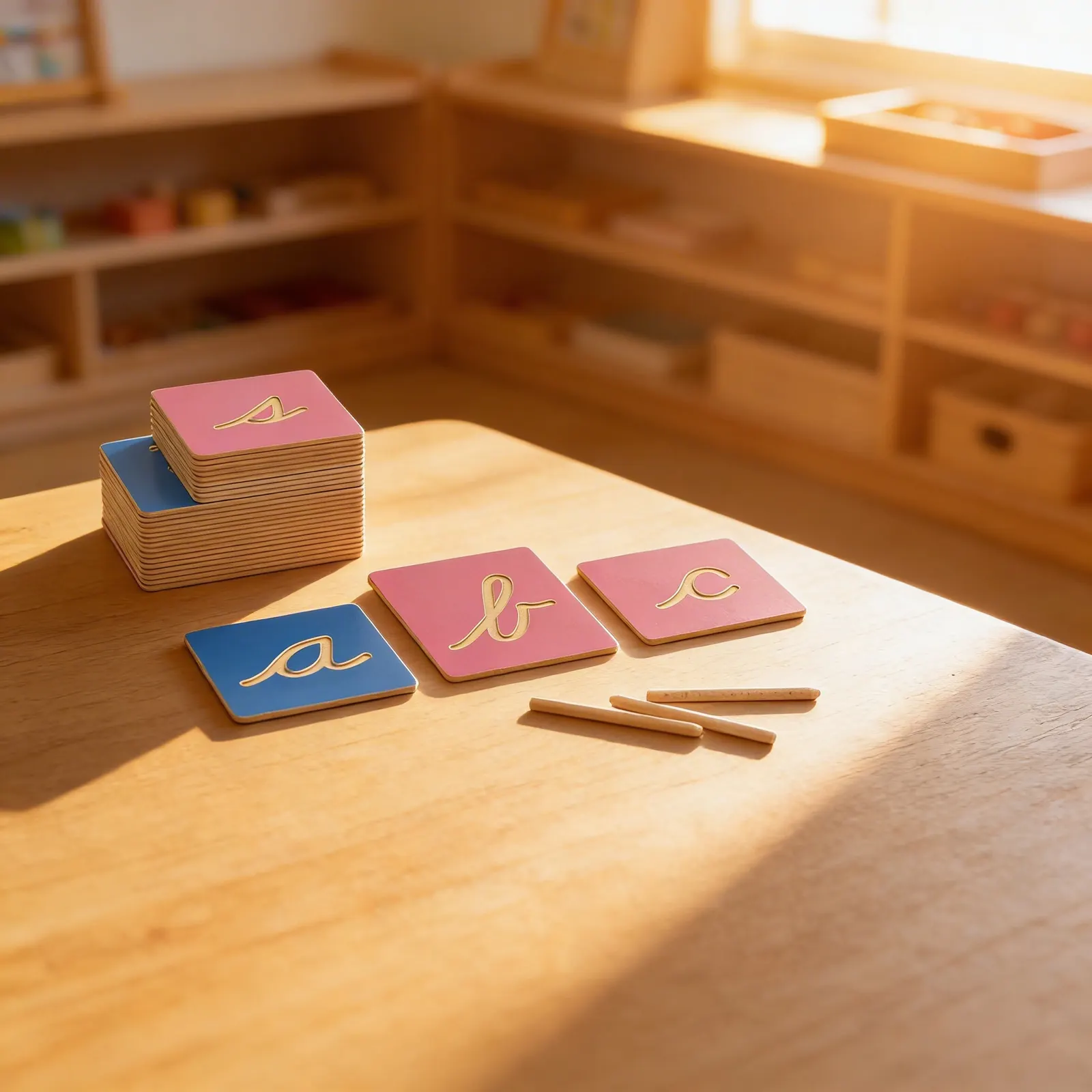
Hollow Letter Shapes in a child's hands
These Hollow Letter Shapes provide a tactile approach to learning US cursive script through guided tracing activities. The laminated cards feature pink consonants and blue vowels following traditional Montessori color coding, with raised edges that guide the child's finger or wooden stylus along the correct letter formation path. Each durable card offers repeated practice opportunities for developing the muscle memory essential for cursive writing.
Muscle Memory Development
Repeated tracing of hollow letters builds the fine motor control and muscle memory required for fluent cursive writing.
Letter Recognition
Color-coded consonants and vowels help children visually distinguish between letter types while learning their cursive forms.
Writing Preparation
The raised edges provide kinesthetic feedback that prepares the hand for proper pencil grip and letter formation.
Concentration Skills
Focused tracing activities develop sustained attention and precision necessary for later writing work.
How to present it
Place the tray of Hollow Letter Shapes on a table. Select 3-4 letter cards to introduce, choosing letters with similar formation patterns. Have the wooden stylus ready.
- 1Demonstrate tracing the first letter slowly with your index and middle fingers together, starting at the correct point
- 2Invite the child to trace the same letter, observing their finger position and movement direction
- 3Introduce the letter's sound while the child traces: 'This is how we write /a/'
- 4Present the wooden stylus as an extension tool once finger tracing is confident
- 5Encourage multiple tracings of each letter before introducing the next
3 tips for parents
- Practice cursive letter tracing during quiet moments, limiting sessions to 10-15 minutes
- Focus on correct formation over speed - proper muscle memory takes time to develop
- Celebrate effort rather than perfection, as cursive requires significant fine motor control

If you are not sure it suits your child, we answer in person.
Norbert Kovalčín, founder of Faborino · write to him
There is no review here yet. We will ask you for one after you buy. Write the first review
What's in the Box
- Letter Cards: Approx. 28 cursive letter shapes
- Wooden Stylus: For tracing practice
- Storage Box: Stackable wooden container
Size and material
| Packaging | 31 × 22 × 16 cm |
| Cards | Wood backing with laminated surface |
| Tracing Tools | Solid wood stylus |
| Recommended Age | 3-6 years |
Care
Wipe cards with damp cloth; dry immediately
Frequently Asked Questions
What is the difference between these hollow letter shapes and sandpaper letters?
While sandpaper letters provide texture for tracing, these hollow letter shapes feature raised edges that create a physical groove to guide the child's finger or stylus along the correct cursive formation path. This provides more structured guidance for proper letter formation and prevents straying from the correct stroke pattern.
Why are the consonants pink and vowels blue?
This follows traditional Montessori language material color coding, which helps children visually distinguish between consonants and vowels. This color differentiation supports phonetic awareness and helps children recognize vowel and consonant patterns when they begin reading and writing words.
Can these cards be used with pencils or only fingers?
These cards are designed for use with fingers or the included wooden stylus for tracing practice. They are not intended for use with pencils, as the purpose is to develop muscle memory through gross motor movements before transitioning to fine motor pencil control.
How durable are the laminated cards for classroom use?
The cards are professionally laminated for durability and can withstand repeated daily use in a classroom setting. The lamination protects against moisture, fingerprints, and general wear, making them easy to clean with a damp cloth and suitable for years of use.
What is the recommended progression after mastering these hollow letters?
After children can confidently trace all cursive letters with proper formation, they typically progress to writing on chalkboards or whiteboards, then move to wide-lined paper. The muscle memory developed with these cards provides the foundation for fluid cursive writing with a pencil.
Product safety
Manufacturer: Nienhuis Montessori, Anders Celsiusstraat 15, 7442 PB Nijverdal, Netherlands
Hollow Letter Shapes