
Hollow Number ShapesUS Version
The first photo is the maker's own. The other shots are illustrative.
Inv. no. NIE-002823
- Maker
- Nienhuis Montessori, since 1929
- Approval
- AMI
- Base
- Wooden boards
- Numbers
- Sandpaper
- EAN
- 8719924001599
Final price incl. VAT. Delivery €5.90, €119.10 to go for free delivery.
Advice, warranty and returns are handled by us.
Why it costs €29.90
Behind the price of the original are things you can check yourself.
AMI approval
The material is approved by the Association Montessori Internationale (AMI). Nienhuis has made Montessori materials since 1929.
A verifiable original
The EAN 8719924001599 is on the box. It is the maker's number, not ours.
Hollow Number Shapes in a child's hands
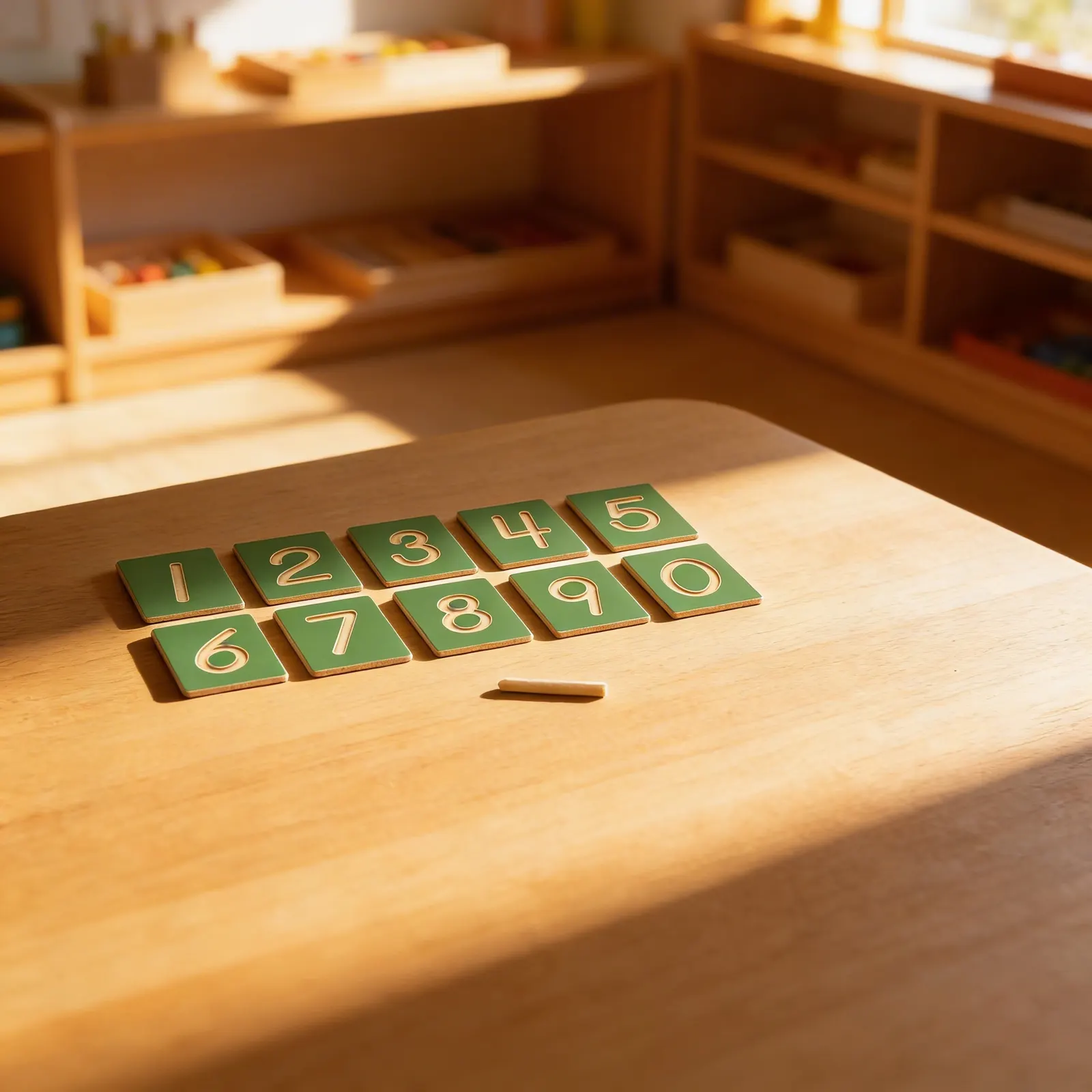
Hollow number shapes in the US version, an additional exercise for preparing a child to write numerals. The idea is Maria Montessori's own and she sets it out in The Discovery Of The Child. Numerals are harder to write than letters for one reason nobody mentions: there are only ten of them, so a child gets far less practice at each, and several are near mirrors of one another. Extra tracing is the answer. Wood with sandpaper and paint, for ages 3 to 6.
Muscular Memory
Tracing sandpaper numbers develops the hand movements needed for writing numerals correctly.
Symbol Recognition
Tactile exploration helps children internalize number shapes before formal writing begins.
Mathematical Foundation
Learning number symbols prepares children for understanding quantity and mathematical operations.
Sensory Integration
Combining touch, sight, and movement creates multiple pathways for learning number formation.
How to present it
Place the number boards in sequence on a mat. Have a small tray with sand or salt nearby for additional tracing practice.
- 1Introduce three numbers at a time using the three-period lesson
- 2Demonstrate tracing with your index and middle fingers together, moving in the correct formation direction
- 3Invite the child to trace while naming the number aloud
- 4Practice tracing in sand or salt after mastering the board
- 5Match the sandpaper numbers with quantity using counters or number rods
3 tips for parents
- Practice air writing numbers together during daily routines like waiting in line
- Point out numbers in the environment and relate them to the sandpaper shapes
- Let your child trace numbers in flour, shaving cream, or sand at home

If you are not sure it suits your child, we answer in person.
Norbert Kovalčín, founder of Faborino · write to him
There is no review here yet. We will ask you for one after you buy. Write the first review
What's in the Box
- Sandpaper Number Boards: 10 boards (numbers 0-9)
Size and material
| Packaging | 12 × 9 × 5 cm |
| Base | Wooden boards |
| Numbers | Sandpaper |
| Background | Green painted surface |
| Recommended Age | 3-6 years |
Care
Wipe boards with slightly damp cloth; avoid wetting sandpaper
Frequently Asked Questions
What is the difference between these hollow number shapes and traditional sandpaper numerals?
These hollow number shapes feature raised sandpaper numbers on wooden boards, allowing children to trace around the raised edges rather than over flat sandpaper. This provides enhanced tactile feedback and helps children better understand the shape and formation of each numeral through both touch and visual contrast.
At what age should children begin using the sandpaper numerals?
Children can begin using sandpaper numerals around age 3 when they show interest in numbers and have developed sufficient fine motor control. The material remains useful through age 6 as children refine their number writing skills and develop deeper number recognition.
How do these numerals prepare children for writing numbers?
The sandpaper texture provides sensory feedback that helps children develop muscle memory for correct number formation. By tracing the raised numbers with their fingers, children internalize the directional movements needed for writing before they begin using pencils, following the Montessori principle of concrete to abstract learning.
What activities can be done with the hollow number shapes?
Children can trace numbers while saying their names, match numerals to quantity materials, create number sequences, play memory games, use them for sandtray writing preparation, and combine them with counters or number rods for comprehensive mathematical understanding.
Why are the numbers on a green background?
The green background provides visual contrast that helps children clearly distinguish the number shapes. In Montessori mathematics materials, green is traditionally used for units, establishing a color-coding system that children will recognize throughout their mathematical journey with advanced Montessori materials.
Product safety
Manufacturer: Nienhuis Montessori, Anders Celsiusstraat 15, 7442 PB Nijverdal, Netherlands
Hollow Number Shapes