
Horizontal Quatrefoil
The first photos are the maker's own. The other shots are illustrative.
Inv. no. NIE-0117C0
- Maker
- Nienhuis Montessori, since 1929
- Approval
- AMI
- Base Material
- Painted wood
- Construction
- Composite board
- EAN
- 8719924006761
Final price incl. VAT. Delivery €5.90, €109.10 to go for free delivery.
Advice, warranty and returns are handled by us.
Why it costs €39.90
Behind the price of the original are things you can check yourself.
AMI approval
The material is approved by the Association Montessori Internationale (AMI). Nienhuis has made Montessori materials since 1929.
A verifiable original
The EAN 8719924006761 is on the box. It is the maker's number, not ours.
Horizontal Quatrefoil in a child's hands
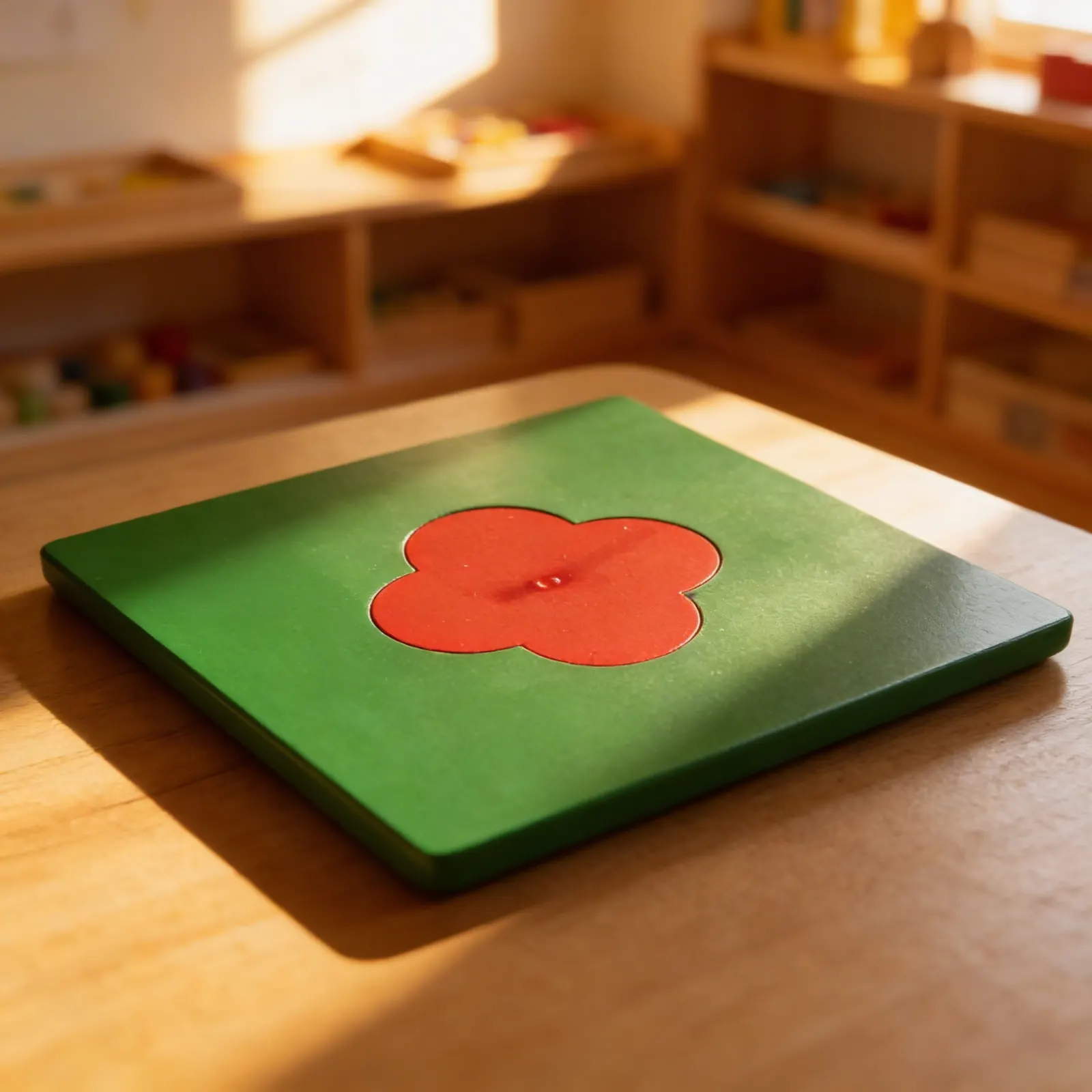
The horizontal quatrefoil from the elementary geometry set of plane figures, worked alongside the small triangle, the trapezoid and its diagonal counterpart. A quatrefoil is four arcs meeting at a centre, and having it horizontally rather than diagonally changes nothing about the figure and everything about what a child sees, which is the point of owning both. Orientation is the property most easily mistaken for a difference in shape. Painted wood, for ages 6 to 12.
Geometric Understanding
Introduces complex curved forms and their properties through direct manipulation
Visual Discrimination
Contrasting colors enhance shape recognition and spatial awareness
Mathematical Vocabulary
Builds precise geometric language through concrete experience with the quatrefoil form
How to present it
Place the Horizontal Quatrefoil on a work mat with tracing paper and colored pencils nearby. Ensure good lighting to see the edges clearly.
- 1Invite the child to remove the quatrefoil from its frame using a three-finger grip
- 2Trace the outer edge of the frame opening with your index finger, moving slowly
- 3Replace the quatrefoil and trace its outer edge within the frame
- 4Remove the shape and place it on paper to trace with a pencil
- 5Create patterns by rotating the quatrefoil and tracing in different positions
3 tips for parents
- Look for quatrefoils in your environment - windows, decorative ironwork, or garden designs
- Support mathematical language by using terms like 'lobe,' 'symmetry,' and 'rotation' naturally
- Create quatrefoil prints using paint or clay to reinforce the shape through different media

If you are not sure it suits your child, we answer in person.
Norbert Kovalčín, founder of Faborino · write to him
There is no review here yet. We will ask you for one after you buy. Write the first review
What's in the Box
- Square base frame: 14cm painted wood
- Quatrefoil inset: Removable geometric shape
Size and material
| Packaging | 14 × 14 × 1 cm |
| Base Material | Painted wood |
| Construction | Composite board |
| Recommended Age | 6-12 years |
Care
Wipe with dry or slightly damp cloth
Frequently Asked Questions
What is a quatrefoil shape and how does this material teach it?
A quatrefoil is a symmetrical four-lobed geometric figure resembling a four-petaled flower. This material features a precisely cut horizontal quatrefoil that children can remove from its frame, trace, and explore to understand its unique properties, curves, and mathematical relationships.
What specific skills does the Horizontal Quatrefoil develop?
This material develops spatial reasoning, geometric vocabulary, fine motor control through tracing, visual discrimination, and pattern recognition. Children also learn about symmetry, curved shapes in geometry, and the mathematical principles behind classical architectural forms.
How is this material typically presented in a Montessori classroom?
The teacher demonstrates removing the quatrefoil from its frame, tracing both the inset and the frame opening, and discussing the shape's properties. Children then work independently to trace, draw, and explore the form, often creating artistic patterns or comparing it with other geometric shapes.
What extensions can be done with the Horizontal Quatrefoil?
Extensions include creating quatrefoil patterns, finding real-world examples in architecture and art, combining with other geometric shapes for design work, measuring and calculating the perimeter, exploring rotational symmetry, and using it as a template for artistic creations.
Why is learning about complex shapes like quatrefoils important for elementary students?
Complex geometric forms bridge concrete and abstract thinking, preparing children for advanced geometry and design concepts. The quatrefoil specifically introduces curved geometry, cultural patterns in architecture, and sophisticated spatial relationships while maintaining the hands-on, exploratory approach essential to Montessori learning.
Product safety
Manufacturer: Nienhuis Montessori, Anders Celsiusstraat 15, 7442 PB Nijverdal, Netherlands
Horizontal Quatrefoil