
Hundred Board With Roman Numerals
The first photo is the maker's own. The other shots are illustrative.
Inv. no. NIE-018050
- Maker
- Nienhuis Montessori, since 1929
- Approval
- AMI
- Board Frame
- Natural wood
- Grid Surface
- Blue fabric or felt
- EAN
- 8719924009724
Final price incl. VAT. Delivery €5.90, €53.10 to go for free delivery.
Advice, warranty and returns are handled by us.
Why it costs €95.90
Behind the price of the original are things you can check yourself.
AMI approval
The material is approved by the Association Montessori Internationale (AMI). Nienhuis has made Montessori materials since 1929.
A verifiable original
The EAN 8719924009724 is on the box. It is the maker's number, not ours.
Hundred Board With Roman Numerals in a child's hands
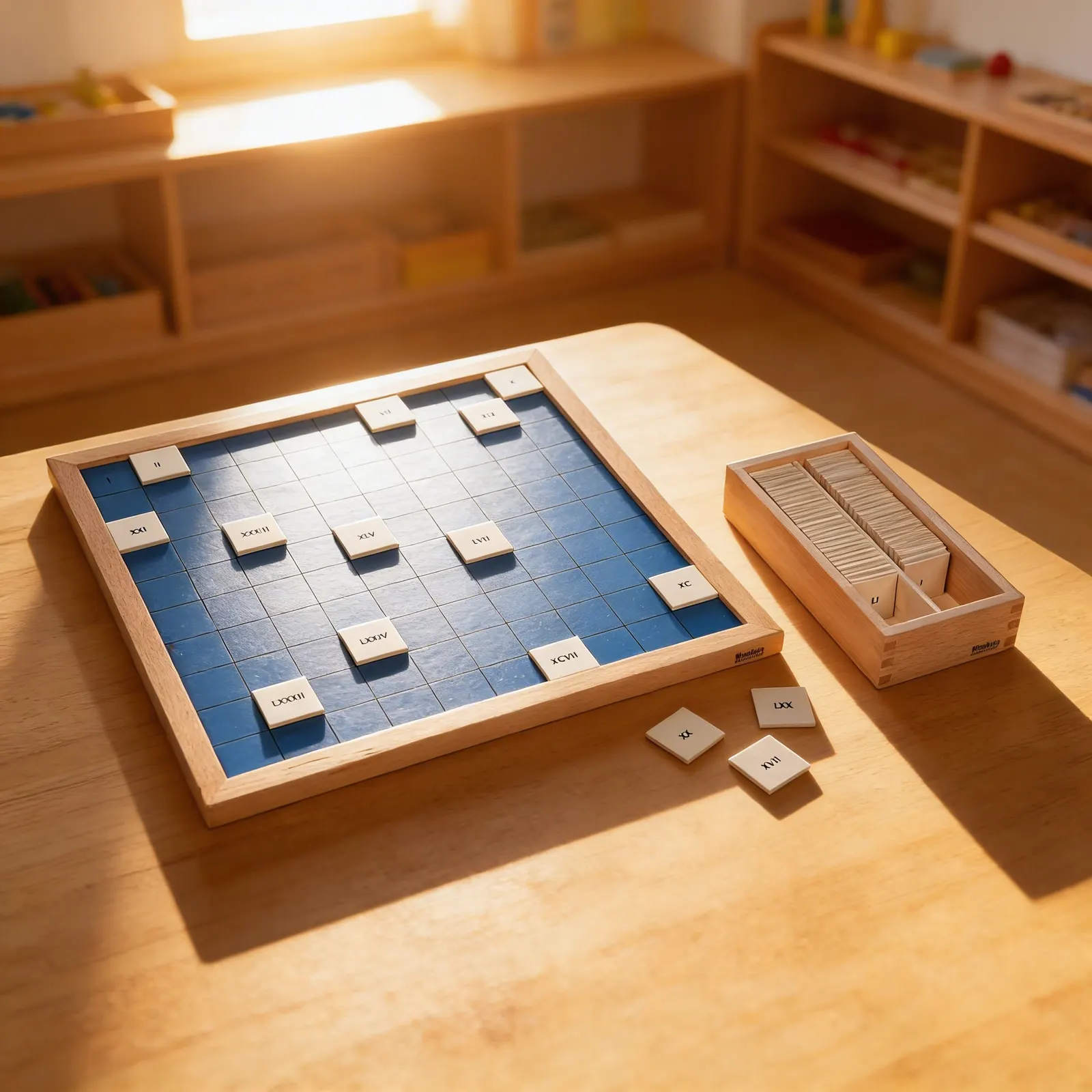
The same hundred board printed with Roman numerals, meant for after the original has been mastered. Doing an identical task in an unfamiliar notation is unusually revealing: a child who can place sixty seven instantly has to stop and work out LXVII, and in the stopping discovers that the number was never the symbol. Roman numerals also make the base ten structure of our own system visible by contrast, because Rome did not have one. Wood with fabric, for ages 3 to 6.
Advanced Number Recognition
Builds understanding of Roman numerals while reinforcing decimal system patterns and number sequences to 100.
Cultural Mathematics
Introduces historical number systems, connecting mathematics to cultural studies and expanding mathematical literacy.
Pattern Recognition
Reveals patterns in Roman numeral construction (I, V, X, L, C) and their systematic combinations.
Sequential Thinking
Strengthens understanding of number order and relationships through hands-on arrangement of tiles in sequence.
How to present it
Place the wooden frame on a work mat. Set the compartmented box containing Roman numeral tiles to the right. Ensure adequate workspace for tile sorting.
- 1Begin by inviting the child to find tile 'I' and place it in the first square
- 2Continue with II and III, allowing pattern recognition
- 3When reaching IV, pause to let the child puzzle over this new formation
- 4Continue systematically, grouping tiles by tens when helpful
- 5Complete the board, noting major patterns at L (50) and C (100)
3 tips for parents
- Point out Roman numerals in daily life - clock faces, book chapters, building dates
- Practice writing family birthdates or the current year in Roman numerals
- Create simple addition problems using Roman numeral cards or tiles

If you are not sure it suits your child, we answer in person.
Norbert Kovalčín, founder of Faborino · write to him
There is no review here yet. We will ask you for one after you buy. Write the first review
What's in the Box
- Hundred Board: Wooden frame with blue fabric grid (45×45 cm)
- Roman Numeral Tiles: 100 wooden tiles marked I through C
- Storage Box: Compartmented wooden box for tile organization
Size and material
| Packaging | 34 × 34 × 7 cm |
| Board Frame | Natural wood |
| Grid Surface | Blue fabric or felt |
| Number Tiles | Wooden tiles with printed numerals |
| Recommended Age | 5-7 years |
Care
Wipe wooden components with damp cloth; brush fabric surface gently
Frequently Asked Questions
At what age should children start working with the Hundred Board with Roman Numerals?
While suitable for ages 3-6, this material is best introduced after children have mastered the regular hundred board and have a solid understanding of numbers 1-100. Most children are ready around age 5-6, when they can confidently work with Arabic numerals.
How does this material differ from a regular hundred board?
This specialized hundred board features Roman numerals (I-C) instead of Arabic numerals (1-100) on each wooden tile. The blue fabric grid surface and wooden frame remain the same, but children learn to recognize and sequence Roman numerals while reinforcing their understanding of number patterns.
What skills does the Roman Numeral Hundred Board develop?
This material develops pattern recognition, sequencing skills, cultural mathematics understanding, and introduces historical number systems. Children strengthen their number sense while learning to read and order Roman numerals, preparing them for advanced mathematical concepts and historical studies.
How should children progress from regular to Roman numeral hundred board work?
Begin with matching exercises, placing Roman numeral tiles next to their Arabic equivalents. Progress to filling in rows (I-X, XI-XX), then work on skip counting patterns. Eventually, children can complete the entire board independently and create their own Roman numeral challenges.
What extension activities can be done with this material?
Children can practice writing Roman numerals, create conversion charts, play memory games matching Roman to Arabic numerals, explore patterns in Roman numeral formation, and research where Roman numerals are used today (clocks, book chapters, building dates).
Product safety
Manufacturer: Nienhuis Montessori, Anders Celsiusstraat 15, 7442 PB Nijverdal, Netherlands
Hundred Board With Roman Numerals