
Hundred / Pythagoras BoardUnprinted Wood Tile (1)
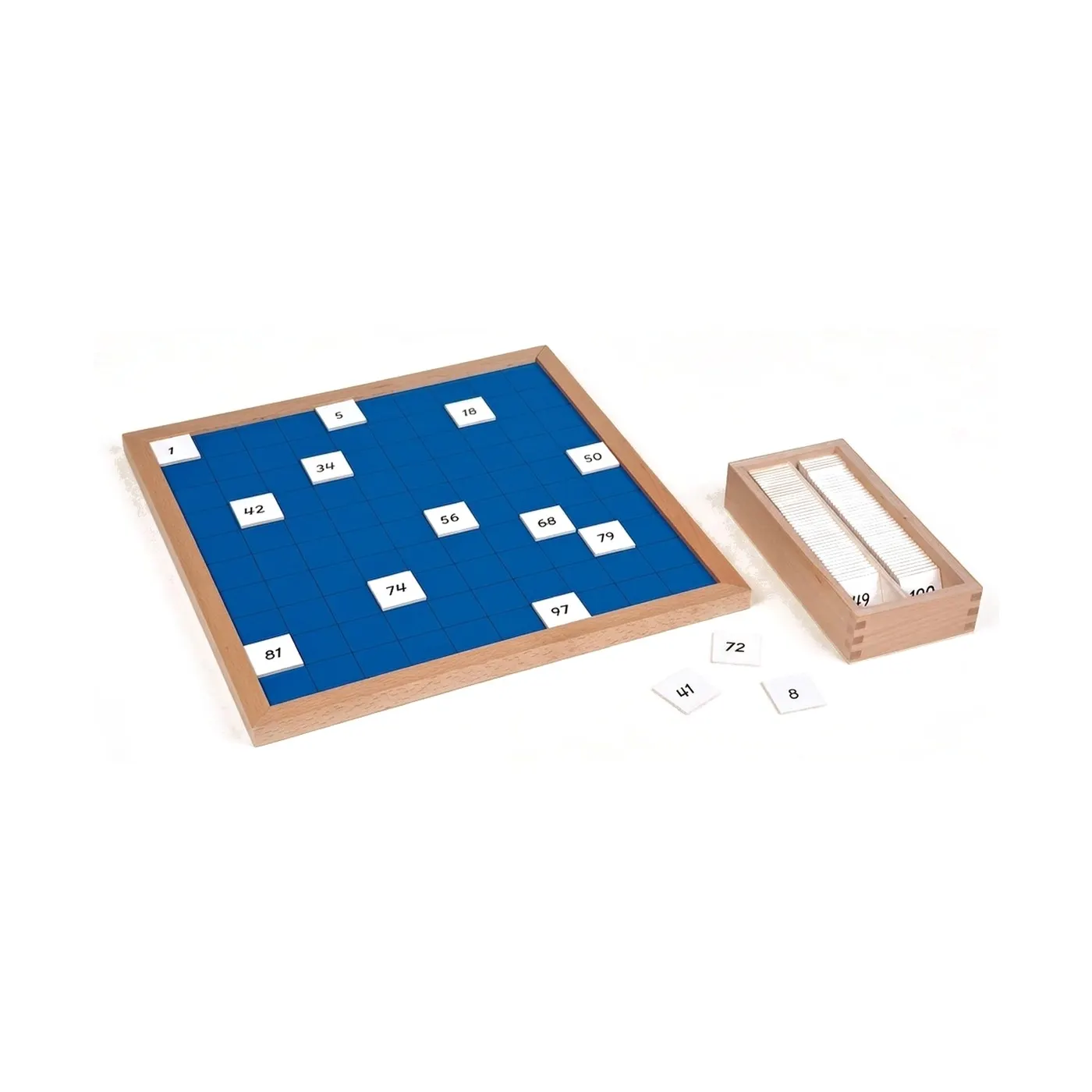
The first photo is the maker's own. The other shots are illustrative.
Inv. no. NIE-01800004
- Maker
- Nienhuis Montessori, since 1929
- Material
- Natural wood
- Finish
- Smooth, unprinted surface
- EAN
- 8719924009717
Final price incl. VAT. Delivery €5.90, €143.50 to go for free delivery.
Advice, warranty and returns are handled by us.
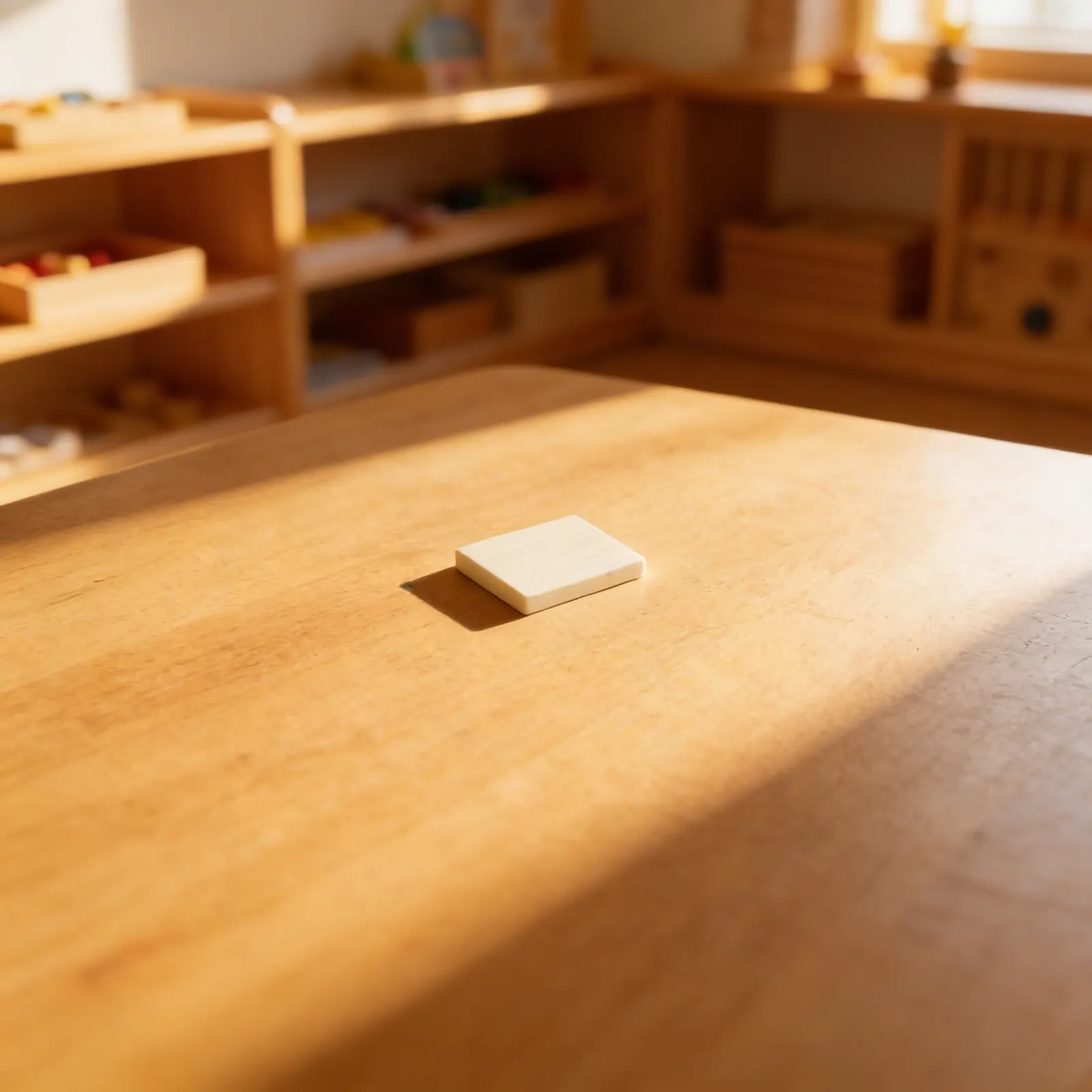
Hundred / Pythagoras Board in a child's hands
One unprinted wooden tile for the hundred board and the Pythagoras board, sold as a single piece. The hundred board is a printed board with a box of chips numbered one to a hundred, and this tile is one of those chips without its number: the right size and thickness for the grid, blank on the face. Use it to keep a set complete, or to mark a value your own work needs and the printed set does not have. The boards are separate items.
Mathematical Abstraction
Unprinted tiles encourage children to internalize number concepts without relying on printed symbols, fostering deeper mathematical understanding.
Pattern Recognition
Working with blank tiles on the Hundred Board develops awareness of numerical patterns and relationships through spatial arrangement.
Fine Motor Precision
Placing small tiles accurately within grid spaces refines pincer grip and hand-eye coordination essential for writing.
How to present it
Place the Hundred Board or Pythagoras Board on a mat. Have a basket containing multiple unprinted tiles alongside printed number tiles if using them for comparison. Ensure adequate workspace for tile arrangement.
- 1Invite the child to explore one tile, feeling its smooth surface and edges
- 2Demonstrate placing tiles in sequence on the board, counting aloud as you place each one
- 3Show how to create patterns using the blank tiles (every other square, diagonal lines, etc.)
- 4Introduce skip counting by placing tiles only on multiples of 2, 5, or 10
3 tips for parents
- Practice counting objects at home using similar one-to-one correspondence demonstrated with the tiles
- Create simple hundred board activities using graph paper and small objects like buttons or beans
- Support pattern recognition by pointing out number patterns in everyday life (house numbers, calendar dates)

If you are not sure it suits your child, we answer in person.
Norbert Kovalčín, founder of Faborino · write to him
There is no review here yet. We will ask you for one after you buy. Write the first review
What's in the Box
- Wooden tile: Single unprinted square (3×3×0.5cm)
Size and material
| Packaging | 13 × 9 × 0 cm |
| Material | Natural wood |
| Finish | Smooth, unprinted surface |
| Recommended Age | 3-6 years |
Care
Wipe with slightly damp cloth, dry immediately
Frequently Asked Questions
What is the purpose of an unprinted wood tile in Montessori mathematics?
The unprinted tile allows children to focus purely on quantity and position without number symbols, helping them develop abstract mathematical thinking and understand numerical relationships through tactile exploration and pattern recognition.
How does this tile work with the Hundred Board and Pythagoras Board?
Children use the blank tile to cover numbers on the board, creating patterns, skip counting sequences, or practicing number recognition. It can also represent unknown quantities in mathematical operations or serve as a placeholder when exploring number relationships.
What are the dimensions of this wooden tile?
This tile is designed to fit perfectly in standard Montessori Hundred Board and Pythagoras Board grids, typically measuring approximately 2.5cm x 2.5cm, matching the size of numbered tiles in these materials.
Can I use this tile with other Montessori mathematics materials?
Yes, this versatile tile can be used with various Montessori math materials including the Addition Strip Board, Subtraction Strip Board, and for creating custom counting activities or pattern work with other mathematical manipulatives.
Why choose unprinted tiles over numbered ones?
Unprinted tiles encourage children to internalize number concepts rather than relying on visual cues. They promote mental math, pattern recognition, and abstract thinking while allowing for open-ended mathematical exploration and discovery.
Product safety
Manufacturer: Nienhuis Montessori, Anders Celsiusstraat 15, 7442 PB Nijverdal, Netherlands
Hundred / Pythagoras Board