
Imbucare Box3 Coloured Knit Balls Shape Matching
The first photo is the maker's own. The other shots are illustrative.
Inv. no. NIE-043300
- Maker
- Nienhuis Montessori, since 1929
- Approval
- AMI
- Frame
- Natural wood with smooth finish
- Balls
- Soft knitted yarn in three colors
- EAN
- 8719924012632
Final price incl. VAT. Delivery €5.90, €51.10 to go for free delivery.
Advice, warranty and returns are handled by us.
Why it costs €97.90
Behind the price of the original are things you can check yourself.
AMI approval
The material is approved by the Association Montessori Internationale (AMI). Nienhuis has made Montessori materials since 1929.
A verifiable original
The EAN 8719924012632 is on the box. It is the maker's number, not ours.
Imbucare Box in a child's hands
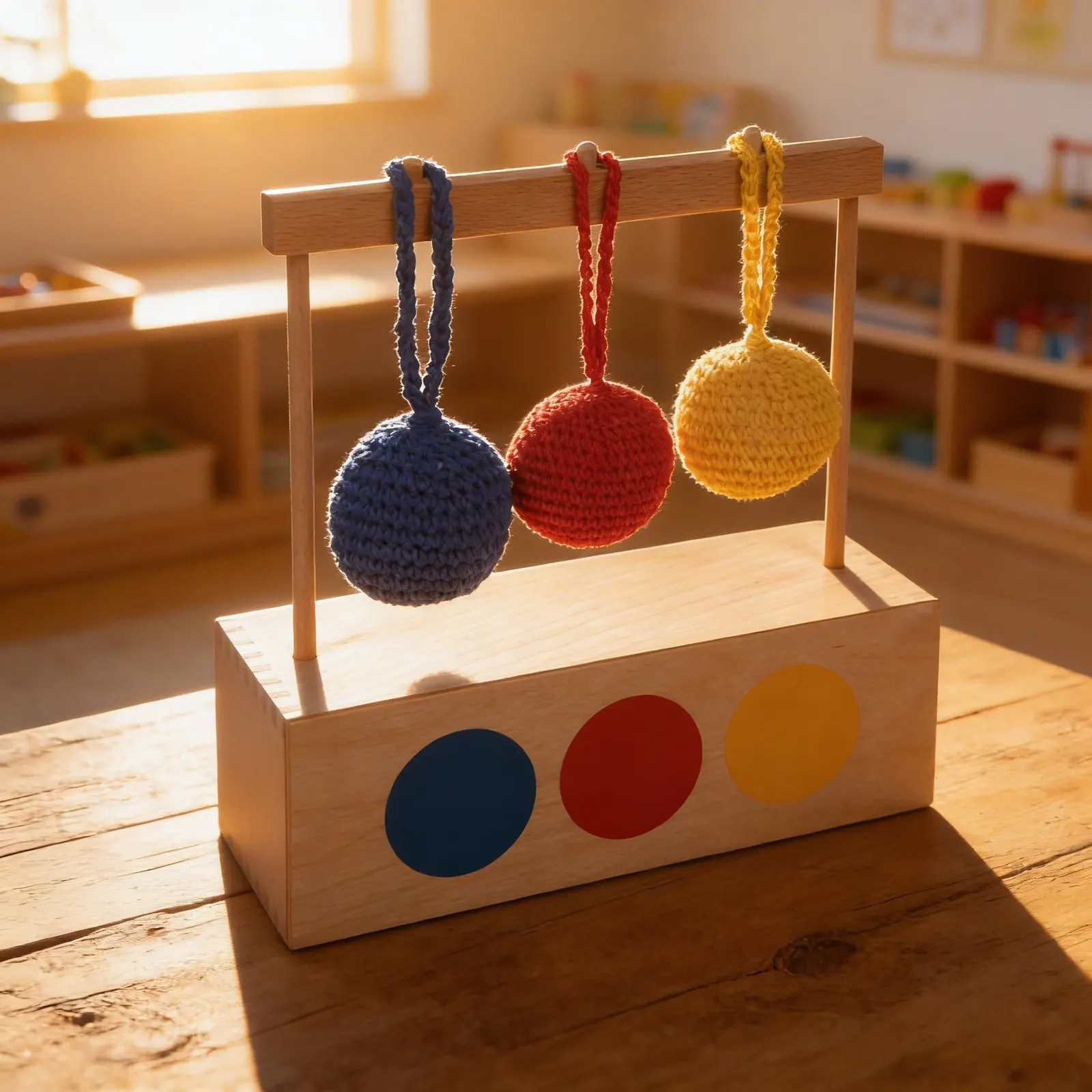
A box with a red, a yellow and a blue circle printed on the lid, three knitted balls on strings hung from a rack built onto the box, plus two stakes and a slat with dowels. The strings are what make this different from a plain posting box: a ball that has been pushed through does not disappear, it swings and can be pulled back, so cause and effect stay visible. Knitted balls also give a very young hand something forgiving to grip. Wood with knitted yarn, for ages 3 to 6.
Advanced Object Permanence
Children discover that objects continue to exist even when dropped through openings, while the attached cords allow repeated practice and self-correction.
Color Discrimination
Matching each ball to its corresponding colored opening refines visual perception and introduces early classification skills.
Bilateral Coordination
Managing the suspended balls while positioning them over openings develops both hands working together in complementary movements.
Concentration Building
The multi-step process of selecting, positioning, and releasing each ball cultivates sustained attention and task completion.
How to present it
Place the box on a mat at the child's work table. Arrange the three knitted balls to the right of the box, ensuring cords are untangled. Sit to the child's right.
- 1Demonstrate lifting the first ball by pinching the knit fabric, not pulling the cord
- 2Guide the ball to hover over each hole, pausing to compare colors
- 3Lower the ball through the matching colored hole with controlled release
- 4Open the drawer to retrieve the ball, showing the complete cycle
- 5Invite the child to try with the remaining balls
3 tips for parents
- Allow your child to work with this material repeatedly - mastery comes through repetition
- Resist the urge to correct color matching immediately - self-discovery is more powerful
- If the material seems too challenging, return to simpler object permanence boxes first

If you are not sure it suits your child, we answer in person.
Norbert Kovalčín, founder of Faborino · write to him
There is no review here yet. We will ask you for one after you buy. Write the first review
What's in the Box
- Wooden imbucare box: with three colored circular openings
- Wooden support frame: with horizontal suspension bar
- Three knitted balls: attached with cords, color-matched to openings
Size and material
| Packaging | 26 × 10 × 11 cm |
| Frame | Natural wood with smooth finish |
| Balls | Soft knitted yarn in three colors |
| Recommended Age | 0-3 years |
Care
Wipe wooden surfaces with damp cloth; spot clean knitted balls as needed
Frequently Asked Questions
What makes this Imbucare box different from basic versions?
This advanced model features three colored knit balls on cords that must be matched to corresponding colored circles on the box lid, adding color discrimination and more complex motor planning to the traditional object permanence exercise.
How do the cords attached to the balls benefit learning?
The cords prevent balls from rolling away, allow for repeated practice without interruption, and add an extra dimension of control as children must manage both the ball and cord while placing it through the correct opening.
What skills does this material specifically develop?
This box develops refined hand-eye coordination, color matching abilities, controlled wrist movements, visual discrimination, concentration, and problem-solving skills as children work to place each ball through its matching colored opening.
Why are the balls made of knitted material?
Knitted balls provide a unique texture for sensorial exploration, are softer and quieter than wooden balls, offer better grip for small hands, and add a tactile element that engages multiple senses during the activity.
How does this material prepare children for future learning?
This exercise prepares the hand for writing through controlled movements, develops visual discrimination needed for reading, builds concentration required for academic work, and establishes the concept of matching and sorting used in mathematics and language activities.
Product safety
Manufacturer: Nienhuis Montessori, Anders Celsiusstraat 15, 7442 PB Nijverdal, Netherlands
Imbucare Box