
Glass Bead Cube of 3: Pink Mathematical Concept Exploration
Made by Nienhuis Montessori · shipped by Heutink International (Netherlands) About the maker
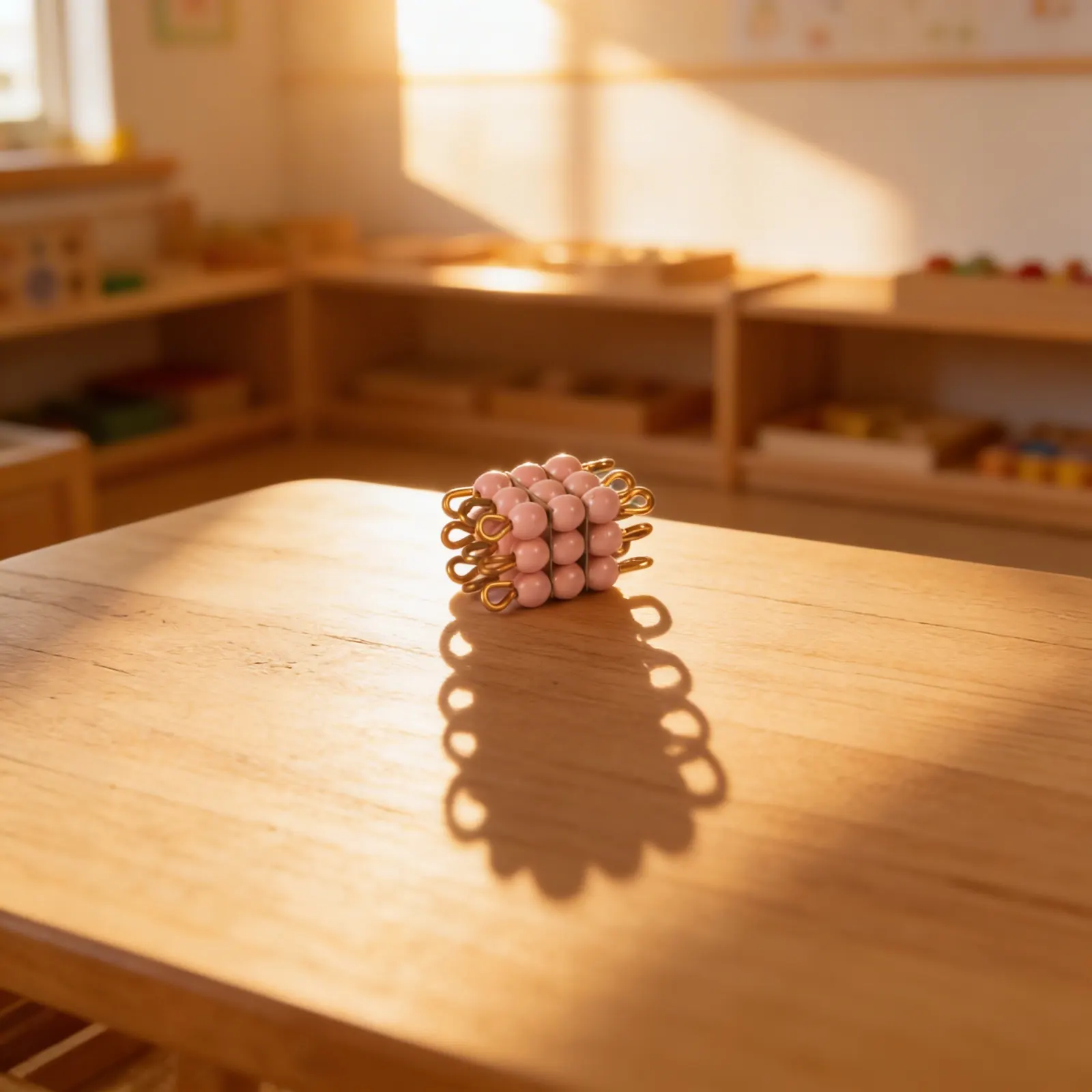
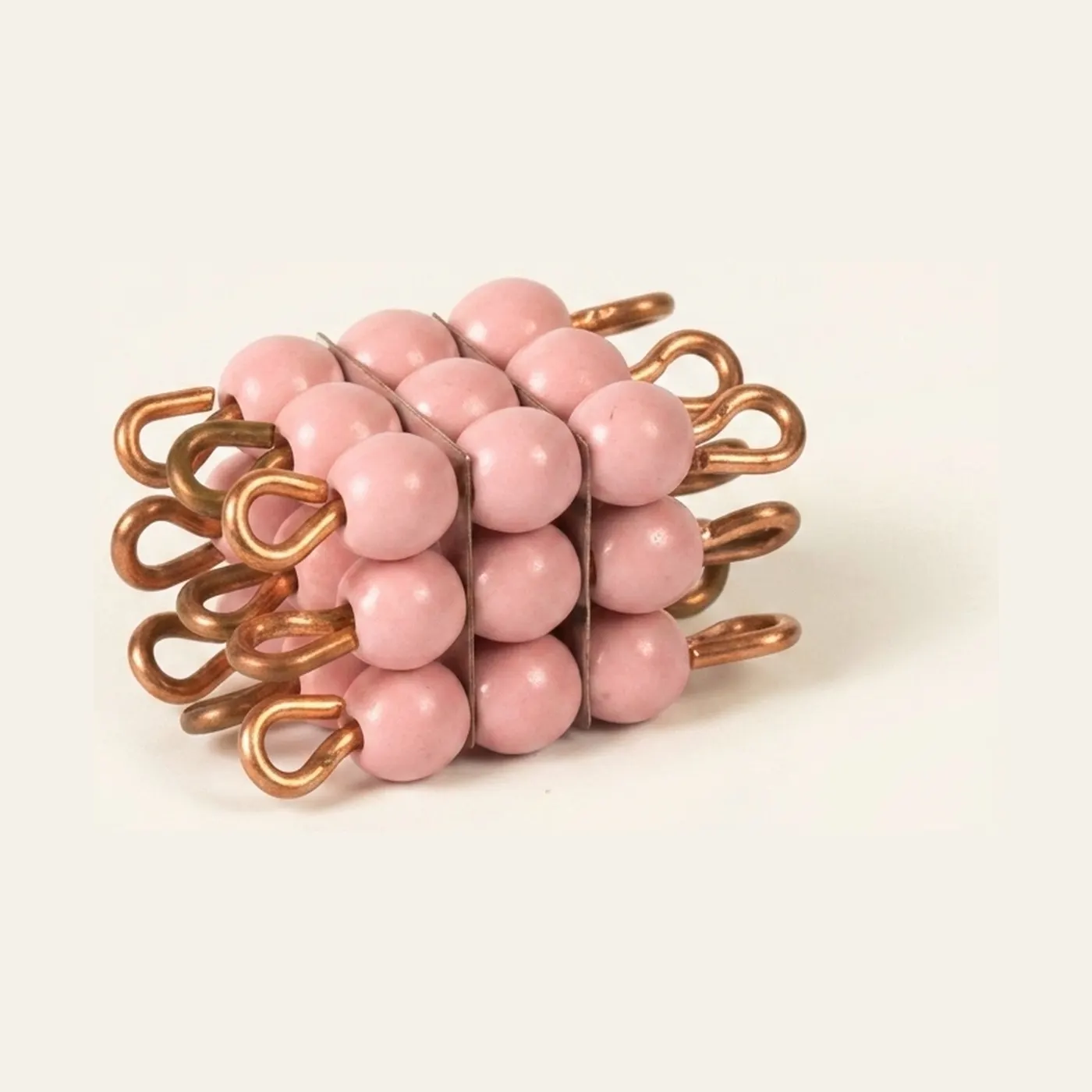
The cube of three in pink glass beads, three bead squares of three wired into a block of twenty seven. Twenty seven is the smallest cube a child can still see as a cube: two cubed is eight, which reads as a lump, and this is the first one where the three layers are visible from the side. Pink is the colour of three throughout the bead material, so it is recognisable across a room. Glass beads on wire, for ages 3 to 6.
“Children display a universal love of mathematics, which is par excellence the science of precision, order, and intelligence.”
The Glass Bead Cube of 3 embodies Maria Montessori's principle of materialized abstraction, where complex mathematical concepts become tangible through sensorial exploration.
- Understanding the concrete representation of 3³ equals 27 through counting and grouping
- Developing spatial awareness and three-dimensional thinking through cube exploration
- Strengthening fine motor control through careful handling of glass beads
- Building foundation for later work with algebraic concepts and powers of numbers
Read More
This material bridges the gap between concrete manipulation and abstract mathematical thinking, allowing the child to physically hold and examine the concept of 3³. Through the precision of the pink glass beads arranged in exact formation, children experience the mathematical beauty of cubic relationships through their senses. The material honors the child's need to touch, count, and internalize mathematical patterns during the sensitive period for order and mathematical relationships. By isolating the concept of cubing through a single, aesthetically pleasing object, we enable deep concentration and repeated exploration, fostering what Montessori called 'mathematical mind' - the human tendency to think in precise, ordered ways.
How to present it
Follow the Montessori method of presentation for optimal child development.
Place the pink glass bead cube on a small tray with a white cloth underneath. Ensure the work area is clear and the child has washed their hands. Have a small mat ready for floor work if preferred.
- 1
Invite the child to carefully carry the tray to their workspace using two hands
Model slow, deliberate movements to emphasize care with glass material - 2
Place the cube gently on the mat and invite the child to observe it from all angles
Use minimal language, allowing the child to make their own discoveries - 3
Demonstrate counting the beads on one face: 'One, two, three' across, then down
Touch each bead lightly as you count, using consistent rhythm - 4
Show how to count one complete layer of 9 beads systematically
Count in rows to establish pattern recognition - 5
Guide the child to discover there are 3 layers, each containing 9 beads
Let the child make the connection that 3×3×3 equals 27 - 6
Invite the child to feel the weight and temperature of the glass beads
This sensorial impression helps cement the mathematical concept
Every Child Is a Little Creator

Heritage
Since 1929

In classrooms
Around the world

European brands
Nienhuis, GAM, Educo

AMI approved
To the association standard
Glass Bead Cube of 3: Pink Mathematical Concept Exploration
