
Glass Bead Cube of 4: Yellow Mathematical Cube Representation
Made by Nienhuis Montessori · shipped by Heutink International (Netherlands) About the maker
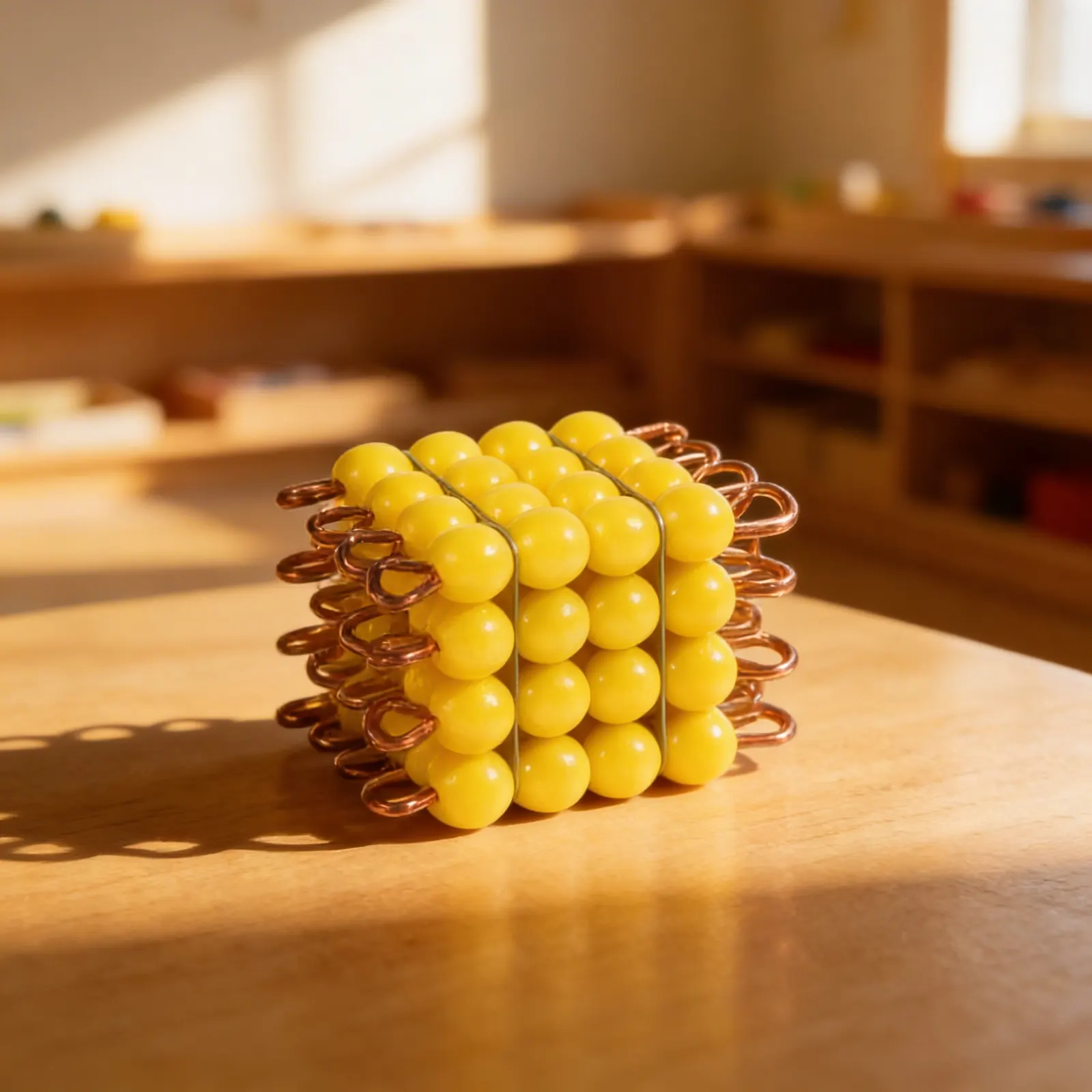
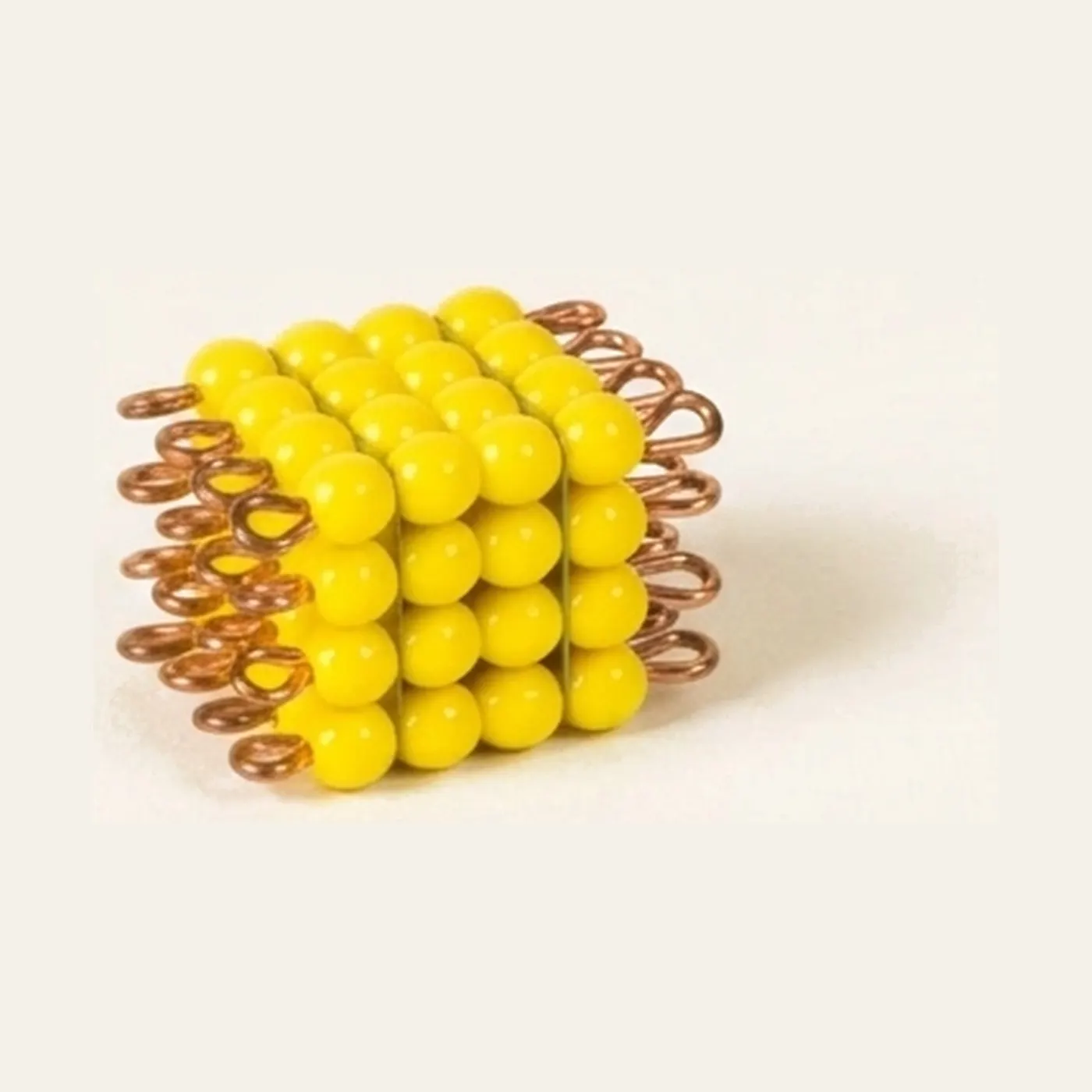
The cube of four in yellow glass beads, four bead squares of four wired into a solid block of sixty four. Yellow is the colour of four throughout the bead material, and four is the first cube small enough to be genuinely counted: a child can check sixty four bead by bead in a few minutes, which is not true of the cube of eight or nine. Glass gives it the weight that makes a cube feel like a quantity. Glass beads on wire, for ages 3 to 6.
“Children display a universal love of mathematics, which is par excellence the science of precision, order, and intelligence.”
The Individual Glass Bead Cube of 4 embodies Maria Montessori's principle of making abstract mathematical concepts concrete through sensorial exploration.
- Understanding the concrete representation of cubing numbers through sensorial exploration
- Developing visual discrimination skills for three-dimensional geometric forms
- Building foundation for later abstract mathematical operations involving powers
- Strengthening concentration through careful observation and handling of precise materials
Read More
This material bridges the gap between the sensorial and mathematical areas of the classroom, allowing children to physically experience the concept of cubing before they cognitively understand the mathematical operation. The precise arrangement of 64 beads in a 4×4×4 formation provides a visual and tactile representation of 4³, enabling children to internalize mathematical relationships through their senses. The yellow color creates visual clarity and beauty, appealing to the child's aesthetic sense while supporting concentration. This material demonstrates Montessori's belief that children can grasp complex mathematical concepts when presented through concrete, manipulable objects that engage multiple senses simultaneously.
How to present it
Follow the Montessori method of presentation for optimal child development.
Place the bead cube on a neutral-colored mat at the child's workspace. Ensure clean hands and a calm environment. Have a tray ready for careful transport.
- 1
Invite the child to carry the cube carefully with two hands to their mat
Model slow, deliberate movements to emphasize care and respect for the material - 2
Place the cube gently on the mat and sit beside the child at their eye level
Position yourself so you don't block the child's view - 3
Slowly trace the edges of the cube with your index finger, counting each edge
Use precise, graceful movements to maintain the child's attention - 4
Count the beads along one edge: '1, 2, 3, 4' touching each bead gently
Speak clearly but softly, allowing the child to focus on the quantity - 5
Explore the faces of the cube, noting how each face contains 16 beads (4×4)
Let the child discover this pattern independently if they show interest - 6
Carefully lift and rotate the cube to examine all six faces
Support the base with one hand while turning to prevent dropping
Every Child Is a Little Creator

Heritage
Since 1929

In classrooms
Around the world

European brands
Nienhuis, GAM, Educo

AMI approved
To the association standard
Glass Bead Cube of 4: Yellow Mathematical Cube Representation
