
Glass Bead Cube of 5Light Blue Individual Unit
The first photo is the maker's own. The other shots are illustrative.
Inv. no. NIE-0086G035
- Maker
- Nienhuis Montessori, since 1929
- Approval
- AMI
- Beads
- Light blue glass
- Frame
- Gold-colored metal wire
- EAN
- 8719924004958
Final price incl. VAT. Delivery €5.90, €97.10 to go for free delivery.
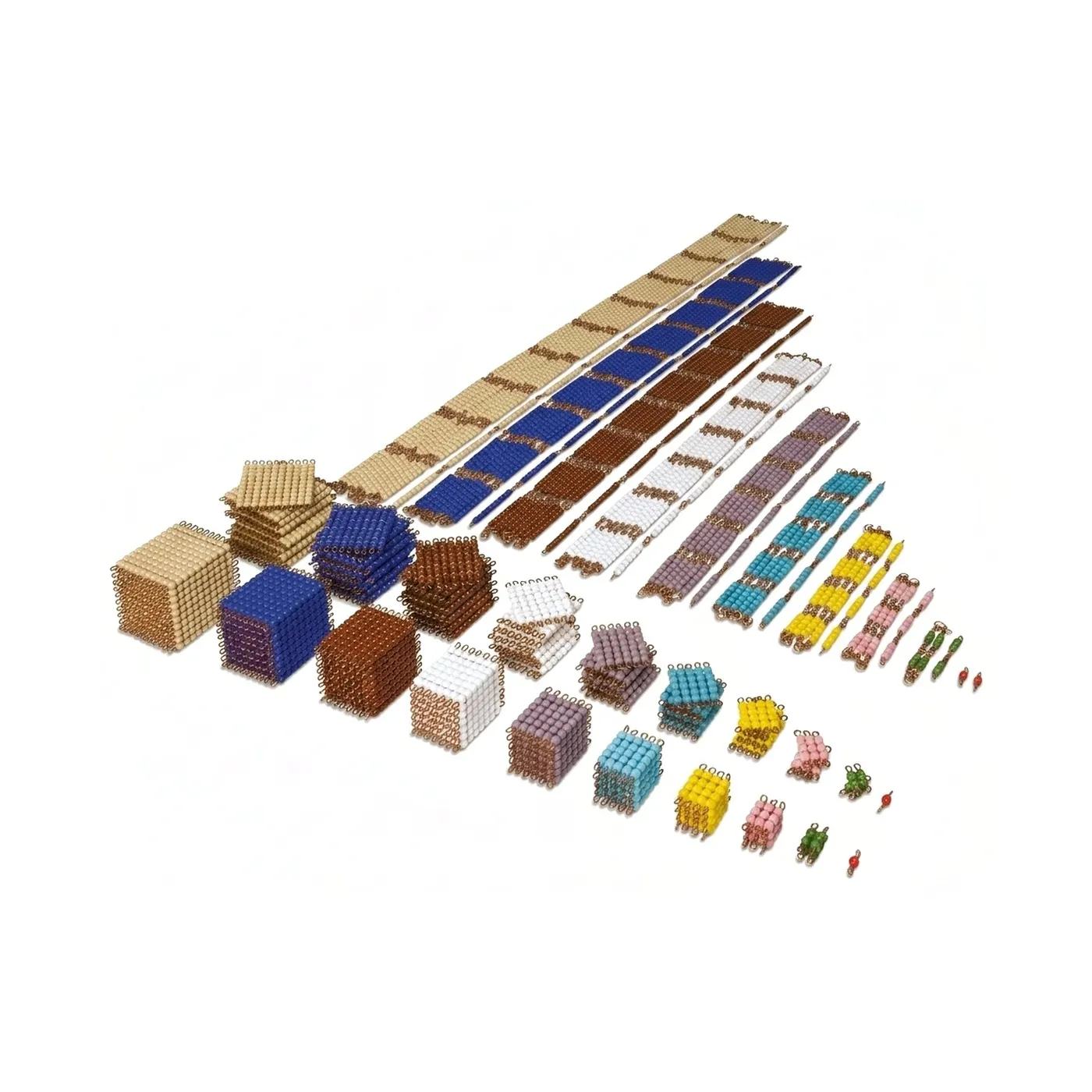 Individual Glass Beads €2,012.90
Advice, warranty and returns are handled by us.
Why it costs €51.90
Behind the price of the original are things you can check yourself.
AMI approval
The material is approved by the Association Montessori Internationale (AMI). Nienhuis has made Montessori materials since 1929.
A verifiable original
The EAN 8719924004958 is on the box. It is the maker's number, not ours.
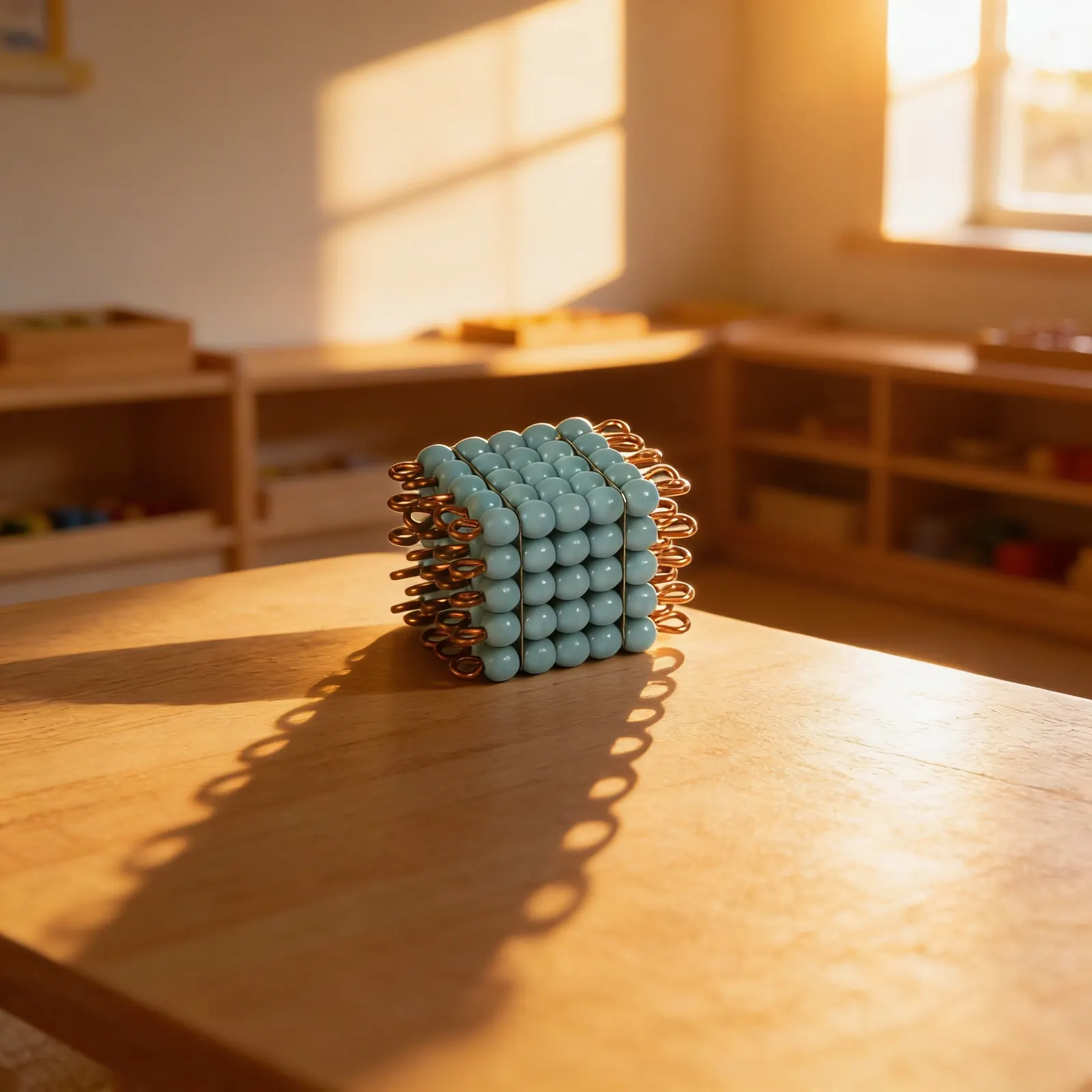
Glass Bead Cube of 5 in a child's hands
Expand your collection with this individual Glass Bead Cube of 5 features light blue glass beads arranged in a precise 5×5×5 formation, representing 125 units in the concrete exploration of cubing. Part of the bead cube series, this material provides a tactile and visual representation of mathematical concepts, empowering children to physically experience the cube of five through counting, touching, and examining the three-dimensional structure.
Mathematical Mind
Concrete representation of 5³ helps children understand cubing through sensorial experience before abstract concepts.
Spatial Reasoning
Three-dimensional structure develops understanding of volume, space, and geometric relationships.
Fine Motor Skills
Handling and counting individual beads refines pincer grip and hand-eye coordination.
Concentration
Systematic counting of 125 beads builds focus and attention to detail essential for mathematical work.
How to present it
Place the cube on a neutral-colored mat at the child's workspace. Have a tray nearby for counting activities. Ensure good lighting to appreciate the light blue color.
- 1Invite the child to carry the cube carefully with both hands to the mat
- 2Explore the cube visually, noting how it appears the same from all angles
- 3Count one face: demonstrate counting the 25 beads systematically in rows
- 4Explore the edges, counting 5 beads along each edge
- 5Count the total beads by layers, counting 25 beads five times
3 tips for parents
- At home, explore cubic relationships using building blocks or sugar cubes in groups of 5
- Point out cubic formations in architecture and nature during outings
- Avoid rushing to abstract notation - let the concrete understanding develop fully

If you are not sure it suits your child, we answer in person.
Norbert Kovalčín, founder of Faborino · write to him
There is no review here yet. We will ask you for one after you buy. Write the first review
What's in the Box
- Glass Bead Cube of 5: Light blue, 125 beads total
Size and material
| Packaging | 10 × 10 × 4 cm |
| Beads | Light blue glass |
| Frame | Gold-colored metal wire |
| Total Beads | 125 units |
| Recommended Age | 3-6 years |
Care
Wipe gently with soft, dry cloth; handle with care due to glass components
Frequently Asked Questions
What mathematical concepts does the Glass Bead Cube of 5 teach?
This material introduces the concept of cubing numbers concretely, showing that 5³ equals 125. Children can physically count and see how 5x5x5 creates a cube, building understanding of volume, multiplication, and exponential growth through tactile exploration.
How do children use this bead cube in the classroom?
Children explore the cube by counting individual beads, examining layers, and comparing it to other bead cubes in the series. They can count by fives, discover patterns, and physically experience how a three-dimensional cube is formed from repeated multiplication.
Why are the beads made of glass and in light blue?
Glass beads provide a premium tactile experience with satisfying weight and smooth texture. The light blue color is part of the Montessori color-coding system for mathematical materials, helping children visually distinguish between different numerical values in the bead cube series.
What prerequisite skills should children have before using this material?
Children should be comfortable counting to 100, have experience with the golden bead material, and understand basic multiplication concepts. Prior work with bead chains and squares helps prepare them for the more complex three-dimensional exploration of cubing.
How does this individual cube relate to the complete bead cube set?
This cube of 5 is one component of the full bead cube series (1-10). While the complete set shows the progression of cubing, individual cubes allow focused exploration of specific numbers and are ideal for classrooms wanting to build their collection gradually or replace specific pieces.
Product safety
Manufacturer: Nienhuis Montessori, Anders Celsiusstraat 15, 7442 PB Nijverdal, Netherlands
Glass Bead Cube of 5