
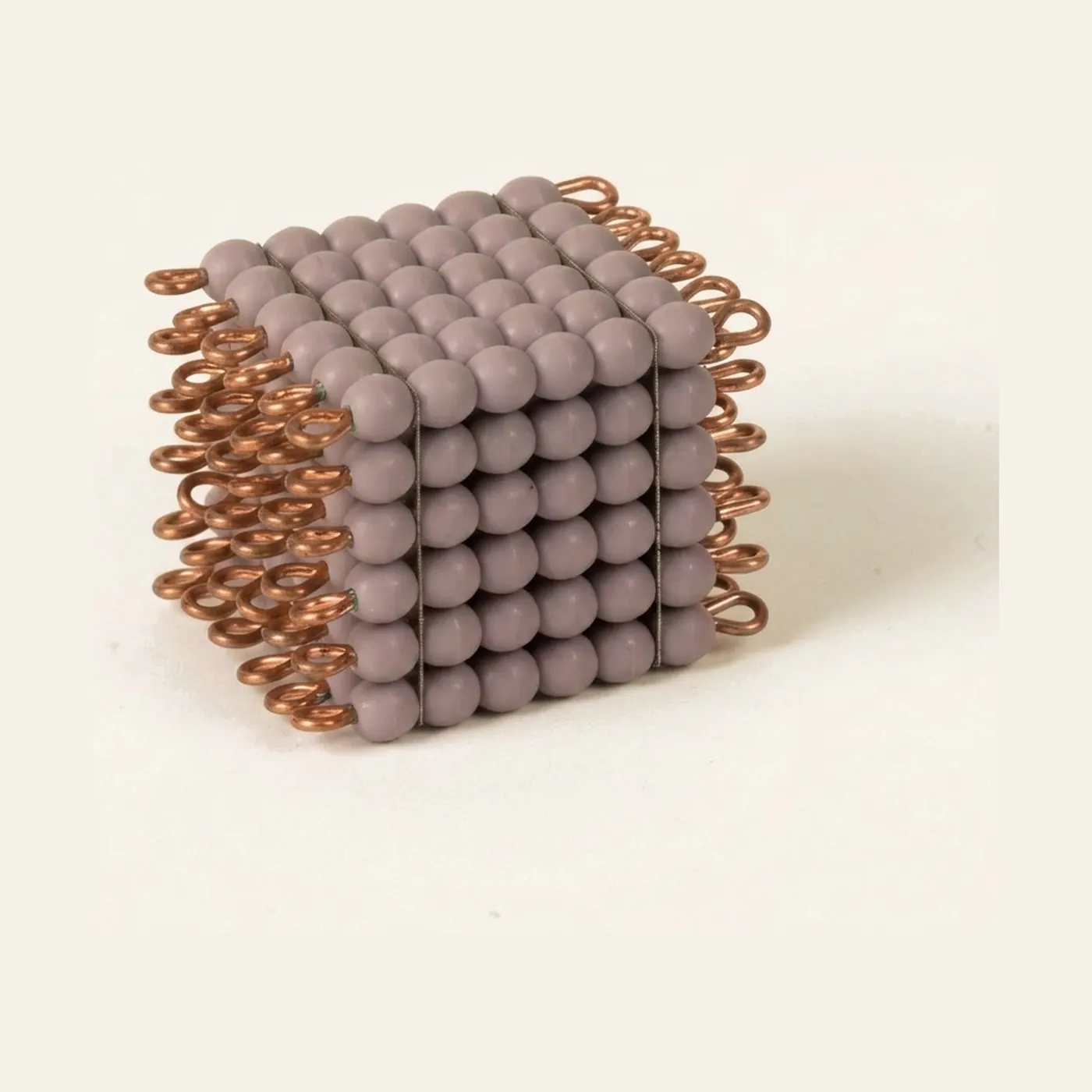
Glass Bead Cube of 6: Purple Cube for Mathematical Visualisation
Made by Nienhuis Montessori · shipped by Heutink International (Netherlands) About the maker
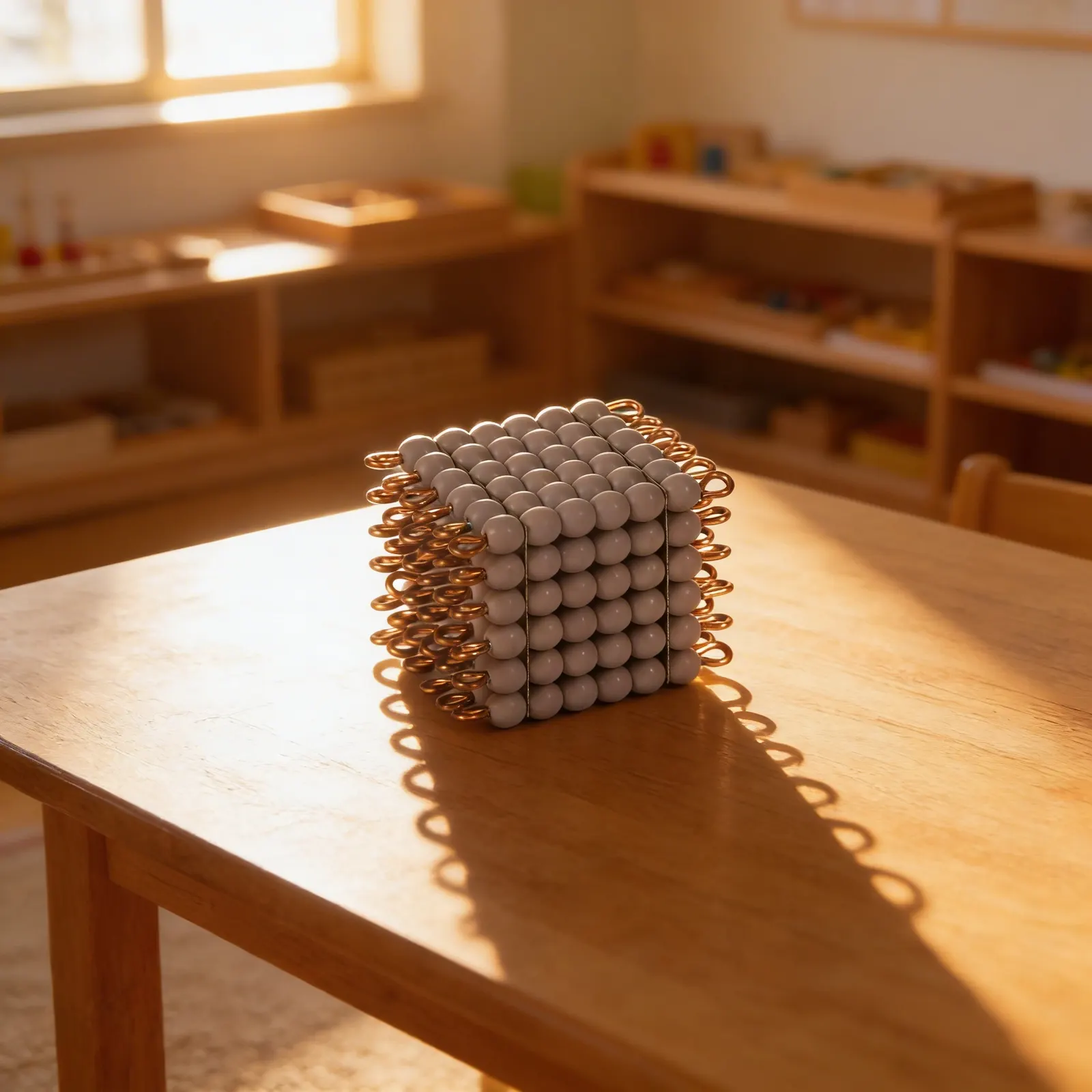
Sharpening perception one step at a time, this exquisite purple glass bead cube represents the concrete manifestation of 6³ (216), serving as a tactile and visual bridge between abstract mathematical concepts and physical reality. Part of the bead material progression, this cube allows children to explore the relationship between linear, square, and cubic dimensions through sensorial experience, preparing them for advanced mathematical work in the elementary years.
“Children display a universal love of mathematics, which is par excellence the science of precision, order, and intelligence.”
The Individual Glass Bead Cube of 6 embodies Maria Montessori's principle of materialized abstraction, where complex mathematical concepts are made tangible through sensorial experience.
- Understanding the physical representation of cubing through holding 6³ (216 units)
- Developing spatial awareness and three-dimensional thinking through cube exploration
- Building foundation for algebraic concepts through concrete cubic relationships
- Strengthening mathematical vocabulary: cube, cubic dimension, power of three
Read More
This purple cube represents 6³ (216 beads), allowing the child to physically hold and examine what would otherwise remain an abstract number. Through this material, the child's mathematical mind is nourished as they transition from concrete to abstract thinking. The weight, texture, and visual beauty of the glass beads engage multiple senses simultaneously, creating neural pathways that support deep mathematical understanding. This material bridges the gap between the sensorial explorations of the Children's House and the more abstract mathematical work of the elementary years, respecting the child's need for concrete manipulation while preparing for intellectual abstraction.
How to present it
Follow the Montessori method of presentation for optimal child development.
Place the purple bead cube on a neutral-colored mat at the child's workspace. Have the bead square of 6 and bead bar of 6 available for comparison. Ensure adequate lighting to appreciate the glass beads' transparency.
- 1
Invite the child to carefully carry the cube with both hands, feeling its weight
The weight provides sensorial feedback about quantity - 216 beads have substantial mass - 2
Place the cube on the mat and observe all faces, noting each shows 36 beads
Use natural light to highlight the purple glass quality and depth of the cube - 3
Compare with the bead bar of 6 (linear) and bead square of 6 (two-dimensional)
Physically demonstrate how 6 bars make a square, and 6 squares stack to form the cube - 4
Count the edge: 1, 2, 3, 4, 5, 6 beads along each dimension
Use a pointer or finger to trace edges, reinforcing that all edges are equal - 5
Introduce the language: 'This is 6 cubed, or 6 to the power of 3'
Write 6³ = 216 on a slip of paper to connect concrete to symbolic
Every Child Is a Little Creator

Heritage
Since 1929

In classrooms
Around the world

European brands
Nienhuis, GAM, Educo

AMI approved
To the association standard
Glass Bead Cube of 6: Purple Cube for Mathematical Visualisation
