
Glass Bead Cube of 7: White Individual Beads for 7³ Concept
Made by Nienhuis Montessori · shipped by Heutink International (Netherlands) About the maker
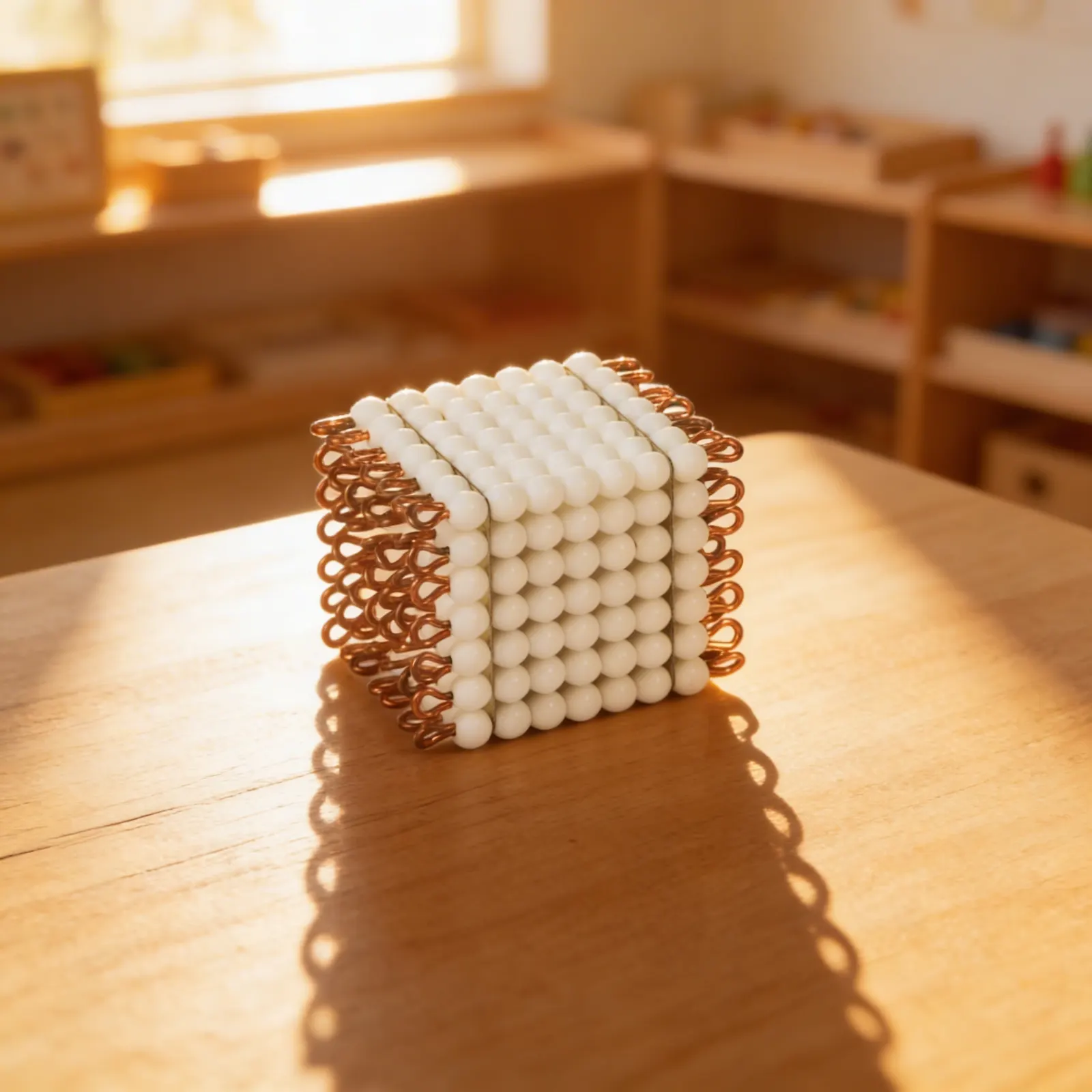
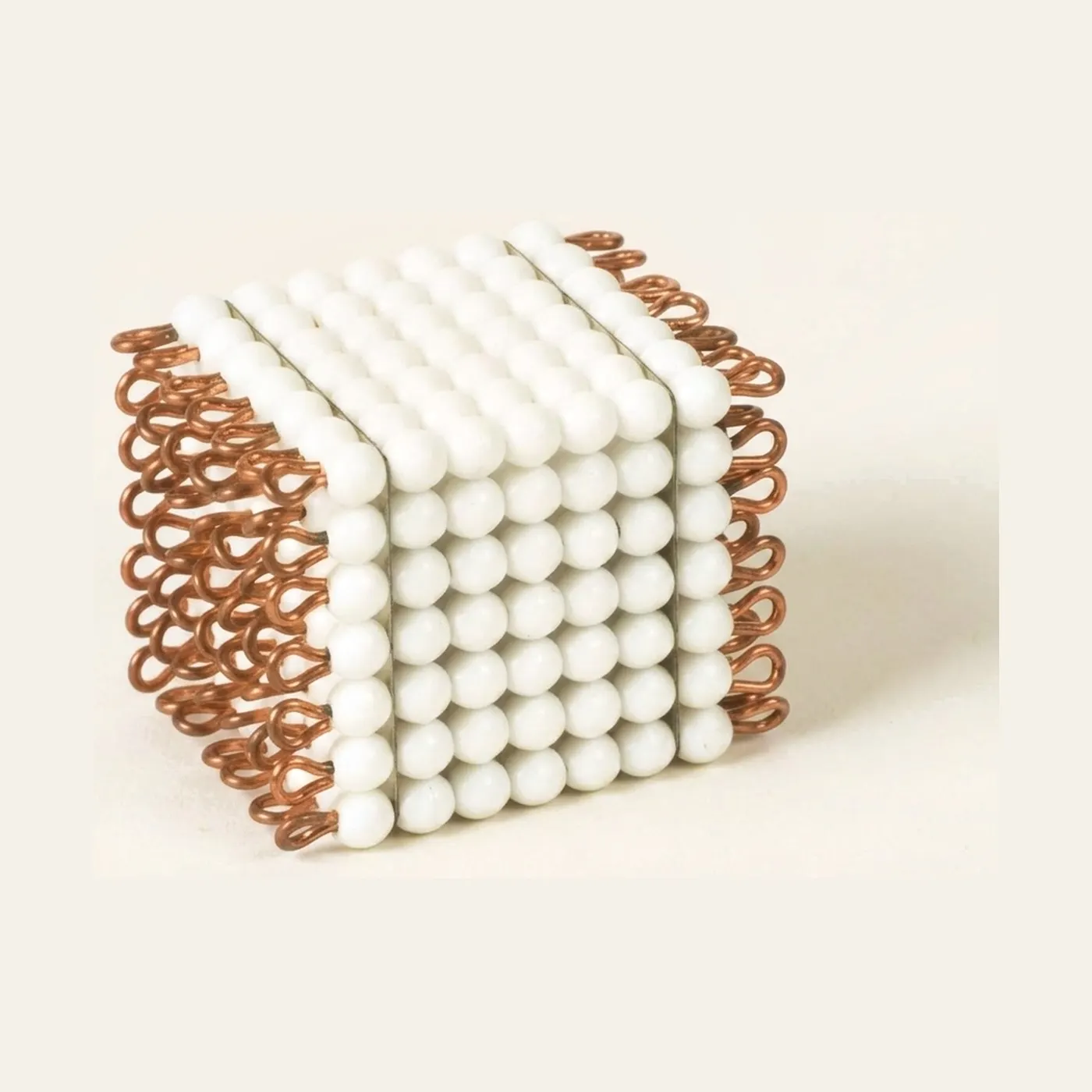
A strong fit for replacing or extending sets, this individual Glass Bead Cube of 7 represents the concrete manifestation of seven cubed (7³ = 343), essential for the child's mathematical abstraction journey in the Casa dei Bambini. The white glass beads strung on copper wire create a tangible representation of cubic numbers, bridging the gap between concrete sensorial experience and abstract mathematical concepts through the child's manipulation and exploration.
“The child is both a hope and a promise for mankind.”
The Individual Glass Bead Cube of 7 embodies Montessori's principle of materialized abstraction, where mathematical concepts become tangible through precisely crafted materials. This cube represents 343 individual beads, allowing the child to physically experience the weight, dimension, and reality of seven cubed.
- Concrete understanding of cubic numbers and the concept of 7³
- Development of mathematical imagination through three-dimensional visualization
- Preparation for advanced mathematical operations including cubing and cube roots
- Refinement of visual discrimination for dimension and proportion
Read More
Through sensorial exploration, children internalize mathematical relationships before formal operations are introduced. The material's beauty and precision appeal to the child's mathematical mind, fostering concentration and repetition. By handling this concrete representation, children build neural pathways that later support abstract thinking. The cube serves as a bridge between the sensorial and mathematical areas, demonstrating Montessori's integrated curriculum where materials in one area prepare the child for work in another.
How to present it
Follow the Montessori method of presentation for optimal child development.
Place the cube of 7 on a neutral-colored mat at the child's work table. Ensure adequate space for manipulation and comparison with other materials. Have the wooden cubes from the pink tower or brown stair available nearby for size comparison.
- 1
Invite the child to carry the cube with both hands, feeling its weight
Allow time for the child to appreciate the heft of 343 beads - this sensorial impression is crucial - 2
Explore the cube's dimensions by running fingers along each edge
Count the beads along one edge together: 1, 2, 3, 4, 5, 6, 7 - 3
Compare with the seventh cube of the pink tower if available
This connection reinforces the relationship between different materials - 4
Count the beads on one face: 7 x 7 = 49
Use slow, deliberate movements to maintain the child's focus - 5
Introduce the concept that the whole cube contains 7 x 7 x 7 beads
Let the child discover this through guided questioning rather than direct teaching
Every Child Is a Little Creator

Heritage
Since 1929

In classrooms
Around the world

European brands
Nienhuis, GAM, Educo

AMI approved
To the association standard
Glass Bead Cube of 7: White Individual Beads for 7³ Concept
