
Glass Bead Cube Of 8: Brown Individual Beads for Place Value
Made by Nienhuis Montessori · shipped by Heutink International (Netherlands) About the maker
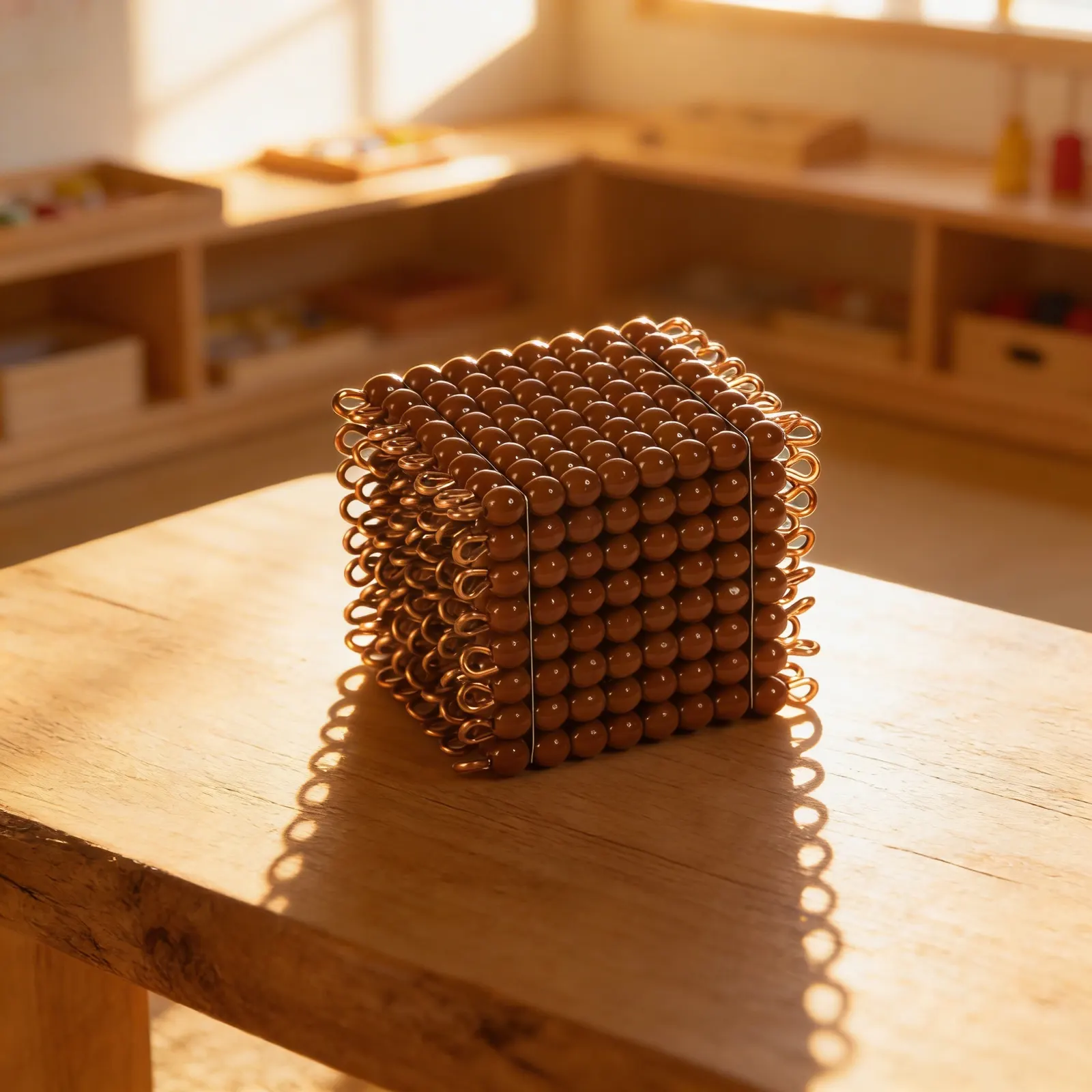
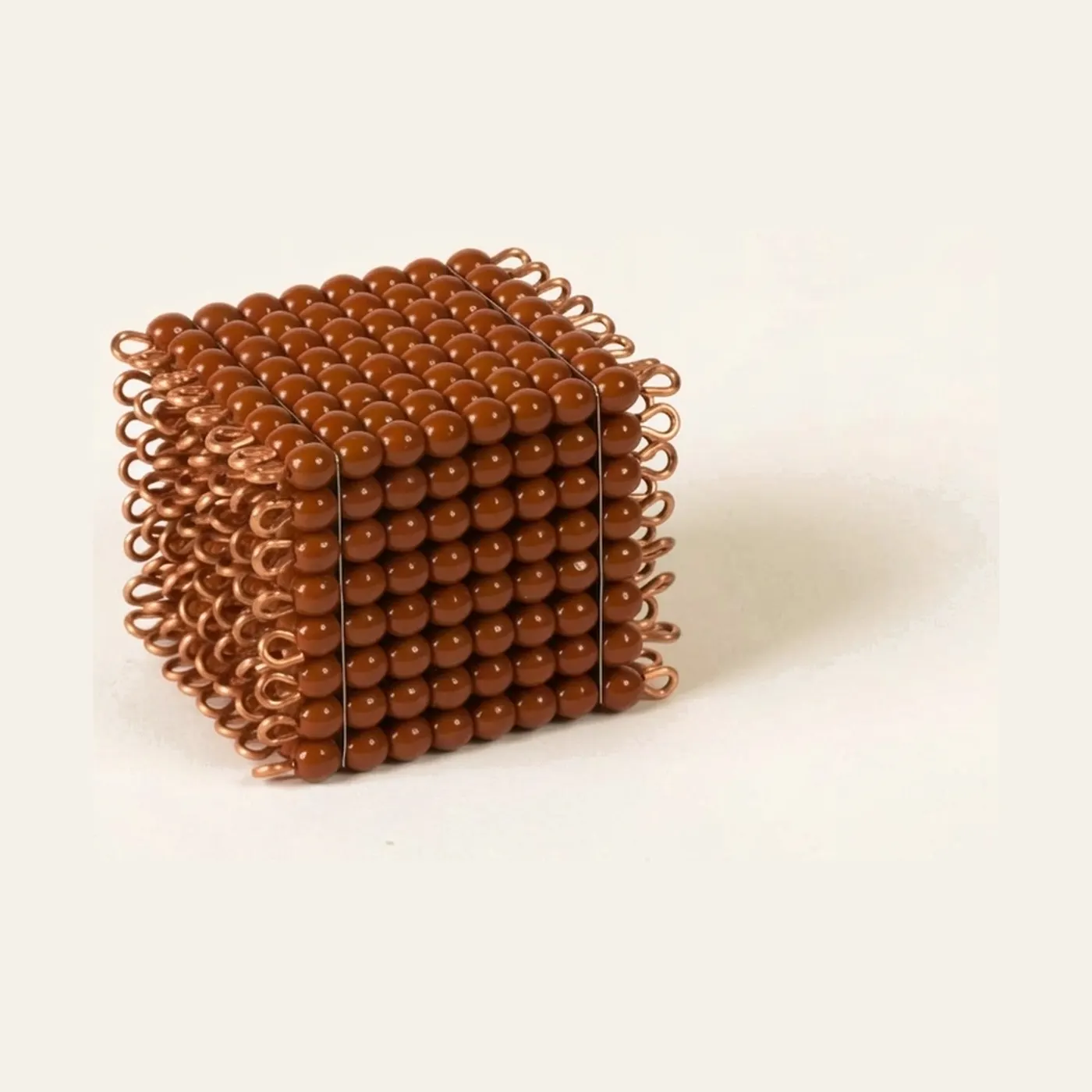
Available as a single replacement piece, this individual Glass Bead Cube of 8 represents 8³ (512) in concrete form, serving as a key component in the Montessori bead materials for understanding the decimal system and powers of numbers. The brown glass beads are precisely arranged in an 8×8×8 formation, connected by wire loops at each edge, letting young learners physically experience the concept of cubing and volumetric relationships through sensorial exploration.
“The child is both a hope and a promise for mankind.”
The Glass Bead Cube of 8 embodies Maria Montessori's principle of materialized abstraction, where mathematical concepts become tangible experiences. This sensorial material bridges concrete and abstract understanding, allowing the child to physically hold and examine 512 units arranged as 8³.
- Understanding of cubing as a three-dimensional multiplication concept
- Sensorial discrimination of weight and volume relationships
- Preparation for algebraic concepts and powers of numbers
- Development of spatial reasoning and geometric visualization
Read More
Through manipulation of this precisely crafted cube, children develop what Montessori called 'mathematical mind' - the human tendency to think in exact, ordered ways. The material's weight, texture, and visual impact create sensorial memories that support later abstract mathematical work. By providing a concrete representation of cubing, we honor the child's need to learn through movement and touch, following the progression from concrete to abstract that characterizes authentic Montessori mathematics education.
How to present it
Follow the Montessori method of presentation for optimal child development.
Place the cube on a mat with adequate space. Have the thousand cube nearby for comparison. Ensure clean hands and a prepared, quiet environment.
- 1
Invite the child to carry the cube with two hands, feeling its weight
Allow time for the child to experience the heft - this sensorial impression is crucial - 2
Place the cube on the mat and invite exploration of its structure
Guide attention to edges, vertices, and faces without over-explaining - 3
Count one edge together: 'One, two, three, four, five, six, seven, eight'
Use deliberate, slow counting to emphasize the quantity - 4
Introduce the language: 'This is eight cubed' or '8 times 8 times 8'
Keep language minimal and precise - avoid lengthy explanations - 5
If appropriate, count layers or rows to verify the total
This should only be done if the child shows readiness for skip counting
Every Child Is a Little Creator

Heritage
Since 1929

In classrooms
Around the world

European brands
Nienhuis, GAM, Educo

AMI approved
To the association standard
Glass Bead Cube Of 8: Brown Individual Beads for Place Value
