
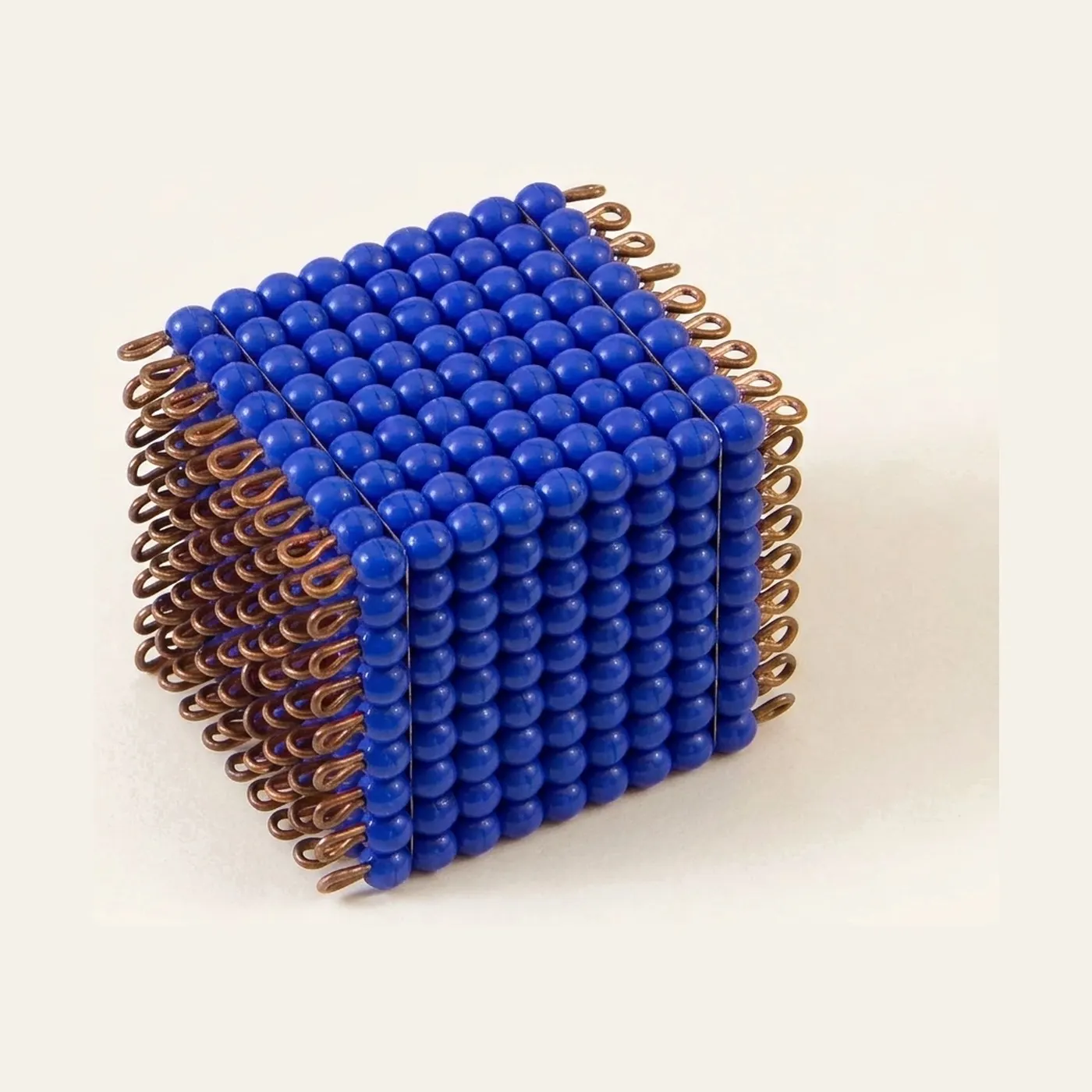
Glass Bead Cube of 9: Dark Blue Wire Frame Representing 729 Units
Made by Nienhuis Montessori · shipped by Heutink International (Netherlands) About the maker
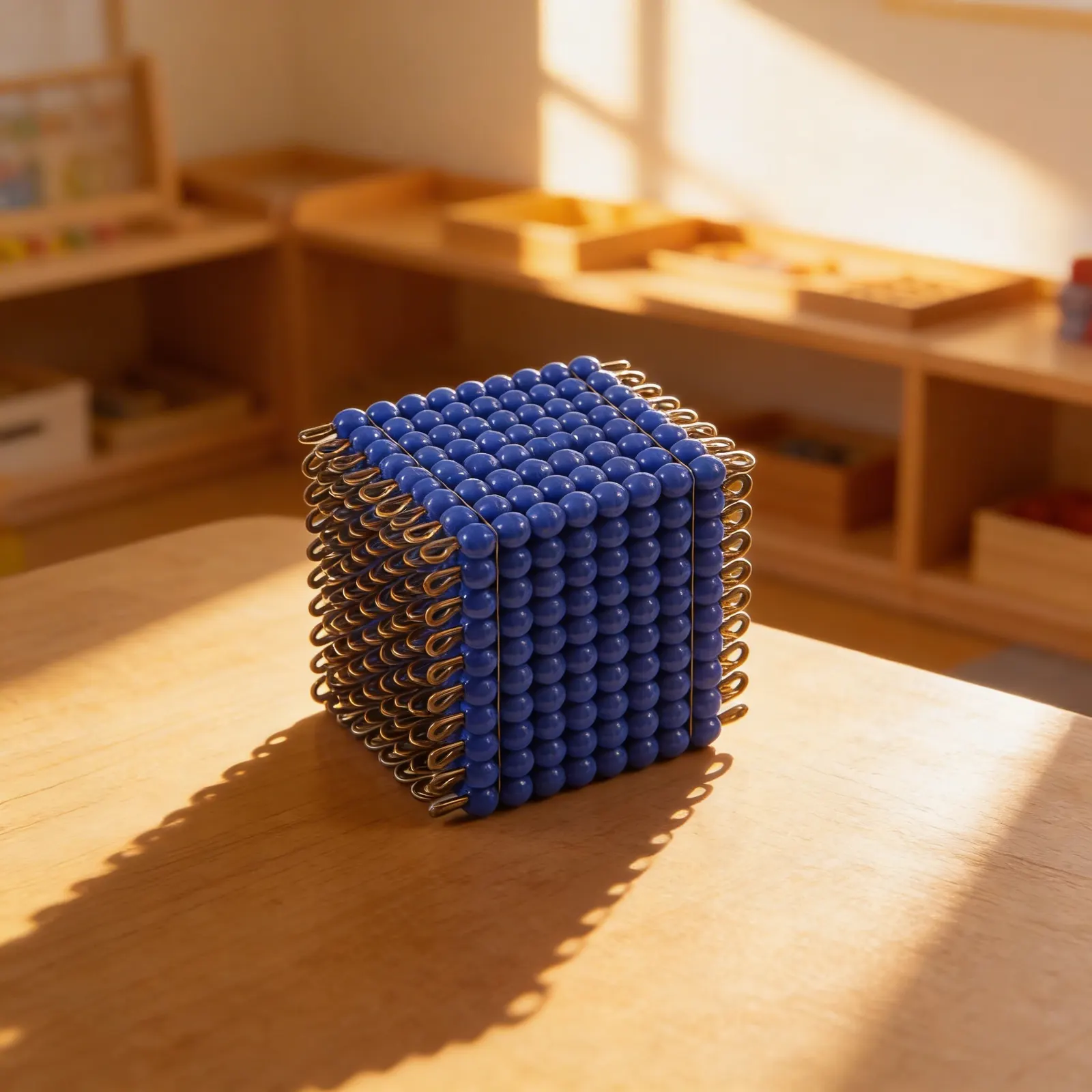
Nine bead bars of nine, held in a dark blue wire frame, making seven hundred and twenty nine as a solid object. A child who has built the square of nine can hold this and feel that the cube is the square taken nine times, which is the step where powers stop being notation. The frame matters: it keeps the cube rigid enough to be carried across a room and set beside the other cubes for comparison. Glass beads on wire, for ages 3 to 6.
“Children display a universal love of mathematics, which is par excellence the science of precision, order, and intelligence.”
The Glass Bead Cube of 9 embodies Montessori's principle of materialized abstraction, where complex mathematical concepts become tangible through precise sensorial experience.
- Understanding the concept of cubing through concrete manipulation
- Developing visual and tactile discrimination of three-dimensional forms
- Building foundation for later work with powers and exponents
- Strengthening concentration through careful observation and handling
Read More
This material bridges the concrete and abstract by allowing children to physically hold and examine 729 individual beads arranged as 9³. Through this sensorial exploration, children absorb the mathematical relationship between linear, square, and cubic dimensions before formally understanding these concepts. The material's beauty and precision appeal to the child's mathematical mind, fostering what Montessori called 'materialized abstractions.' The cube serves as a concrete representation that will later support the child's understanding of cubing in mathematics, demonstrating how sensorial experiences in early childhood lay the foundation for abstract thinking.
How to present it
Follow the Montessori method of presentation for optimal child development.
Place the cube on a neutral-colored mat at the child's workspace. Ensure clean hands for handling. Have the bead square of 9 and bead bar of 9 available for comparison if the child has worked with these materials.
- 1
Invite the child, saying 'I'd like to show you something special.' Carefully carry the cube with both hands to the mat.
Model reverent handling to convey the material's value and precision - 2
Place the cube gently on the mat. Sit to the child's right. Pause and observe the cube together in silence.
Allow time for visual impression before manipulation - 3
Slowly trace the edges of the cube with your index finger, following each dimension.
Use deliberate, slow movements to emphasize the three-dimensional nature - 4
Invite the child to feel the weight of the cube by carefully lifting it with both hands.
The weight provides sensorial feedback about quantity - 5
If appropriate, count one edge: '1, 2, 3, 4, 5, 6, 7, 8, 9.' Show how each edge has 9 beads.
Only count if the child shows interest; the primary experience is sensorial - 6
Return the cube to its designated place on the shelf with the same care.
Consistent placement supports the child's sense of order
Every Child Is a Little Creator

Heritage
Since 1929

In classrooms
Around the world

European brands
Nienhuis, GAM, Educo

AMI approved
To the association standard
Glass Bead Cube of 9: Dark Blue Wire Frame Representing 729 Units
