
Individual Glass Bead Square Of 3Pink
The first photo is the maker's own. The other shots are illustrative.
Inv. no. NIE-0086G023
- Maker
- Nienhuis Montessori, since 1929
- Approval
- AMI
- Beads
- Pink glass beads
- Wire
- Gold-toned metal wire
- EAN
- 8719924004859
Final price incl. VAT. Delivery €5.90, €141.40 to go for free delivery.
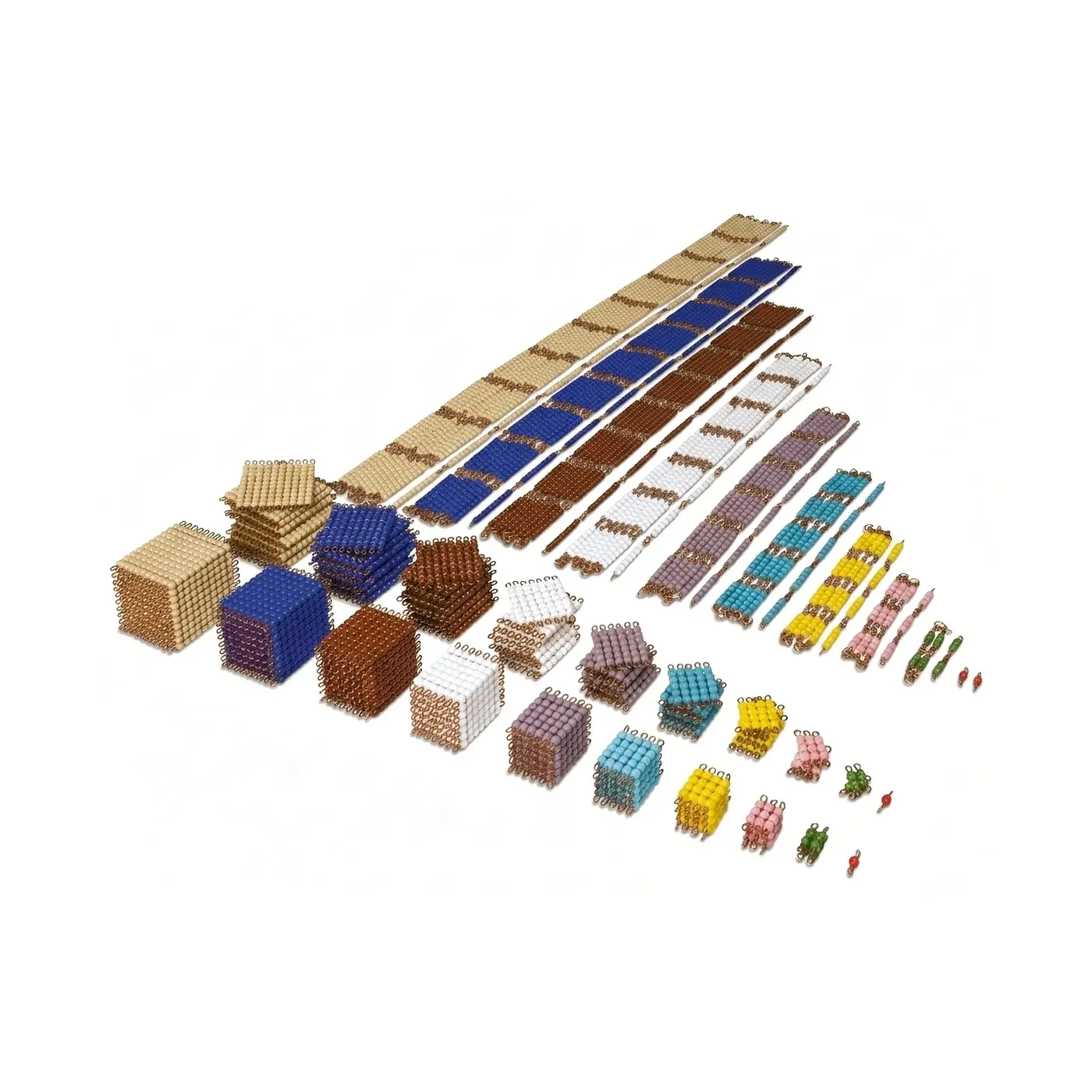 Individual Glass Beads €2,012.90
Advice, warranty and returns are handled by us.
Why it costs €7.60
Behind the price of the original are things you can check yourself.
AMI approval
The material is approved by the Association Montessori Internationale (AMI). Nienhuis has made Montessori materials since 1929.
A verifiable original
The EAN 8719924004859 is on the box. It is the maker's number, not ours.
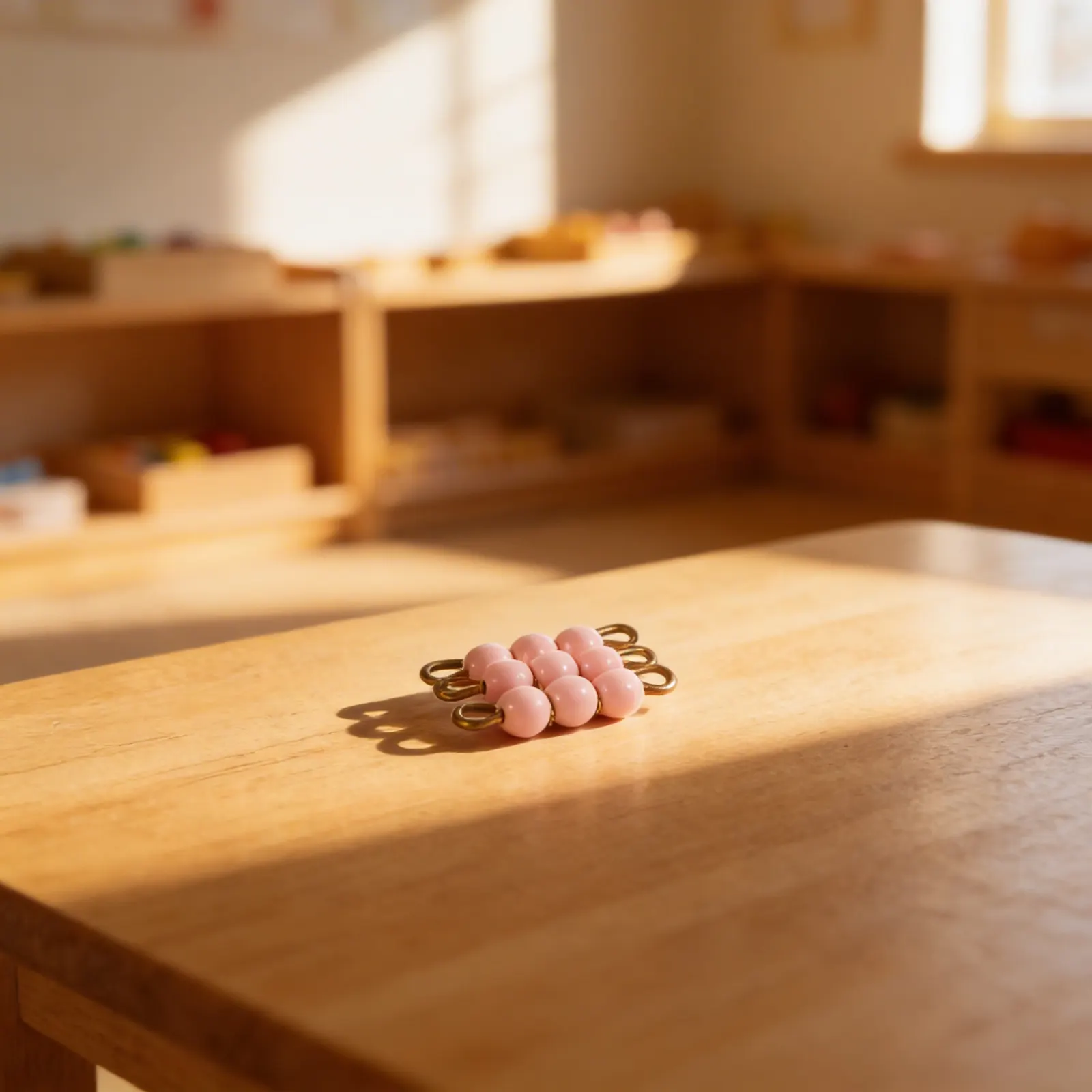
Individual Glass Bead Square Of 3 in a child's hands
The square of three in pink, a single glass bead square sold on its own. Nine beads, three chains of three, and it is small enough that a child can check the rule instead of believing it: count the beads, count the rows, see that three rows of three really do make nine. Squares get too big to verify quickly by the time you reach eight, so this is the one that earns the trust. Pink is three throughout the material. The nylon version is a separate item.
Mathematical Understanding
Provides concrete representation of squaring, helping children visualize that 3² means 3 groups of 3.
Pattern Recognition
The square formation helps children recognize geometric patterns and understand area concepts.
Preparation for Algebra
Introduces the concept of powers through manipulative materials before abstract notation.
Sensorial Learning
The tactile nature of counting and handling beads reinforces numerical concepts through touch.
How to present it
Place the pink glass bead square on a felt mat. Have individual beads and a bead tray nearby for exploration.
- 1Invite the child to count the beads along one edge of the square
- 2Count the beads along the perpendicular edge, noting both edges have three
- 3Count all nine beads systematically, row by row
- 4Introduce the language: 'This is three squared, or three times three'
- 5Have the child recreate the square using loose beads
3 tips for parents
- Look for square patterns in everyday life (floor tiles, windows) to reinforce the concept
- Create simple squared arrangements with household items like buttons or coins
- Support mathematical vocabulary by using terms like 'squared' in casual conversation when appropriate

If you are not sure it suits your child, we answer in person.
Norbert Kovalčín, founder of Faborino · write to him
There is no review here yet. We will ask you for one after you buy. Write the first review
What's in the Box
- Glass Bead Square: 3×3 arrangement (9 pink beads)
Size and material
| Packaging | 13 × 9 × 1 cm |
| Beads | Pink glass beads |
| Wire | Gold-toned metal wire |
| Recommended Age | 3-6 years |
Care
| Cleaning | Wipe gently with soft, dry cloth |
| Storage | Store flat to maintain square shape |
Frequently Asked Questions
What does the pink bead square of 3 represent mathematically?
The pink bead square visually represents 3² (three squared), showing that 3 x 3 = 9 through a concrete arrangement of 9 beads in a 3x3 formation. This helps children understand the concept of squaring numbers through hands-on manipulation.
How is this material used in the Montessori classroom?
Children use this square to explore squaring concepts concretely before moving to abstraction. It's typically introduced after children understand linear counting and is used alongside other bead squares to discover patterns in squared numbers and prepare for work with the bead chains and cubing materials.
What age is appropriate for introducing the bead square of 3?
While suitable for ages 3-6, this material is typically introduced around age 4-5, after children have mastered counting to 10 and have experience with the golden bead material. The exact timing depends on each child's individual development and readiness.
What other materials complement the pink bead square?
This square works with the complete set of bead squares (1-10), bead chains, bead cubes, and the bead cabinet. It also connects to the colored bead bars, hundred board, and later to the squaring and cubing chains for advanced mathematical exploration.
Why is the square specifically pink colored?
In Montessori mathematics, each number 1-10 has a specific color coding. Pink represents the number 3 throughout all bead materials, creating consistency that helps children recognize and work with the number 3 across different mathematical concepts and materials.
Product safety
Manufacturer: Nienhuis Montessori, Anders Celsiusstraat 15, 7442 PB Nijverdal, Netherlands
Individual Glass Bead Square Of 3