
Individual Glass Bead Square Of 8Brown
The first photo is the maker's own. The other shots are illustrative.
Inv. no. NIE-0086G028
- Maker
- Nienhuis Montessori, since 1929
- Approval
- AMI
- Beads
- Glass
- Connectors
- Metal wire
- EAN
- 8719924004903
Final price incl. VAT. Delivery €5.90, €128.10 to go for free delivery.
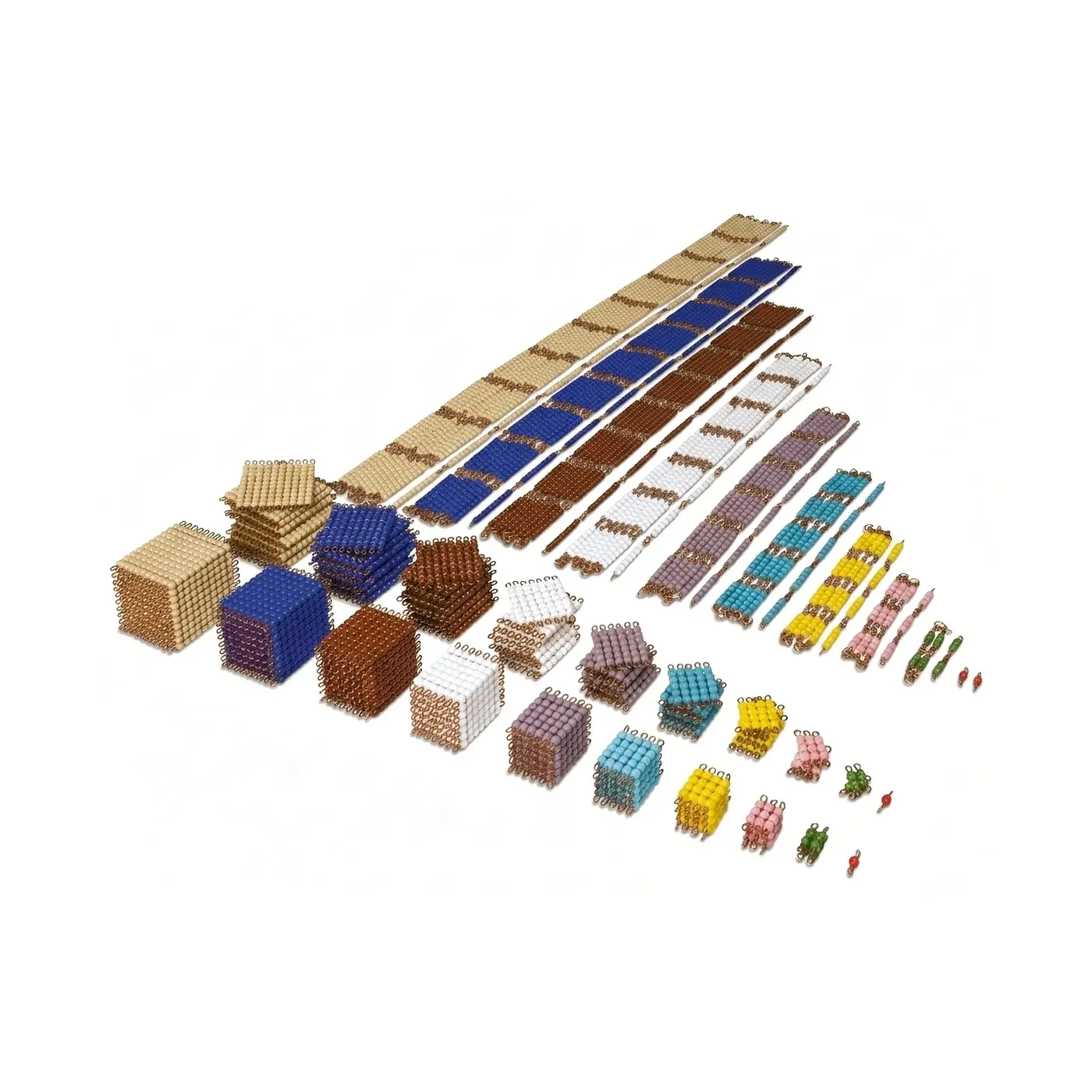 Individual Glass Beads €2,012.90
Advice, warranty and returns are handled by us.
Why it costs €20.90
Behind the price of the original are things you can check yourself.
AMI approval
The material is approved by the Association Montessori Internationale (AMI). Nienhuis has made Montessori materials since 1929.
A verifiable original
The EAN 8719924004903 is on the box. It is the maker's number, not ours.
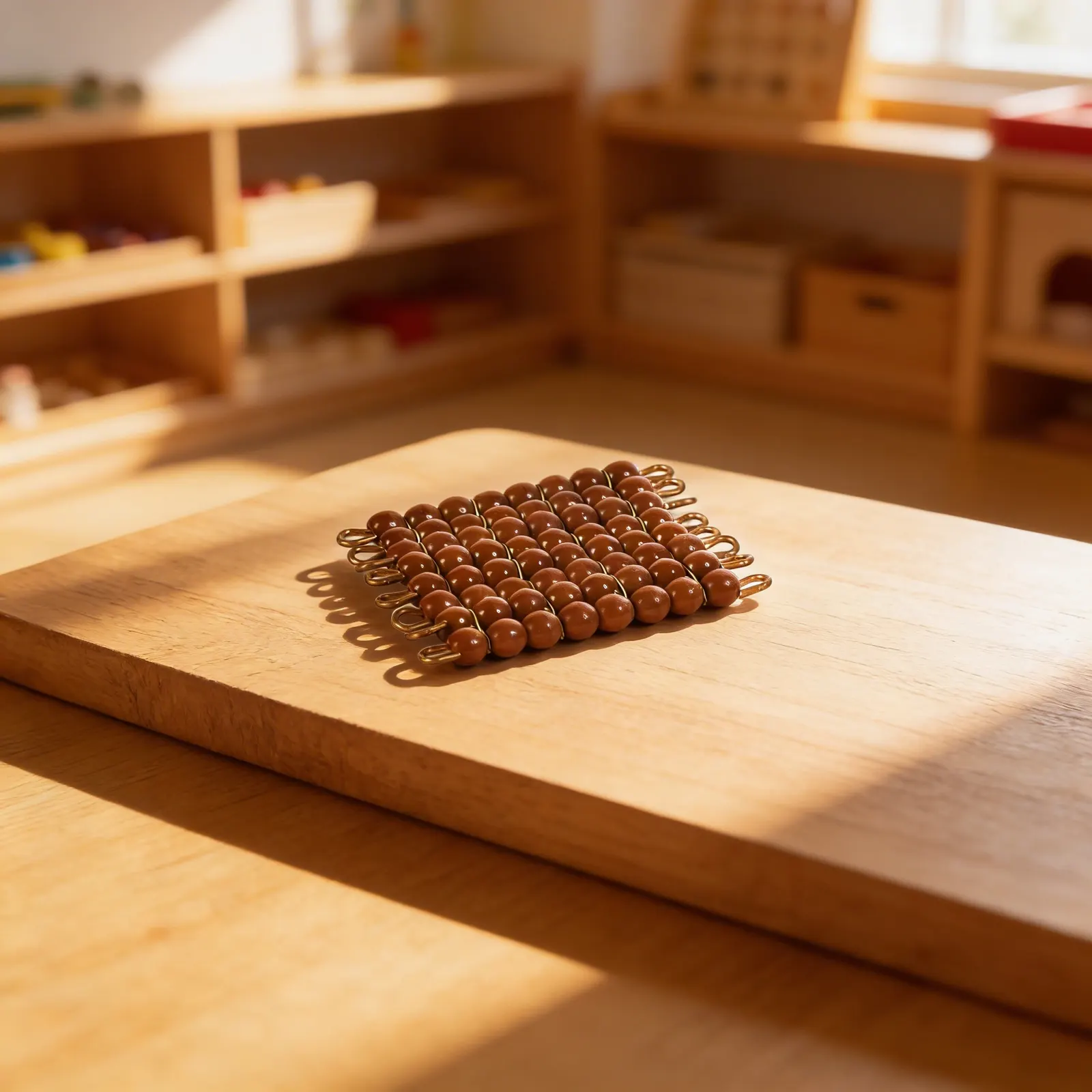
Individual Glass Bead Square Of 8 in a child's hands
A single square of eight: eight bead bars of eight wired flat into a sheet of sixty four beads, in the brown that stands for eight throughout the bead material. The square is the step where multiplication stops being a table to recite, because eight taken eight times becomes a shape with edges the child can count along. It is sold as an individual square, which is how a classroom replaces one that has been lost or builds up only the squares it uses. Glass beads on wire, for ages 3 to 6.
Mathematical Abstraction
Bridges concrete counting to abstract understanding of squared numbers through visual and tactile exploration.
Pattern Recognition
The square formation helps children recognize mathematical patterns and relationships between linear and squared quantities.
Fine Motor Coordination
Handling and counting individual beads refines pincer grasp and hand-eye coordination.
Concentration Development
Systematic counting and arranging of 64 beads builds sustained focus and attention to detail.
How to present it
Place the brown bead square on a work mat. Have a small tray nearby for any activities requiring bead movement. Ensure good lighting to appreciate the glass beads' clarity.
- 1Invite the child to carry the bead square with two hands to the work mat
- 2Count the beads along one wire bar: 'One, two, three... eight beads'
- 3Show that there are eight wire bars: 'Eight bars of eight beads each'
- 4Count by eights: '8, 16, 24, 32, 40, 48, 56, 64'
- 5Demonstrate the square shape by tracing the outline with your finger
3 tips for parents
- Practice skip counting by 8s during everyday activities to reinforce the concept
- Point out square shapes in the environment and relate to the bead square's form
- Support careful handling at home if child has similar materials by providing defined work spaces

If you are not sure it suits your child, we answer in person.
Norbert Kovalčín, founder of Faborino · write to him
There is no review here yet. We will ask you for one after you buy. Write the first review
What's in the Box
- Glass Bead Square: 8×8 formation (64 beads)
Size and material
| Packaging | 13 × 9 × 1 cm |
| Beads | Glass |
| Connectors | Metal wire |
| Recommended Age | 3-6 years |
Care
Wipe gently with dry cloth; avoid moisture
Frequently Asked Questions
What is the purpose of the Glass Bead Square of 8 in Montessori mathematics?
The Glass Bead Square of 8 helps children visualize and understand the concept of 8² (64) through concrete manipulation. It provides tactile and visual learning experiences that bridge the gap between concrete counting and abstract mathematical concepts, particularly in understanding squared numbers and skip counting by 8s.
How do children use this brown bead square in the classroom?
Children use the bead square for counting exercises, exploring multiplication patterns, and understanding the relationship between linear counting and squared numbers. They can physically touch and count the 64 beads arranged in an 8x8 formation, use it alongside other bead squares for comparison, and incorporate it into skip counting and multiplication activities.
What makes this individual bead square different from the complete bead cabinet?
This individual square allows for focused work with the number 8 and can be used as a replacement piece or for specific lessons without requiring the entire bead cabinet. It's ideal for classrooms that want to introduce squared number concepts gradually or need to replace a lost or damaged square from their existing materials.
At what age should children start working with the Glass Bead Square of 8?
While designed for ages 3-6, children typically begin working with bead squares around age 4-5, after they have mastered basic counting and have experience with the golden bead material. The child should be comfortable with numbers 1-10 and show interest in skip counting before introducing squared number concepts.
How does the brown color coding support learning?
In Montessori mathematics, brown represents the number 8 throughout all materials, creating consistency and visual memory aids. This color coding helps children recognize patterns across different mathematical materials and supports their understanding of the base-10 system and number relationships within the bead cabinet hierarchy.
Product safety
Manufacturer: Nienhuis Montessori, Anders Celsiusstraat 15, 7442 PB Nijverdal, Netherlands
Individual Glass Bead Square Of 8