
Bead Cube of 3: Pink Individual Nylon Cube for Mathematics
Made by Nienhuis Montessori · shipped by Heutink International (Netherlands) About the maker
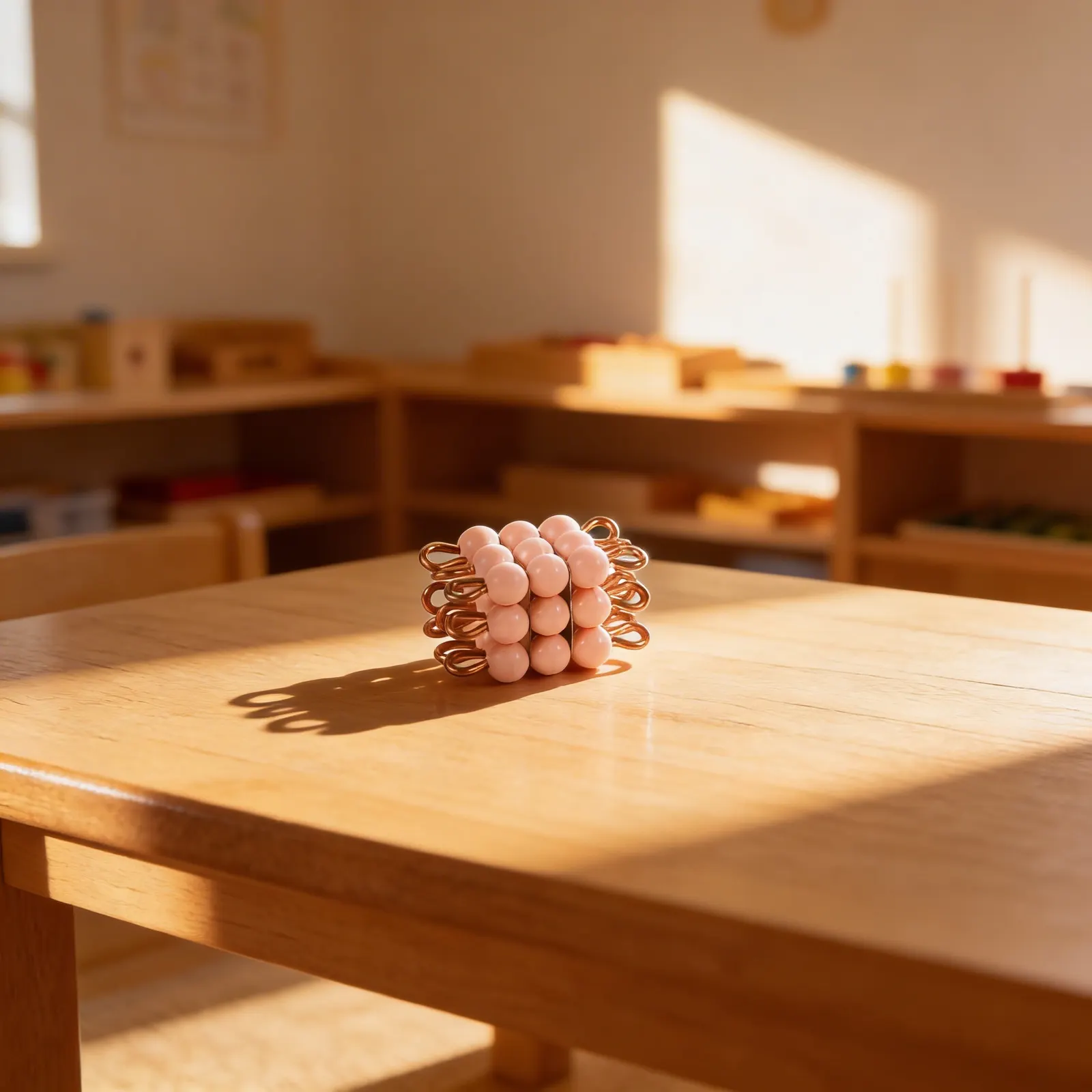
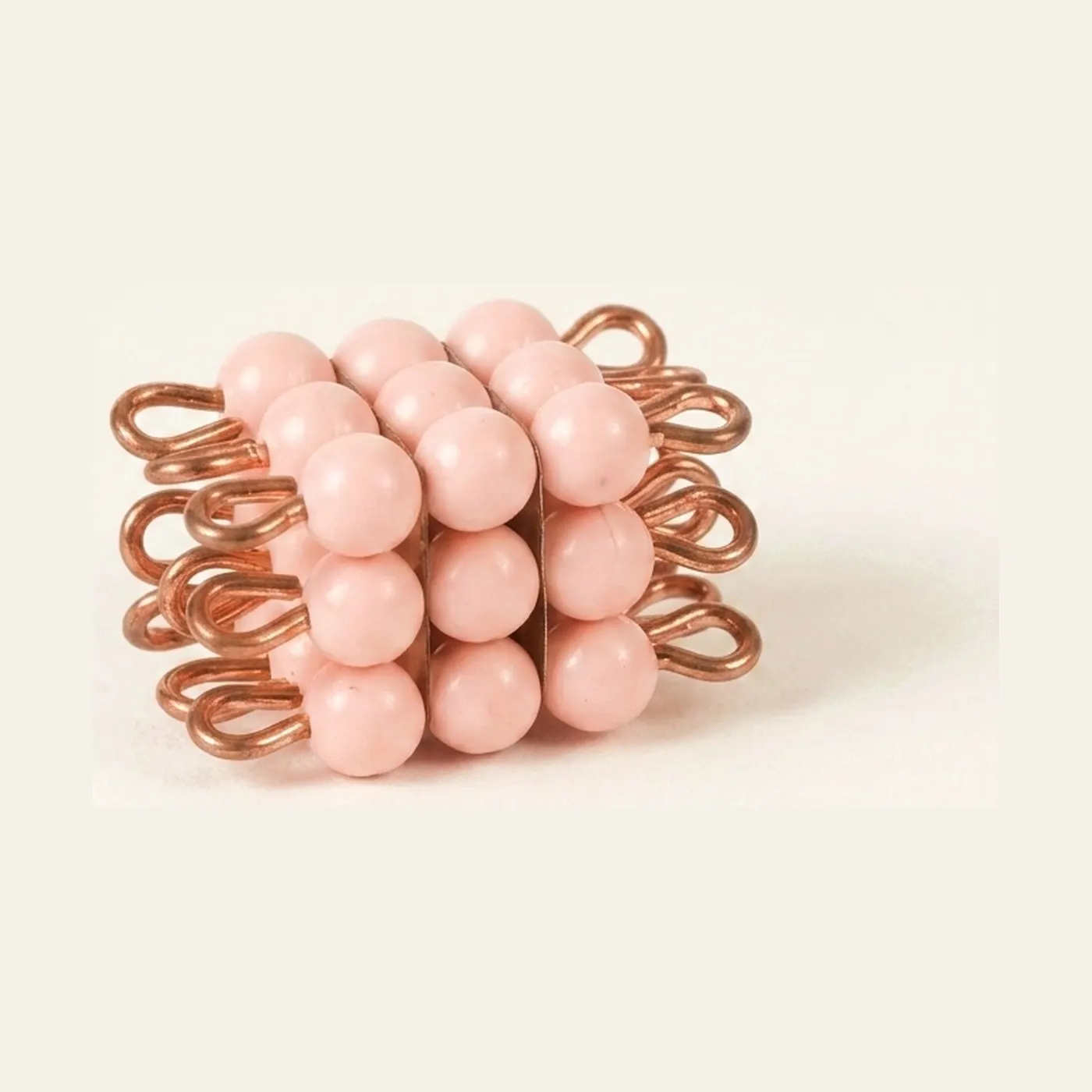
The cube of three in pink, a single nylon bead cube sold on its own. Pink is three throughout the bead material, so the colour names the number before anyone counts, and the cube is the third power made solid: a chain of three is a line, a square of three is flat, and this is that square stacked three times over, twenty seven beads a child can hold in one hand. Order in the bead type you already own, since the glass cubes are separate items.
“Free the child's potential, and you will transform him into the world.”
The Pink Bead Cube of 3 embodies Maria Montessori's principle of making abstract mathematical concepts concrete through manipulative materials. This sensorial material allows children to physically experience the concept of cubing through visual and tactile exploration.
- Understanding the concrete representation of 3³ through visual and tactile exploration
- Developing spatial reasoning by examining three-dimensional geometric forms
- Building foundation for later work with cubing and powers of numbers
- Strengthening fine motor control through careful handling of the bead structure
Read More
By holding and examining the cube, children internalize the relationship between linear, square, and cubic dimensions before formal mathematical instruction begins. The material's precise construction, 27 individual beads arranged in perfect cubic form, satisfies the child's need for order while developing mathematical intuition. The pink color designation follows the Montessori color-coding system, creating visual consistency across materials. This concrete representation of 3³ serves as a bridge between sensorial exploration and mathematical abstraction, preparing the mathematical mind through hands-on experience.
How to present it
Follow the Montessori method of presentation for optimal child development.
Place the pink bead cube on a neutral-colored mat. Ensure the child has previously worked with the pink tower and has experience with the number 3 in bead materials.
- 1
Invite the child to carry the cube with both hands to the mat
Demonstrate holding the cube by its wire loops to prevent bead displacement - 2
Place the cube gently on the mat and invite exploration through touch
Allow silent examination first, respecting the child's concentration - 3
Count the beads along one edge together: 'One, two, three'
Use slow, deliberate counting to emphasize each unit - 4
Show how 3 beads on each edge creates layers of 9 beads
Use your finger to trace each layer without disrupting the structure - 5
Connect to previous work by comparing with the third cube of the pink tower
Place materials side by side for visual comparison
Every Child Is a Little Creator

Heritage
Since 1929

In classrooms
Around the world

European brands
Nienhuis, GAM, Educo

AMI approved
To the association standard
Bead Cube of 3: Pink Individual Nylon Cube for Mathematics
