
Nylon Bead Cube of 8: Brown Cube for Mathematical Concepts
Made by Nienhuis Montessori · shipped by Heutink International (Netherlands) About the maker
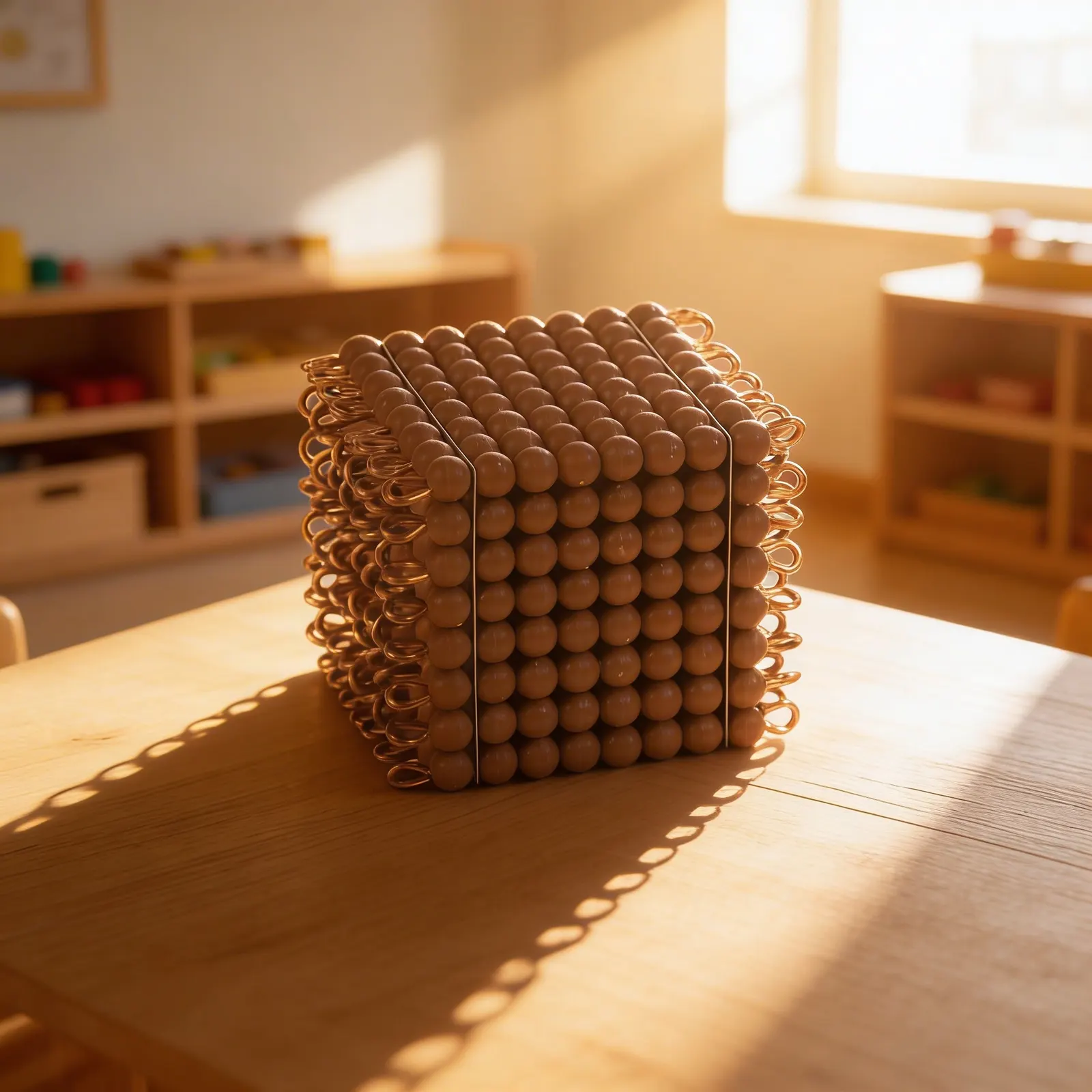
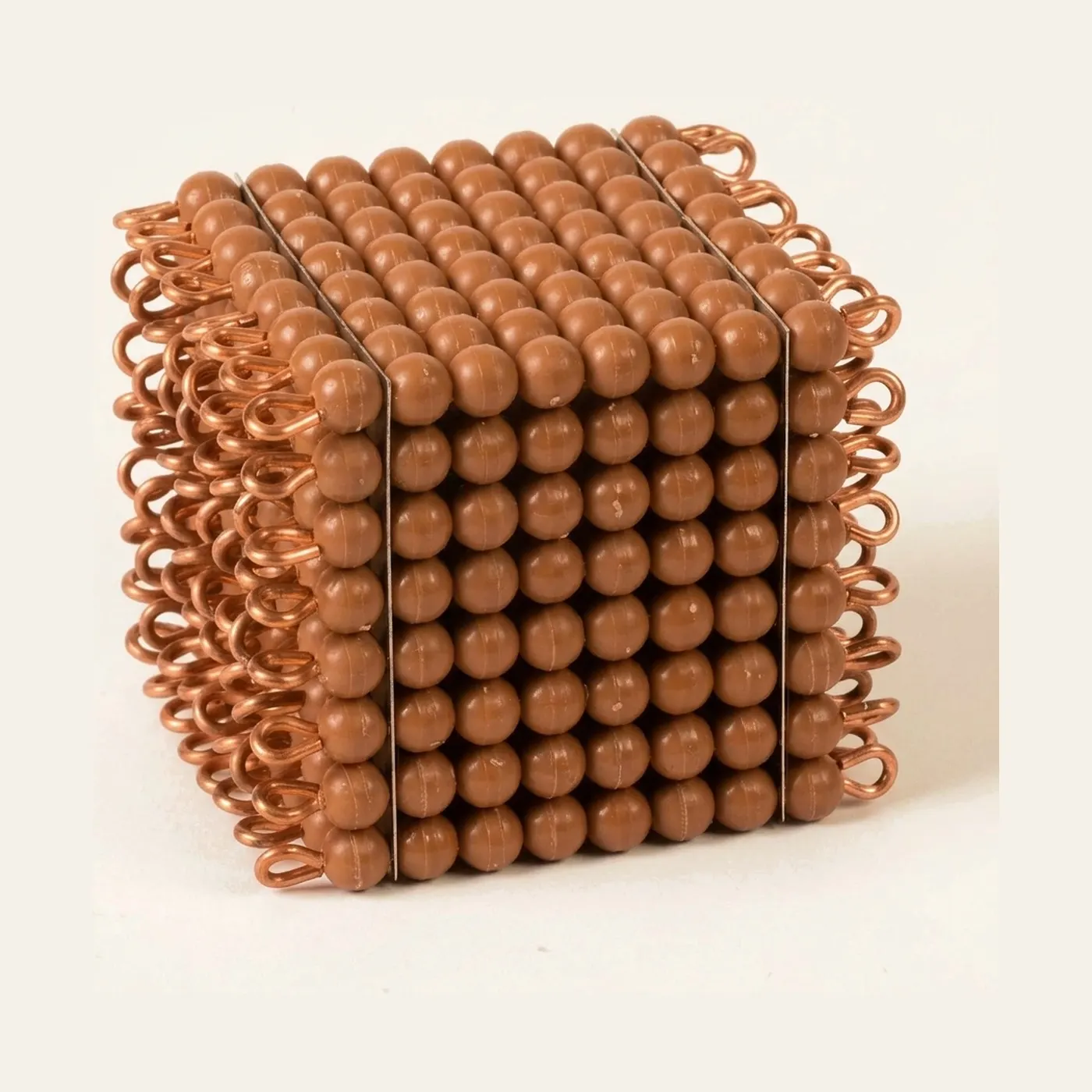
The cube of eight in brown nylon beads, eight bead squares of eight stacked and wired into a solid block of five hundred and twelve. Brown is the colour of eight throughout the bead material, so a child spots what this is across a room without counting. Held in one hand, the cube makes the third power something you feel rather than something you are told: it is heavy in a way the square of eight is not, and that weight is the argument. Nylon beads on wire, for ages 3 to 6.
“Education is a natural process spontaneously carried out by the human individual, and is acquired not by listening to words but by experiences upon the environment.”
The Individual Nylon Bead Cube of 8 embodies Montessori's principle of materialized abstractions, where mathematical concepts become tangible realities. This sensorial material bridges the concrete and abstract by allowing children to physically hold and explore the concept of 8³.
- Understanding cubic relationships through visual and tactile exploration of 8×8×8
- Developing spatial intelligence by examining three-dimensional geometric forms
- Building mathematical foundations for volume, cubing, and exponential growth
- Refining stereognostic sense through handling and comparing cubic materials
Read More
Through repetitive sensorial exploration, children internalize the relationship between linear, square, and cubic dimensions. The material's precision and beauty inspire concentration and mathematical wonder, while its weight and three-dimensional form provide crucial sensorial feedback. This concrete representation prepares the mathematical mind for later abstract work with cubing, supporting Montessori's vision of education as preparation for life through hands-on discovery.
How to present it
Follow the Montessori method of presentation for optimal child development.
Place the bead cube on a mat at the child's workspace. Ensure the Pink Tower and Brown Stair have been previously explored. Have the bead squares of 8 nearby for comparison.
- 1
Invite the child to carry the bead cube with two hands, feeling its weight
Emphasize slow, careful movements to appreciate the material's substantiality - 2
Place the cube on the mat and invite exploration through touch, examining all six faces
Allow extended sensorial exploration without rushing to count - 3
Count one edge: 1, 2, 3, 4, 5, 6, 7, 8 beads
Use deliberate pointing to each bead while counting - 4
Show how to count one face: 8 rows of 8 beads equals 64 beads
Count in groups of 8 to reinforce the pattern - 5
Explain that the cube has 8 layers of 64 beads: 8×8×8 = 512
Use hand gestures to indicate the layers - 6
Compare with the 8cm cube from the Pink Tower if available
Note the similarity in proportions despite different materials
Every Child Is a Little Creator

Heritage
Since 1929

In classrooms
Around the world

European brands
Nienhuis, GAM, Educo

AMI approved
To the association standard
Nylon Bead Cube of 8: Brown Cube for Mathematical Concepts
