
Dressing Frame: 3 Buttons: Yellow Gingham Fine Motor Practice
Made by Nienhuis Montessori · shipped by Heutink International (Netherlands) About the maker
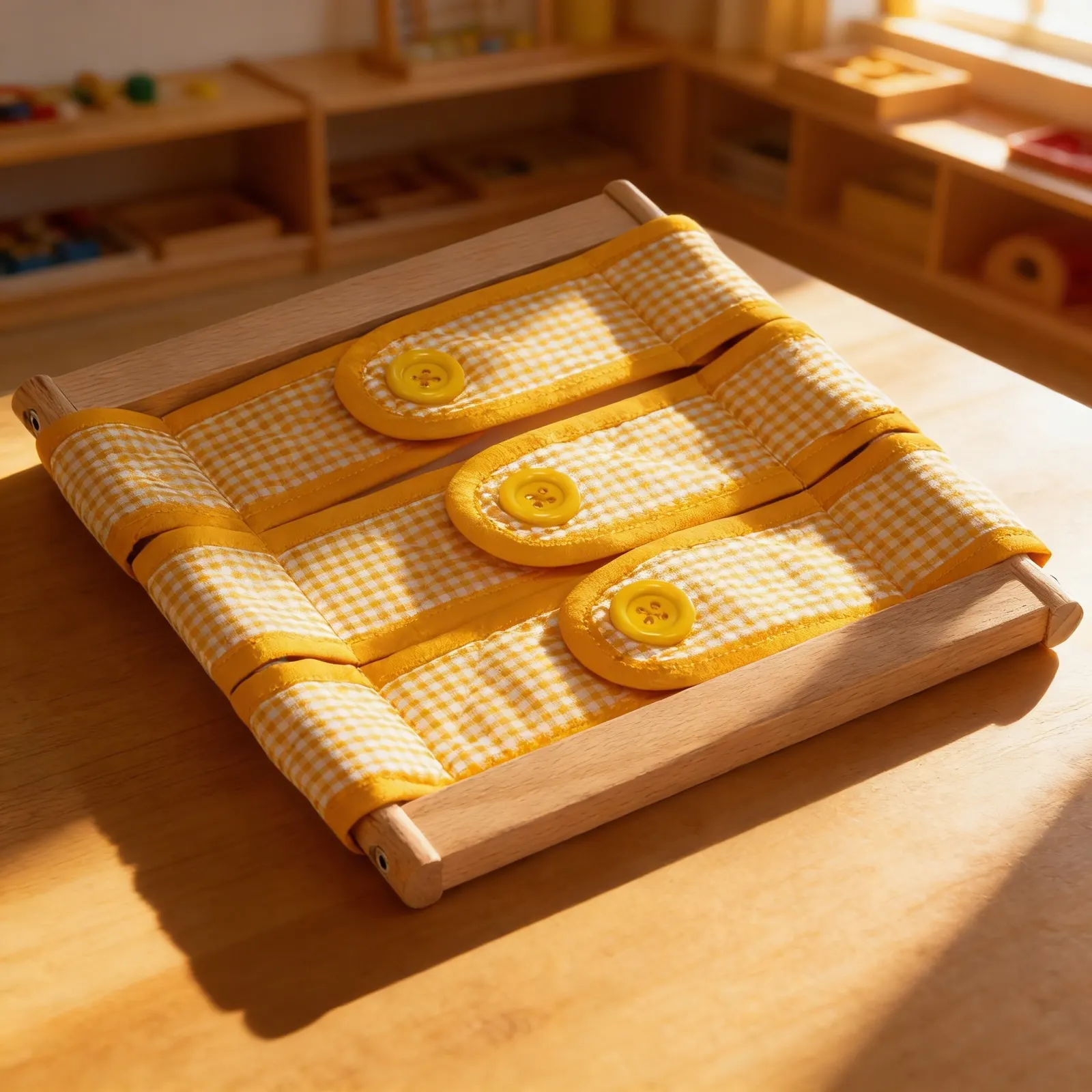
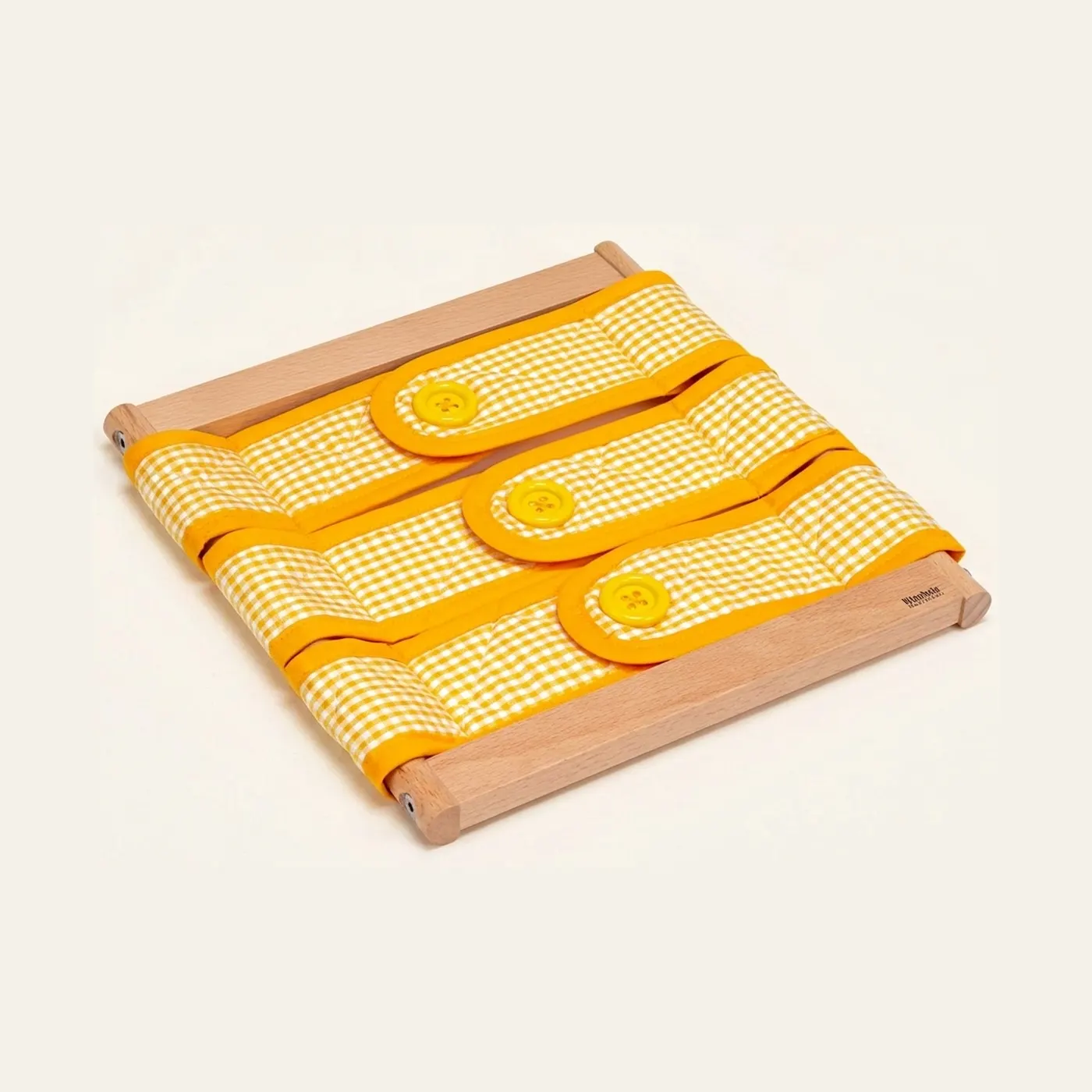
A dressing frame with three buttons in yellow gingham, built to the infant and toddler scale with rounded edges, removable washable fabric and fastenings a small hand can grasp. Buttons are the hardest of this group by some distance, because the two hands have to do different jobs at the same time: one holds the buttonhole open while the other pushes and then lets go and catches on the far side. Three of them is enough to learn on and few enough to finish. Wood, cotton blend and buttons, for ages 0 to 3.
“The greatest sign of success for a teacher is to be able to say, 'The children are now working as if I did not exist.'”
The Three-Button Dressing Frame embodies Maria Montessori's principle of 'Help me to do it myself' by isolating the buttoning skill in a manageable format for the youngest learners. This material respects the infant's natural drive toward independence and self-care, recognizing that even toddlers possess an innate desire to master the practical activities they observe in daily life.
- Development of pincer grasp and refined finger movements
- Strengthening of hand-eye coordination through precise manipulation
- Building concentration through repetitive, purposeful activity
- Fostering independence in self-care routines
Read More
The large buttons and curved flaps are specifically designed to match the developmental capabilities of children under three, honoring their need for appropriately-sized materials. By providing repeated opportunities for practice without the frustration of managing an entire garment, this frame builds confidence and refined hand movements. The isolation of difficulty, a key Montessori principle, allows the child to focus solely on the buttoning motion without the complexity of dressing themselves, preparing them for future independence in self-care.
How to present it
Follow the Montessori method of presentation for optimal child development.
Place the frame on a low table or mat at the child's working height. Ensure the buttons are unfastened with the flap open. Sit beside the child, not opposite, so they can observe your movements from the same perspective.
- 1
Demonstrate slowly grasping the top button between thumb and first two fingers
Exaggerate your pincer grasp slightly so the child can clearly see the finger positioning - 2
Hold the buttonhole area steady with your non-dominant hand
Move deliberately slowly, allowing the child to absorb each micro-movement - 3
Guide the button through the hole with a gentle pushing-pulling motion
If the button gets stuck halfway, show how to wiggle it gently rather than forcing it - 4
Smooth down the fabric once buttoned to show completion
This final gesture provides closure and reinforces the sense of accomplishment - 5
Repeat for remaining buttons, working from top to bottom
Maintain the same slow, deliberate pace throughout the demonstration
Every Child Is a Little Creator

Heritage
Since 1929

In classrooms
Around the world

European brands
Nienhuis, GAM, Educo

AMI approved
To the association standard
Dressing Frame: 3 Buttons: Yellow Gingham Fine Motor Practice
