
Inscribed And Concentric FiguresPlastic
The first photo is the maker's own. The other shots are illustrative.
Inv. no. NIE-004550
- Maker
- Nienhuis Montessori, since 1929
- Approval
- AMI
- Box
- Birch plywood and beech
- Shapes
- Plastic
- EAN
- 8719924002565
Final price incl. VAT. Delivery €5.90, €92.10 to go for free delivery.
Advice, warranty and returns are handled by us.
Why it costs €56.90
Behind the price of the original are things you can check yourself.
AMI approval
The material is approved by the Association Montessori Internationale (AMI). Nienhuis has made Montessori materials since 1929.
A verifiable original
The EAN 8719924002565 is on the box. It is the maker's number, not ours.
Inscribed And Concentric Figures in a child's hands
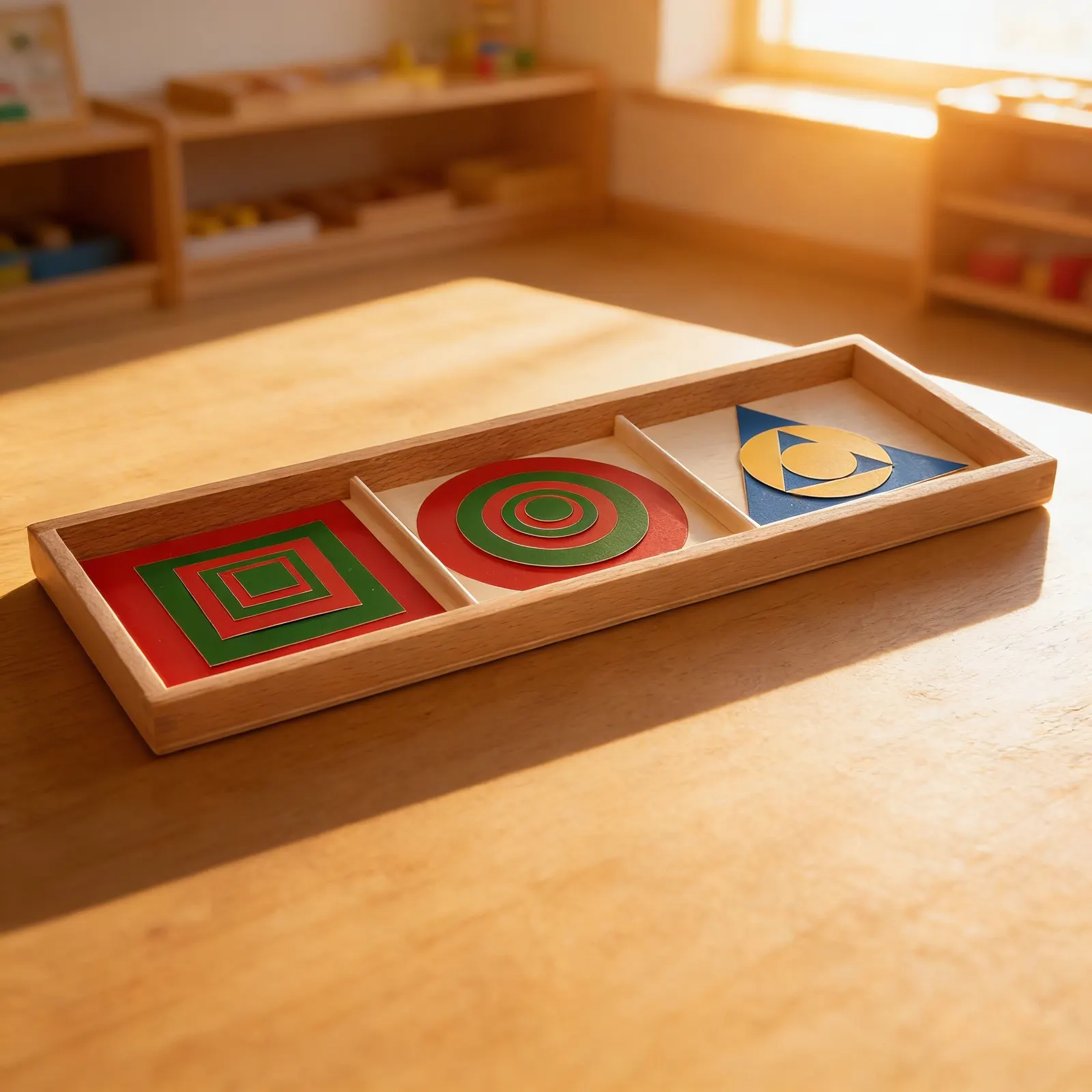
Inscribed and Concentric Figures in plastic: a wooden box with a lid and three compartments, holding graded circles, graded squares and a variation with triangles. Concentric means a shared centre, inscribed means touching from the inside, and these are two different things that words do not separate. In the hand they separate at once: the circles keep the same gap between them all the way round, while a triangle touches the other shape at only three points. Plastic is lighter than metal, so younger children can work with the material too. For children aged 3 to 6.
Visual Discrimination
Distinguishing between sizes and shapes refines perception skills crucial for reading and mathematics.
Geometric Concepts
Hands-on exploration of concentric shapes introduces fundamental geometry principles through concrete manipulation.
Fine Motor Control
Precise placement of nested pieces develops pincer grip and hand-eye coordination.
Concentration
Repeatedly placing the graded shapes encourages sustained focus and problem-solving persistence.
How to present it
Place the wooden box with its lid on a work mat and open it. Sit to the child's right if you are right-handed, or to their left if left-handed.
- 1Take all the shapes out of one compartment and place them randomly on the mat
- 2Select the largest shape and trace its edge with your index finger
- 3Place the next smaller shape inside the largest one
- 4Continue with progressively smaller shapes, nesting each inside the previous
- 5Invite the child to try another set of shapes
3 tips for parents
- Look for concentric patterns in everyday life - onion layers, nested bowls, Russian dolls
- Practice the vocabulary during daily activities: 'The small pot nests inside the large one'
- Allow repetition without suggesting the child move on - mastery comes through practice

If you are not sure it suits your child, we answer in person.
Norbert Kovalčín, founder of Faborino · write to him
There is no review here yet. We will ask you for one after you buy. Write the first review
What's in the Box
- Wooden box with lid: 3 compartments, birch plywood and beech
- Graded circles: 6 plastic circles, green on one side, red on the other
- Graded squares: 6 plastic squares, green on one side, red on the other
- Triangles and circles: 2 graded triangles and 2 graded circles, blue on one side, yellow on the other
Size and material
| Packaging | 35 × 12 × 2 cm |
| Box | Birch plywood and beech |
| Shapes | Plastic |
| Recommended Age | 3-6 years |
Care
Wipe with damp cloth, dry immediately
Frequently Asked Questions
What age is the Inscribed and Concentric Figures material suitable for?
This material is designed for children ages 3-6 years old, aligning with the Montessori sensorial curriculum for the primary classroom.
What shapes are included in this set?
The box with a lid has three compartments holding 6 graded circles and 6 graded squares (green on one side, red on the other), and 2 graded triangles with 2 graded circles (blue on one side, yellow on the other). The shapes are plastic; the box is birch plywood and beech.
How does this material support mathematical development?
Children develop visual discrimination, size relationships, and spatial awareness through hands-on exploration of nested shapes, building foundational concepts for geometry, measurement, and mathematical reasoning.
What skills do children develop using these concentric figures?
Children develop fine motor control, hand-eye coordination, visual perception, concentration, and problem-solving skills while learning to distinguish between different sizes and understand the concept of shapes fitting within shapes.
How do I present this material to a child?
Begin by showing how to carefully remove each piece from largest to smallest, then demonstrate replacing them in order. Use precise language like 'large,' 'medium,' 'small' and allow the child to explore independently after the initial presentation.
Product safety
Manufacturer: Nienhuis Montessori, Anders Celsiusstraat 15, 7442 PB Nijverdal, Netherlands
Inscribed And Concentric Figures