
Introduction To Decimal Symbol (Nienhuis)
The first photo is the maker's own. The other shots are illustrative.
Inv. no. NIE-025100
- Maker
- Nienhuis Montessori, since 1929
- Approval
- AMI
- Tray
- Natural wood with smooth finish
- Cards
- Laminated cardstock
- EAN
- 8719924011925
Final price incl. VAT. Delivery €5.90, €115.10 to go for free delivery.
Advice, warranty and returns are handled by us.
Why it costs €33.90
Behind the price of the original are things you can check yourself.
AMI approval
The material is approved by the Association Montessori Internationale (AMI). Nienhuis has made Montessori materials since 1929.
A verifiable original
The EAN 8719924011925 is on the box. It is the maker's number, not ours.
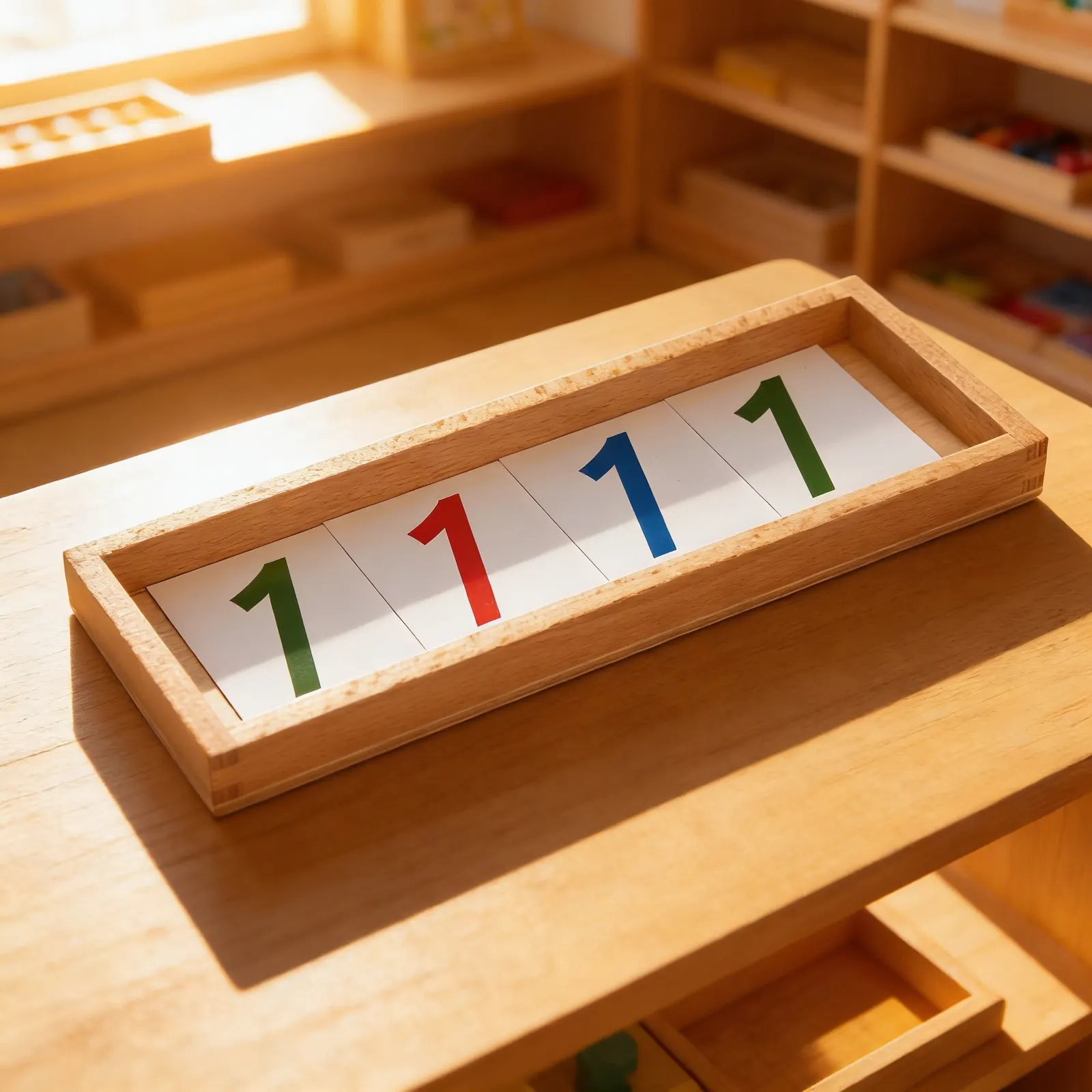
Introduction To Decimal Symbol (Nienhuis) in a child's hands
A wooden box of plastic number cards for introducing the values one, ten, a hundred and a thousand. Four cards is the whole decimal system in its shortest form, and meeting the symbols on their own, before any beads are counted out, gives a child something to attach the quantities to. The jump in size on the page from 1 to 1000 is also the first honest warning that these are not four numbers of similar weight. Plastic and wood, for ages 3 to 6.
Place Value Understanding
Children grasp that the position of a digit determines its value, building foundation for decimal system comprehension.
Visual Discrimination
Color-coding helps children distinguish between place values, supporting visual memory and pattern recognition.
Mathematical Abstraction
Bridges concrete number work with abstract decimal concepts, preparing for advanced mathematical thinking.
How to present it
Place the wooden tray on a mat. Arrange cards by category: green units (1-9), blue tens (10-90), red hundreds (100-900), and green thousands (1000-9000). Ensure each category is clearly separated in its compartment.
- 1Introduce unit cards 1-9, naming each as you place them in sequence
- 2Present tens cards (10-90), showing how the zero indicates 'ten' value
- 3Display hundreds cards (100-900), emphasizing the two zeros
- 4Show thousands cards (1000-9000), noting three zeros for thousand place
- 5Build a four-digit number by layering cards: place 3000, add 500, then 40, finally 7
- 6Read the complete number: 'three thousand, five hundred, forty-seven'
- 7Invite child to build specific numbers using the layering technique
3 tips for parents
- Practice reading house numbers or prices using place value language: 'That's 2 hundreds, 4 tens, and 5 units for 245'
- Point out digital clocks and help identify the place value of each digit
- When counting collections at home, group by tens to reinforce decimal organization

If you are not sure it suits your child, we answer in person.
Norbert Kovalčín, founder of Faborino · write to him
There is no review here yet. We will ask you for one after you buy. Write the first review
What's in the Box
- Wooden storage tray: With recessed compartment
- 4 number cards: Each showing '1' in different colors
Size and material
| Packaging | 24 × 9 × 2 cm |
| Tray | Natural wood with smooth finish |
| Cards | Laminated cardstock |
| Recommended Age | 3-6 years |
Care
Wipe tray with damp cloth, clean cards with dry cloth
Frequently Asked Questions
What age is the Introduction to Decimal Symbol material suitable for?
This material is designed for children ages 3-6 in the Montessori Casa/Primary environment. It introduces foundational decimal concepts that prepare children for more advanced decimal work in Elementary.
What does this material include?
The material includes color-coded number cards stored in a wooden tray. The cards demonstrate place value through the Montessori color-coding system (green for units, blue for tens, red for hundreds) showing how the digit '1' represents different values.
How does this material teach decimal place value?
Children learn that the position of a digit determines its value. Through hands-on manipulation of the color-coded cards, they discover that '1' can represent 1 unit, 10 (1 ten), 100 (1 hundred), etc., establishing the hierarchical nature of our decimal system.
What prerequisites should children have before using this material?
Children should have experience with the golden bead material and understand quantities 1-9. Familiarity with the decimal system through other Montessori math materials helps children grasp the abstract concept of place value more easily.
How does this material prepare children for future learning?
This material lays the groundwork for understanding large numbers, decimal operations, and the base-ten system. It directly prepares children for the stamp game, bead frames, and eventual work with decimals and fractions in Elementary.
Product safety
Manufacturer: Nienhuis Montessori, Anders Celsiusstraat 15, 7442 PB Nijverdal, Netherlands
Introduction To Decimal Symbol (Nienhuis)