
Introduction To The Decimal SystemIndividual Beads Glass
The first photo is the maker's own. The other shots are illustrative.
Inv. no. NIE-0252G0
- Maker
- Nienhuis Montessori, since 1929
- Approval
- AMI
- Beads
- Golden glass
- Wire
- Metal
- EAN
- 8719924011949
Final price incl. VAT. Free delivery.
Advice, warranty and returns are handled by us.
Why it costs €452.90
Behind the price of the original are things you can check yourself.
AMI approval
The material is approved by the Association Montessori Internationale (AMI). Nienhuis has made Montessori materials since 1929.
A verifiable original
The EAN 8719924011949 is on the box. It is the maker's number, not ours.
Introduction To The Decimal System in a child's hands
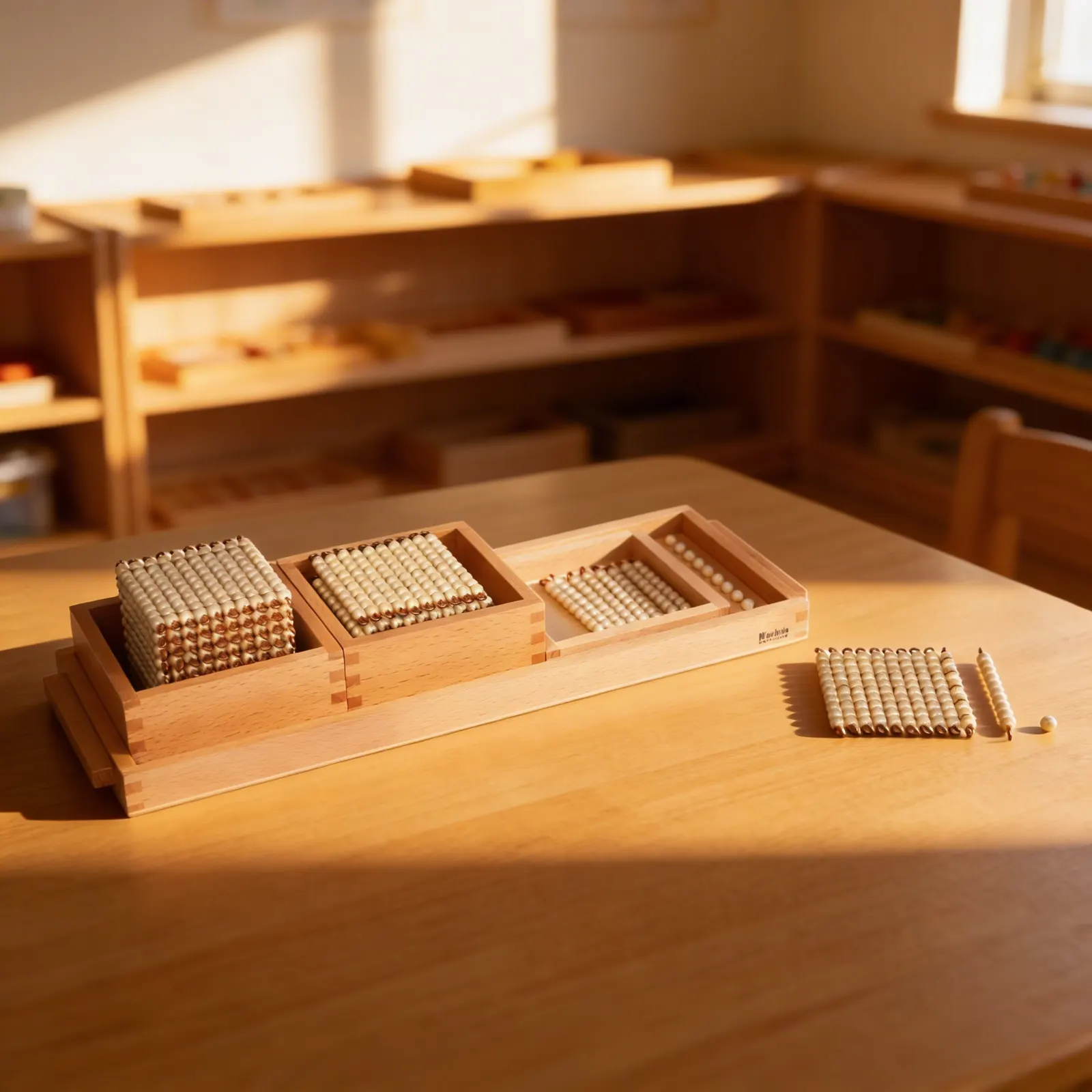
A high-quality addition to any environment, this Introduction to Decimal System material features lustrous golden glass beads meticulously arranged in a multi-compartment wooden tray, providing concrete representations of units, tens (bars), hundreds (squares), and thousands (cubes). The glass beads on metal wire offer exceptional durability and a satisfying weight that helps children internalize the hierarchical nature of our decimal system through sensorial exploration.
Concrete to Abstract Thinking
Physical manipulation of beads builds foundational understanding of place value and the base-ten system.
Mathematical Mind Development
Hierarchical bead arrangements support pattern recognition and systematic thinking essential for advanced mathematics.
Sensorial Discrimination
The weight and visual differences between units, tens, hundreds, and thousands enhance mathematical comprehension through multiple senses.
How to present it
Place the wooden tray on a work mat. Ensure all glass beads are properly arranged: individual unit beads in one compartment, ten-bars in another, hundred-squares and thousand-cube in their designated spaces.
- 1Introduce the unit bead, letting the child hold one golden glass bead
- 2Present the ten-bar, counting each bead while running fingers along it
- 3Show the hundred-square, demonstrating it contains ten ten-bars
- 4Present the thousand-cube, showing how ten hundred-squares stack to form it
- 5Practice exchanging: ten units for one ten-bar, ten bars for one hundred-square
3 tips for parents
- Practice counting objects at home in groups of ten to reinforce the decimal grouping concept
- Point out real-world examples of tens (fingers, toes) and hundreds (pennies in a dollar)
- Avoid rushing to written numbers - the physical understanding must come first

If you are not sure it suits your child, we answer in person.
Norbert Kovalčín, founder of Faborino · write to him
There is no review here yet. We will ask you for one after you buy. Write the first review
What's in the Box
- Wooden storage tray: With four compartments
- Unit beads: Individual golden glass beads
- Ten bars: 10-bead bars on metal wire
- Hundred squares: 100-bead squares on wire
- Thousand cube: 1000-bead cube formation
Size and material
| Packaging | 40 × 13 × 9 cm |
| Beads | Golden glass |
| Wire | Metal |
| Tray | Natural wood |
| Recommended Age | 3-6 years |
Care
Wipe wooden tray with damp cloth; handle glass beads gently
Frequently Asked Questions
What makes glass beads superior to plastic beads for teaching the decimal system?
Glass beads provide superior sensorial feedback through their weight and cool temperature, helping children better internalize mathematical concepts. The lustrous golden finish and satisfying heft of glass beads create a more impressive and memorable learning experience, while their durability ensures they maintain their beauty through years of classroom use.
How do children progress from individual beads to more abstract mathematical concepts?
Children begin by handling and counting individual unit beads, then explore ten-bars, hundred-squares, and thousand-cubes. This concrete manipulation builds a strong sensorial foundation for place value. As they work with the material, they naturally discover patterns and relationships, eventually transitioning to written numbers and abstract operations while maintaining their concrete understanding.
What specific mathematical concepts can be taught with this decimal system material?
This material introduces place value, the hierarchical nature of the decimal system, and the relationship between units, tens, hundreds, and thousands. Children learn counting, skip counting, building large numbers, decomposing numbers, and the foundation for all four mathematical operations through hands-on exploration and manipulation.
Why is this material recommended for ages 3-6 when decimal concepts seem advanced?
Montessori recognizes that young children have remarkable mathematical minds when concepts are presented concretely. The glass beads allow 3-6 year olds to physically handle and see quantities, making abstract concepts tangible. This age represents a sensitive period for order and precision, making it ideal for introducing the systematic nature of our number system.
How should teachers present this material to maximize learning outcomes?
Begin with a three-period lesson introducing unit, ten-bar, hundred-square, and thousand-cube. Allow extensive exploration time for children to feel the weight differences and count beads. Progress to building numbers, exchanging activities, and simple operations. The key is following the child's interest while ensuring they experience the material's sensorial qualities fully.
Product safety
Manufacturer: Nienhuis Montessori, Anders Celsiusstraat 15, 7442 PB Nijverdal, Netherlands
Introduction To The Decimal System