
Introduction To The Decimal SystemIndividual Beads Nylon (Nienhuis)
The first photo is the maker's own. The other shots are illustrative.
Inv. no. NIE-0252M0
- Maker
- Nienhuis Montessori, since 1929
- Approval
- AMI
- Beads
- Nylon
- Tray
- Wood
- EAN
- 8719924011956
Final price incl. VAT. Free delivery.
Advice, warranty and returns are handled by us.
Why it costs €281.90
Behind the price of the original are things you can check yourself.
AMI approval
The material is approved by the Association Montessori Internationale (AMI). Nienhuis has made Montessori materials since 1929.
A verifiable original
The EAN 8719924011956 is on the box. It is the maker's number, not ours.
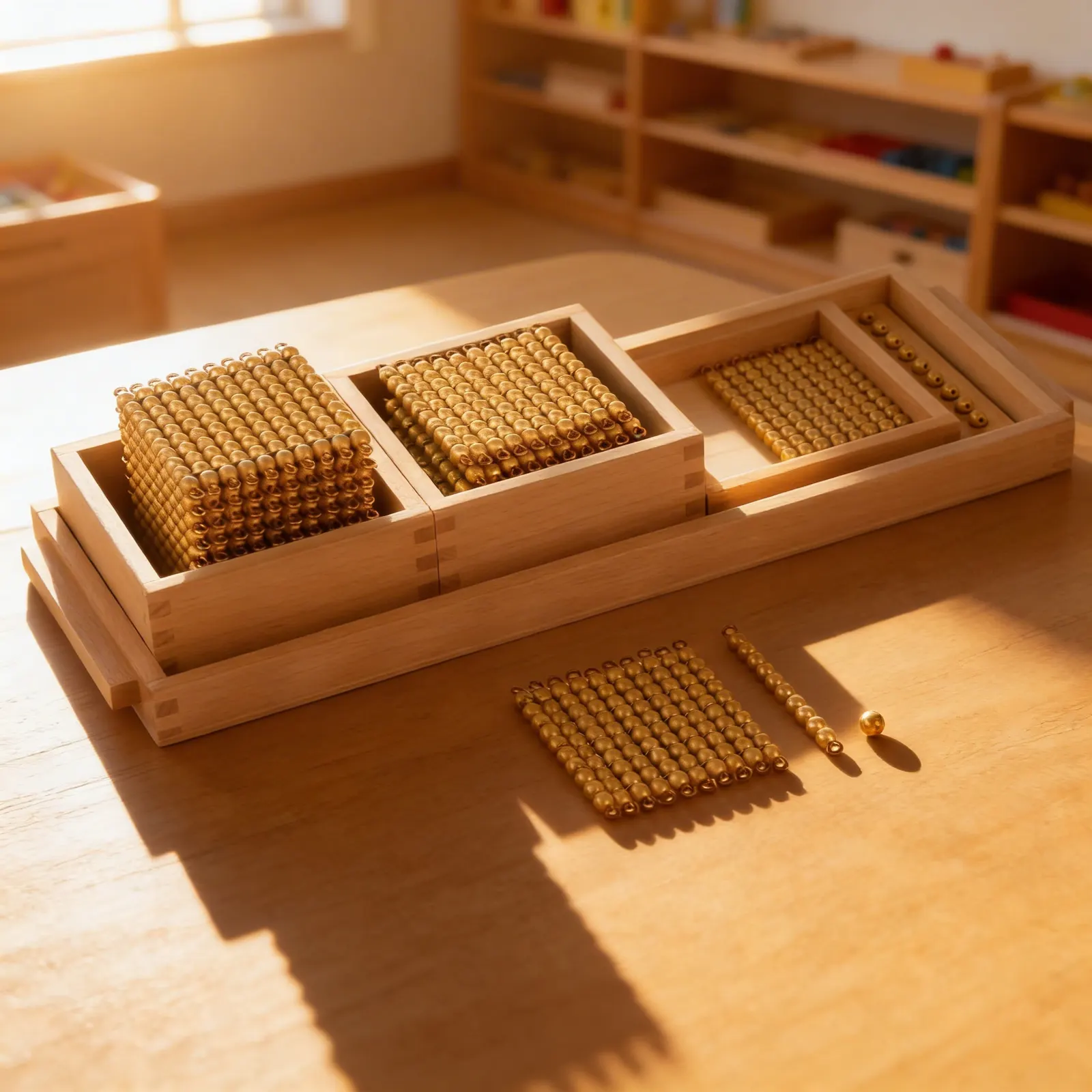
Introduction To The Decimal System in a child's hands
Nine unit beads, nine ten bars, nine hundred squares and one thousand cube, which is the whole point: a child who tries to lay out a tenth hundred finds there isn't one, and discovers for themselves that a decimal category can never hold more than nine. That single constraint, met physically rather than explained, is what place value actually is. Everything sits in wooden boxes and trays so quantities can be carried across a room and compared. Nylon beads with wooden boxes and trays, for ages 3 to 6.
Mathematical Mind
Builds concrete understanding of place value and the decimal system through hands-on manipulation of quantities.
Abstract Thinking
Bridges the gap between concrete materials and abstract numerical concepts through visual and tactile exploration.
Order and Precision
Develops systematic thinking and attention to detail through organized arrangement of decimal quantities.
How to present it
Place the wooden tray system on a mat. Arrange golden nylon beads by hierarchy: loose units in one compartment, ten-bars in another, hundred-squares and thousand-cubes in their sections. Ensure adequate floor space for laying out quantities.
- 1Introduce each hierarchy separately, starting with one unit bead. Name it clearly: 'This is one unit.'
- 2Count out nine unit beads, then add one more. Exchange for one ten-bar, demonstrating that 10 units = 1 ten
- 3Build quantities like 23 using 2 ten-bars and 3 unit beads, naming each component
- 4Invite the child to fetch specific quantities: 'Please bring me 5 ten-bars and 7 units'
- 5Introduce the hundred-square and thousand-cube through similar exchange processes
3 tips for parents
- Practice skip counting by tens at home using everyday objects to reinforce base-ten understanding
- When your child mentions bead work, ask them to explain which beads they used rather than asking about numbers
- Support mathematical language by using terms like 'exchange' and 'equivalent' in daily conversations

If you are not sure it suits your child, we answer in person.
Norbert Kovalčín, founder of Faborino · write to him
There is no review here yet. We will ask you for one after you buy. Write the first review
What's in the Box
- Wooden sliding tray: with multiple compartments
- Unit beads: individual golden beads
- Ten bars: bars of 10 connected beads
- Hundred squares: squares of 100 beads
- Thousand cube representation: visual reference
Size and material
| Packaging | 38 × 14 × 9 cm |
| Beads | Nylon |
| Tray | Wood |
| Recommended Age | 3-6 years |
Care
Wipe beads with damp cloth; clean tray with wood-safe cleaner
Frequently Asked Questions
What age is the Introduction to Decimal System material appropriate for?
This material is designed for children ages 3-6 years old. It's typically introduced when children can count to 10 and have worked with number rods and sandpaper numerals.
What's included in this decimal system set?
The set includes golden nylon beads representing units (1), tens bars (10), hundreds squares (100), and thousand cubes (1000), all organized in a sliding wooden tray system for easy access and storage.
Why are nylon beads used instead of traditional golden beads?
Nylon beads are more durable, lightweight, and cost-effective than traditional metal beads while maintaining the same educational value. They're easier for small hands to manipulate and won't chip or tarnish over time.
How does this material teach place value concepts?
Children physically handle and count beads to see that 10 units equal 1 ten bar, 10 ten bars equal 1 hundred square, and 10 hundred squares equal 1 thousand cube, building concrete understanding of our base-ten system.
What activities can children do with this decimal system material?
Children can practice counting, building numbers, exchanging (10 units for 1 ten bar), and performing basic operations like addition and subtraction using the concrete beads before moving to abstract numbers.
Product safety
Manufacturer: Nienhuis Montessori, Anders Celsiusstraat 15, 7442 PB Nijverdal, Netherlands
Introduction To The Decimal System