
King Sphere And King Cube Make Peace
Made by Nienhuis Montessori · shipped by Heutink International (Netherlands) About the maker
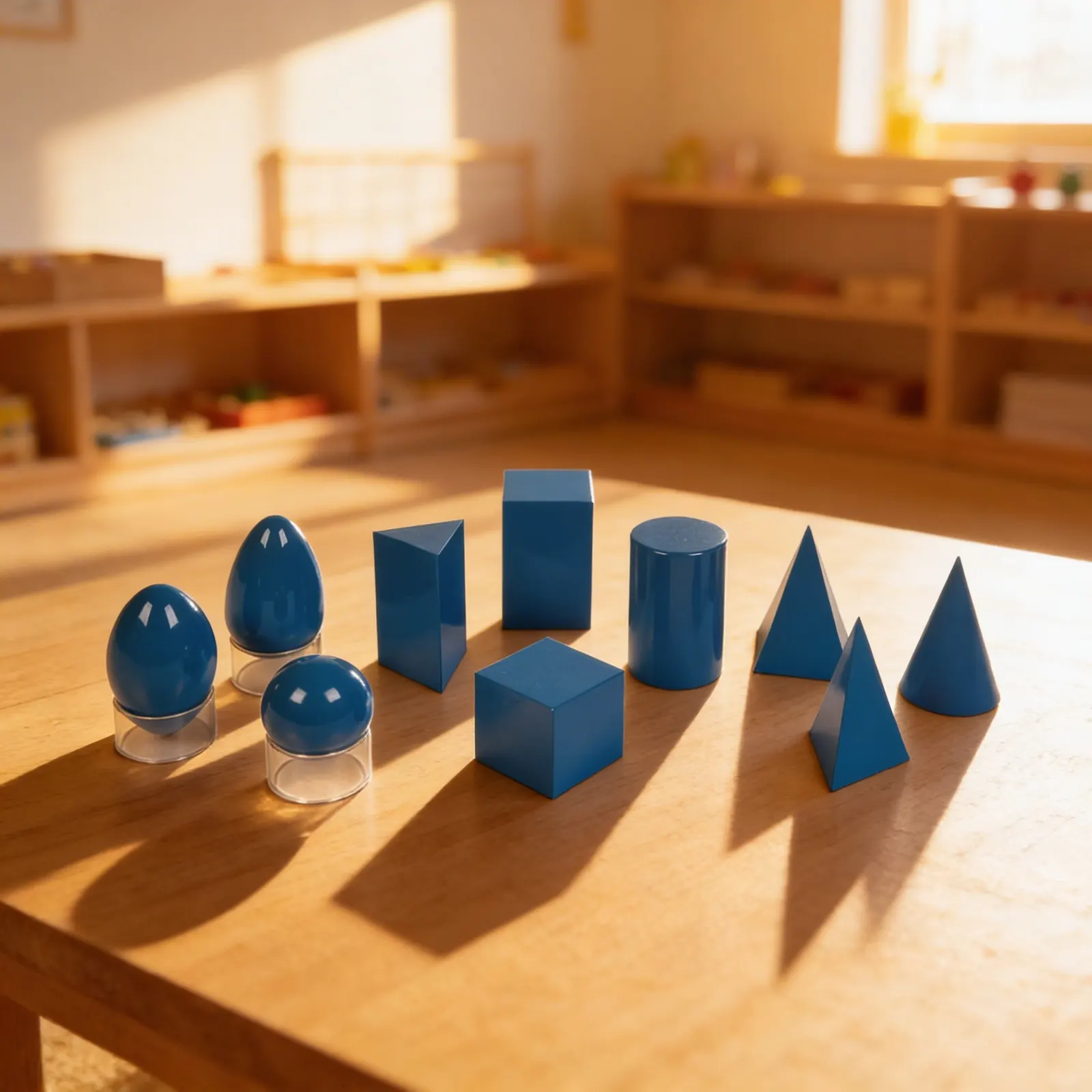
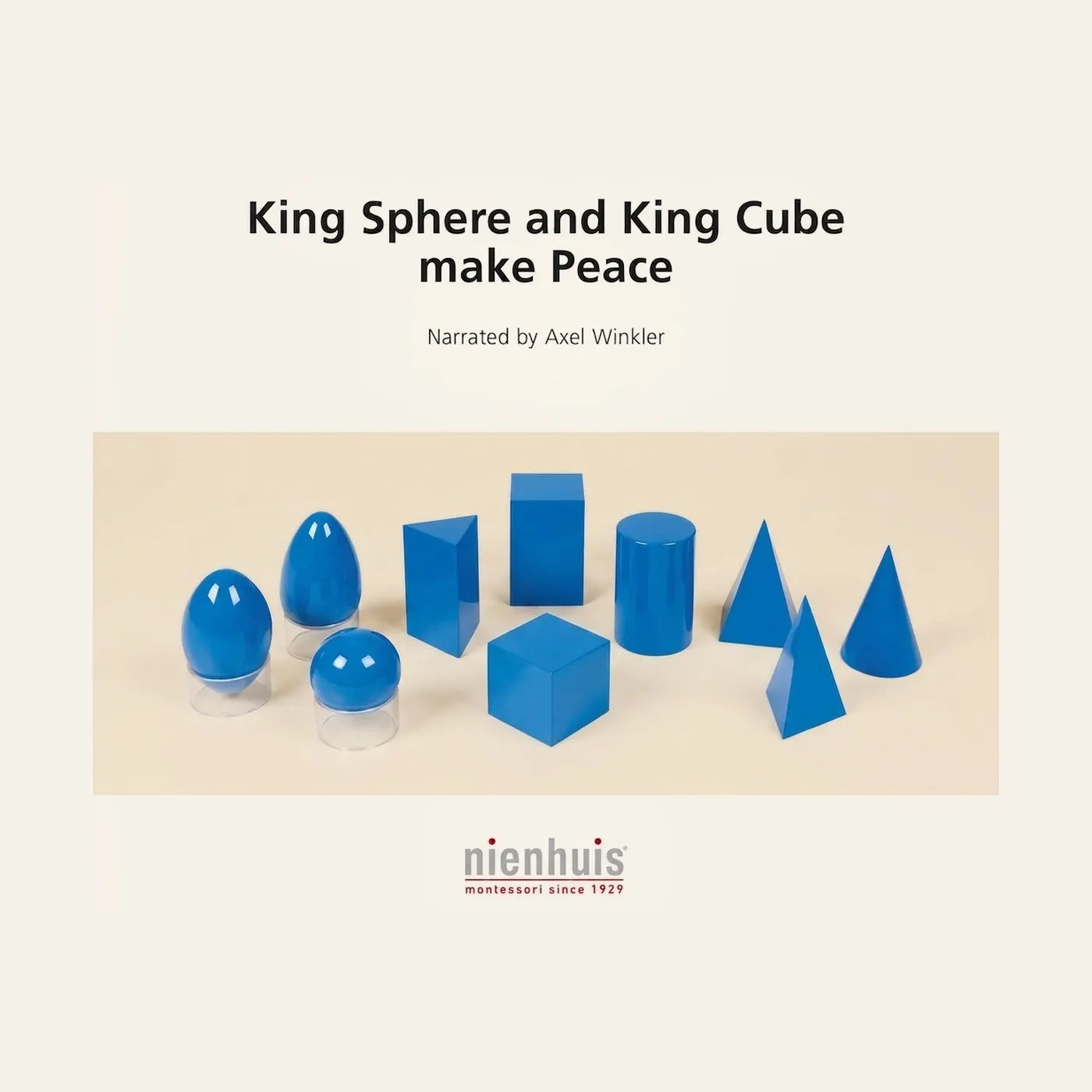
A story in which two geometric kingdoms make peace, the curved one and the angular one. It is written to prepare a child for classifying the Geometric Solids, and the classification is the whole point: a sphere and a cube are not two objects but two families, and a story is how that lands before anybody uses the word category. The solids themselves are sold separately. Paper. It is one of a set of stories in this catalogue written to prepare a specific material.
“The senses, being explorers of the world, open the way to knowledge.”
The geometric solids embody Dr. Montessori's principle of providing concrete experiences before abstract understanding.
- Refined stereognostic sense through handling three-dimensional forms
- Visual and tactile discrimination between curved and angular surfaces
- Understanding of geometric relationships and spatial awareness
- Development of mathematical vocabulary for describing 3D shapes
Read More
By manipulating three-dimensional forms, children develop their stereognostic sense, the ability to perceive and understand shapes through touch and movement. This material bridges the gap between curved and angular forms, allowing children to discover mathematical relationships through sensorial exploration. The juxtaposition of the sphere's infinite curved surface with the cube's defined edges and vertices creates a profound contrast that children can feel and internalize. Through repeated handling, children build mental representations of these forms, preparing them for later geometric studies. The material respects the child's need for order by presenting clear, isolated concepts while encouraging discovery of relationships between different geometric families.
How to present it
Follow the Montessori method of presentation for optimal child development.
Place the geometric solids on a tray. Prepare a work mat on a table or floor. Ensure hands are clean for optimal tactile experience.
- 1
Invite the child to carry the tray to the work mat using both hands
Model careful, deliberate movements to show respect for the material - 2
Remove the sphere first, holding it with both hands, rotating slowly to feel the continuous curved surface
Close your eyes briefly to emphasize the tactile experience - 3
Place the sphere gently on the mat, then take the cube with both hands
Trace edges and vertices with fingertips to highlight the angular nature - 4
Explore each solid individually, then place them side by side for comparison
Allow silence during exploration for maximum concentration - 5
Introduce vocabulary using the three-period lesson: 'This is a sphere. This is a cube.'
Wait until after sensorial exploration to introduce language - 6
Demonstrate how the sphere rolls in all directions while the cube remains stable
Let the child discover that the ovoid rolls in a curved path
Every Child Is a Little Creator

Heritage
Since 1929

In classrooms
Around the world

European brands
Nienhuis, GAM, Educo
King Sphere And King Cube Make Peace
