
Land And Water Form TraysSet 2
The first photo is the maker's own. The other shots are illustrative.
Inv. no. NIE-022800
- Maker
- Nienhuis Montessori, since 1929
- Approval
- AMI
- Product size
- 20 × 20 × 4 cm
- Primary Material
- Polymer (plastic)
- EAN
- 8719924011024
Final price incl. VAT. Delivery €5.90, €40.10 to go for free delivery.
Advice, warranty and returns are handled by us.
Why it costs €108.90
Behind the price of the original are things you can check yourself.
AMI approval
The material is approved by the Association Montessori Internationale (AMI). Nienhuis has made Montessori materials since 1929.
A verifiable original
The EAN 8719924011024 is on the box. It is the maker's number, not ours.
Land And Water Form Trays in a child's hands
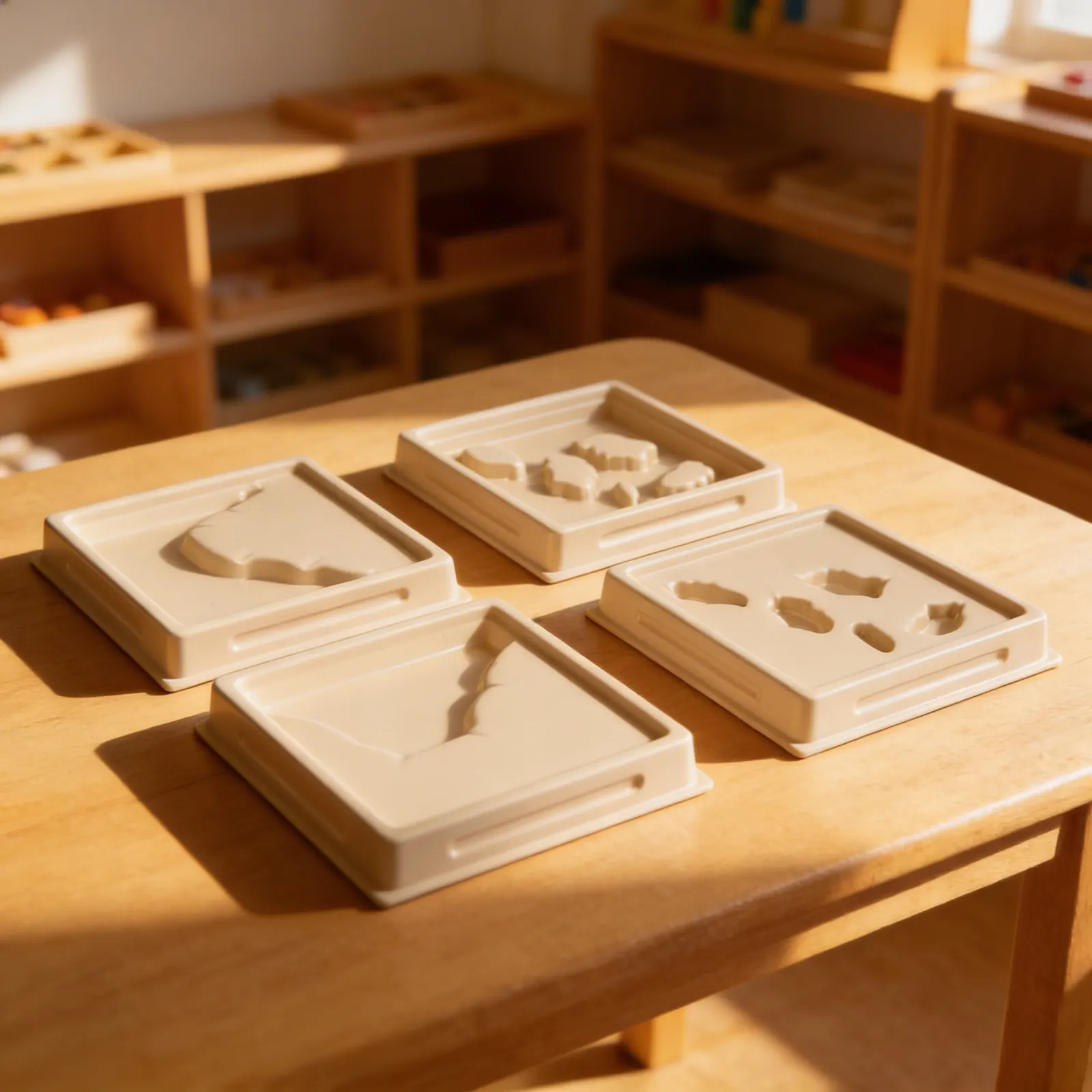
Four trays of 20 x 20 x 4 cm holding the second set of land and water forms: system of lakes, archipelago, bay and cape. These are the harder four, because each is a variation on something the first set already covered: an archipelago is islands but plural, a system of lakes is a lake but connected. Pouring water into them is what shows that the difference is real and not just a longer word. Follows on from set one. Polymer trays, for ages 3 to 6.
Geographic Vocabulary
Children learn precise terminology for complex land and water formations through hands-on manipulation.
Spatial Reasoning
Tracing and filling formations develops understanding of positive and negative space relationships.
Scientific Thinking
Experimenting with water flow between formations introduces basic concepts of geography and hydrology.
Fine Motor Control
Carefully pouring water and tracing formations refines hand movements and coordination.
How to present it
Place trays on a waterproof mat. Have a small pitcher of water (tinted blue with food coloring), a sponge, and a drying cloth ready. Arrange trays in order: system of lakes, archipelago, bay, cape.
- 1Invite the child to trace the outline of the system of lakes with their index finger
- 2Pour water carefully into the tray and watch it fill the connected water areas
- 3Discuss how the lakes are connected to one another while the child observes
- 4Empty the tray using the sponge, then proceed to the archipelago
- 5Continue with the bay and the cape, allowing exploration time for each
3 tips for parents
- Look for these formations in picture books or maps at home to reinforce classroom learning
- During bath time, create simple land and water formations with washcloths and water
- Use proper geographical terms in conversation rather than simplified language

If you are not sure it suits your child, we answer in person.
Norbert Kovalčín, founder of Faborino · write to him
There is no review here yet. We will ask you for one after you buy. Write the first review
What's in the Box
- System of lakes tray: multiple connected water bodies
- Archipelago tray: group of islands formation
- Bay tray: part of the water reaching into the land
- Cape tray: part of the land reaching out into the water
Size and material
| Product size | 20 × 20 × 4 cm |
| Packaging | 24 × 23 × 13 cm |
| Primary Material | Polymer (plastic) |
| Recommended Age | 3-6 years |
Care
Wipe with damp cloth after water activities; air dry completely before stacking
Frequently Asked Questions
What geographical features are included in Set 2?
Set 2 includes four intermediate land and water forms: system of lakes (multiple connected lakes), archipelago (group of islands), bay (part of the water reaching into the land) and cape (part of the land reaching out into the water). These build upon the basic forms learned in Set 1.
How do children use water with these trays?
Children pour water into the recessed areas of each tray to visually demonstrate how water and land interact. The formations clearly show boundaries, and the water fills the appropriate areas to create a realistic representation of each geographical feature. Use a pitcher and food coloring for enhanced visibility.
What material are the trays made from?
The trays are made from polymer (plastic) and each measures 20 x 20 x 4 cm.
Do I need Set 1 before using Set 2?
While Set 2 can be used independently, it's recommended to introduce Set 1 first, which Set 2 builds on. Set 2 presents more complex formations that are easier to understand once children have mastered the fundamental concepts from Set 1.
What extensions can be done with these trays?
Extensions include: creating matching nomenclature cards, finding real-world examples on maps or globes, making clay models of the forms, drawing the formations, creating definitions booklets, and comparing how these features appear in different parts of the world. Children can also use blue and brown paper to create 2D representations.
Product safety
Manufacturer: Nienhuis Montessori, Anders Celsiusstraat 15, 7442 PB Nijverdal, Netherlands
Land And Water Form Trays