
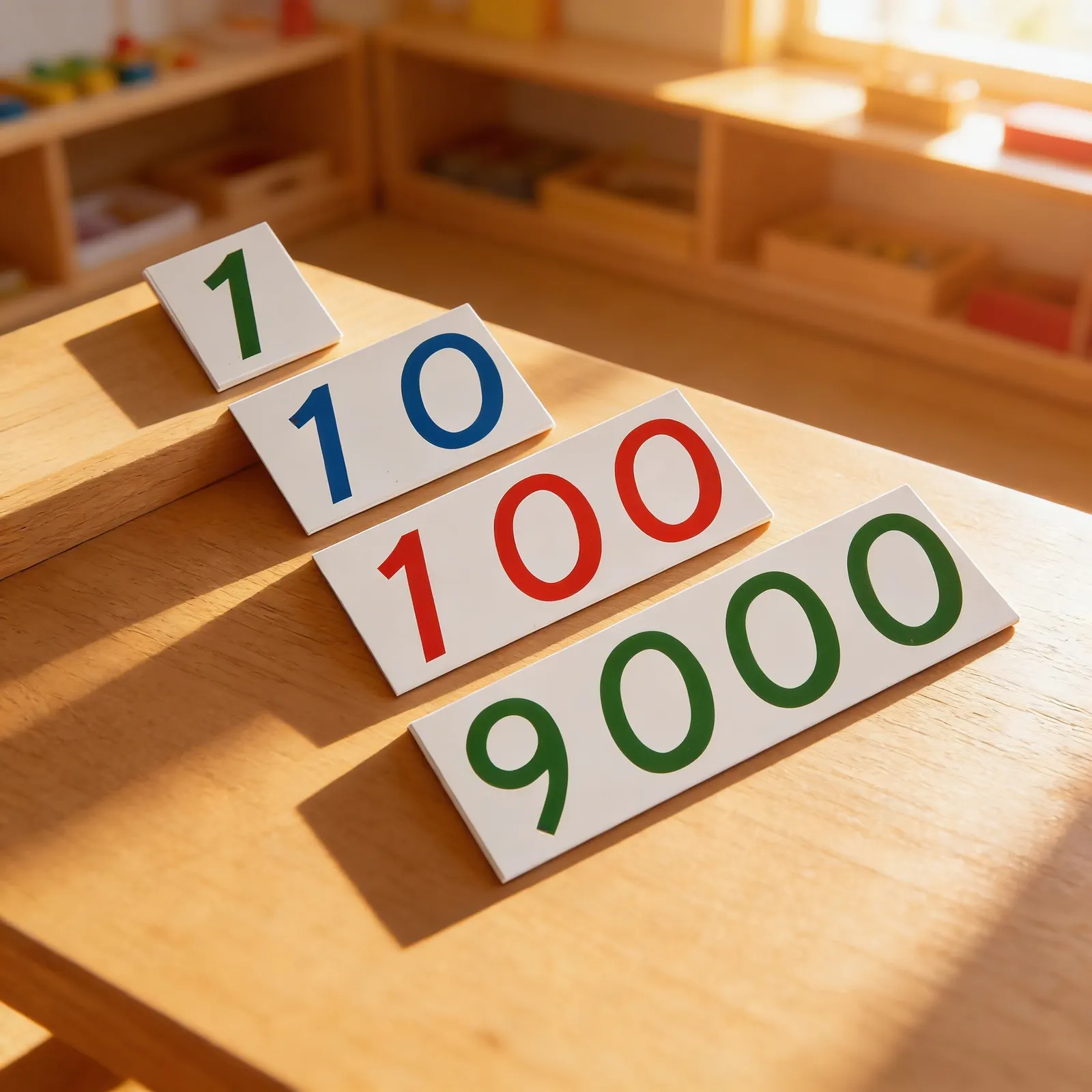
Large Number Cards 1-9000Plastic
The first photo is the maker's own. The other shots are illustrative.
Inv. no. NIE-0072C0
- Maker
- Nienhuis Montessori, since 1929
- Approval
- AMI
- Construction
- Rigid plastic
- Printing
- Color-coded numerals
- EAN
- 8719924004347
Final price incl. VAT. Delivery €5.90, €117.10 to go for free delivery.
Advice, warranty and returns are handled by us.
Why it costs €31.90
Behind the price of the original are things you can check yourself.
AMI approval
The material is approved by the Association Montessori Internationale (AMI). Nienhuis has made Montessori materials since 1929.
A verifiable original
The EAN 8719924004347 is on the box. It is the maker's number, not ours.
Large Number Cards 1-9000 in a child's hands
Hands-on to minds-on, these color-coded plastic number cards introduce children to the decimal system and place value concepts from units to thousands. The durable cards feature clear numerals in Montessori-standard colors (green for units, blue for tens, red for hundreds, green for thousands), where children physically build and decompose numbers up to 9999. Essential for developing concrete understanding of mathematical hierarchy and number composition.
Mathematical Hierarchy
Visual and tactile understanding of place value through color coding and physical manipulation of cards.
Number Composition
Children learn to build and decompose numbers by layering cards, creating concrete understanding of how numbers are formed.
Abstract Thinking
Bridges the gap between concrete quantity work and abstract number symbols through systematic presentation.
Sequential Learning
Supports orderly progression from simple to complex numbers, building confidence in mathematical concepts.
How to present it
Arrange cards in columns by place value on a mat: green units (1-9) on far right, blue tens (10-90) next, red hundreds (100-900), then green thousands (1000-9000) on far left
- 1Introduce one category at a time, starting with units. Show how to read '1', '2', etc.
- 2Progress to tens, demonstrating how '10' has a zero to show no units
- 3Build two-digit numbers by overlaying tens and units: place '20' then slide '3' on top to make '23'
- 4Continue pattern with hundreds (red) and thousands (green), building increasingly complex numbers
- 5Play 'make the number' - say a number like '2,547' and child builds it with cards
3 tips for parents
- Practice reading large numbers in daily life - house numbers, prices, page numbers
- Point out the same color pattern in Montessori materials at school
- Avoid rushing to mental math - physical card manipulation builds deep understanding

If you are not sure it suits your child, we answer in person.
Norbert Kovalčín, founder of Faborino · write to him
There is no review here yet. We will ask you for one after you buy. Write the first review
What's in the Box
- Unit cards (1-9): Green numerals
- Ten cards (10-90): Blue numerals
- Hundred cards (100-900): Red numerals
- Thousand cards (1000-9000): Green numerals
Size and material
| Packaging | 20 × 7 × 1 cm |
| Construction | Rigid plastic |
| Printing | Color-coded numerals |
| Recommended Age | 3-6 years |
Care
Wipe with damp cloth, dry immediately
Frequently Asked Questions
How do these cards help children understand place value?
The color-coding system (green units, blue tens, red hundreds, green thousands) provides visual distinction between place values. Children can physically overlay cards to build numbers, seeing how 2000 + 300 + 40 + 5 creates 2345, making abstract concepts concrete and manipulable.
What activities can children do with these number cards?
Children can practice number formation, decomposition, skip counting, and place value games. They can build any number up to 9999, match quantities with symbols, play 'fetch' games where they retrieve specific numbers, and explore patterns in our number system.
Why are the cards made of plastic instead of cardboard?
Plastic cards are more durable for frequent classroom use, easy to clean, and maintain their shape without bending or tearing. They're designed to withstand years of handling by young children while maintaining clear, crisp numbers for easy reading.
Can younger children use these cards before understanding thousands?
Yes! Start with just units (1-9), then gradually introduce tens, hundreds, and thousands as the child develops. The cards grow with the child's understanding, making them useful from early number recognition through advanced place value work.
How do these cards prepare children for future math concepts?
By physically building and decomposing numbers, children develop deep understanding of our base-10 system, preparing them for addition, subtraction, multiplication, and division. The visual and tactile experience creates strong mental models for abstract mathematical operations.
Product safety
Manufacturer: Nienhuis Montessori, Anders Celsiusstraat 15, 7442 PB Nijverdal, Netherlands
Large Number Cards 1-9000