
Large Number Cards 1-9000Wood
The first photo is the maker's own. The other shots are illustrative.
Inv. no. NIE-0072B0
- Maker
- Nienhuis Montessori, since 1929
- Approval
- AMI
- Stand
- Solid wood construction
- Cards
- Laminated cardstock
- EAN
- 8719924004330
Final price incl. VAT. Delivery €5.90, €55.10 to go for free delivery.
Advice, warranty and returns are handled by us.
Why it costs €93.90
Behind the price of the original are things you can check yourself.
AMI approval
The material is approved by the Association Montessori Internationale (AMI). Nienhuis has made Montessori materials since 1929.
A verifiable original
The EAN 8719924004330 is on the box. It is the maker's number, not ours.
Large Number Cards 1-9000 in a child's hands
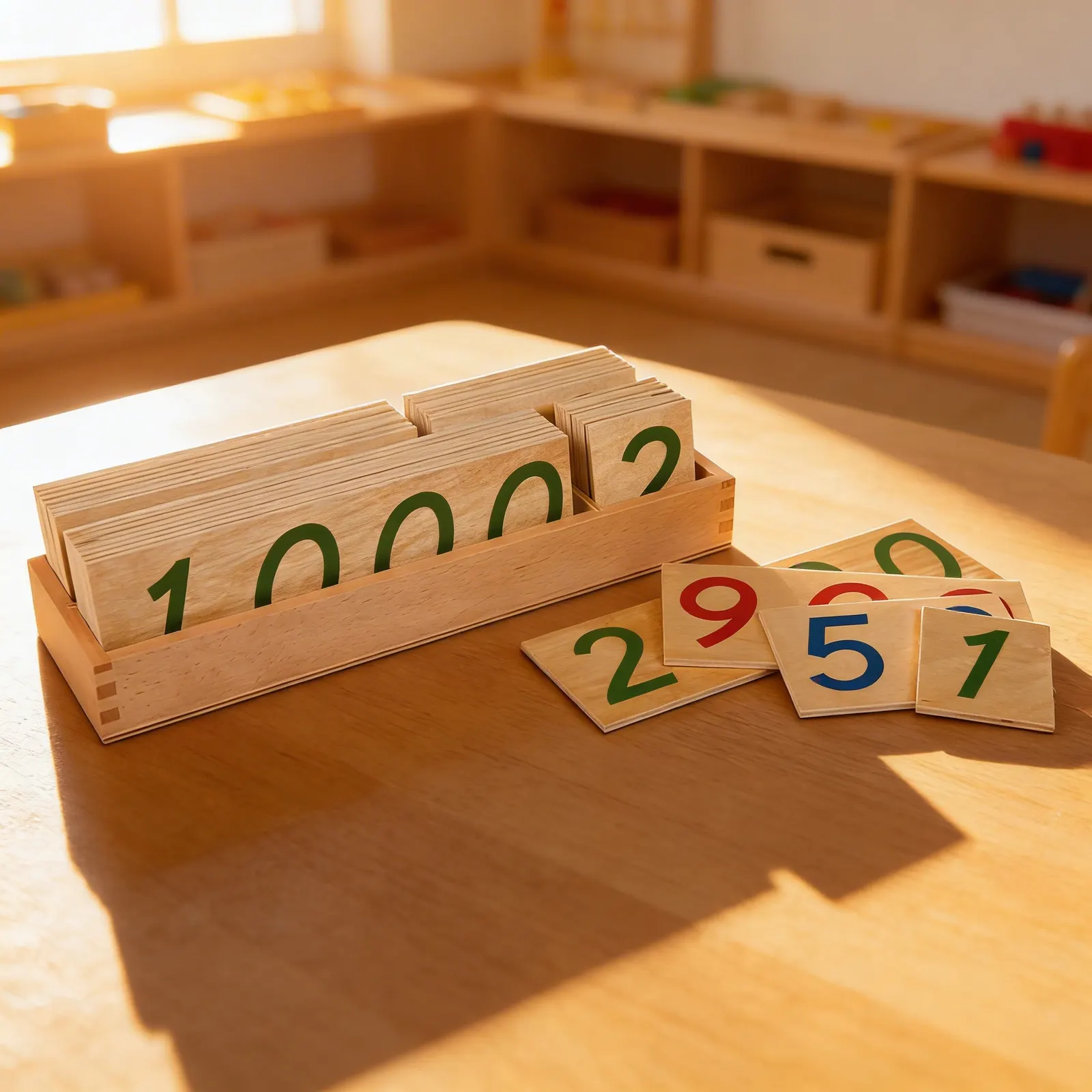
Wooden number cards from one to nine thousand, finished in clear varnish, with a box for handling and storage. The large cards are what make the decimal system readable: laying 3000, 400, 50 and 6 in a row and then stacking them so only 3456 shows is the moment a child sees what a written number is actually hiding. Wooden cards rather than card stock matter because these get laid out on the floor daily. Wood with plywood, for ages 3 to 6.
Place Value Understanding
Color-coding and physical layering of cards creates concrete understanding of how units, tens, hundreds, and thousands combine to form numbers.
Visual Discrimination
Large, clear numerals in distinct colors develop visual recognition and support the transition from concrete to abstract number concepts.
Mathematical Foundation
Building numbers physically prepares children for advanced operations like addition and subtraction with exchanging.
Sequential Thinking
Systematic organization of cards from 1-9000 reinforces number patterns and decimal system structure.
How to present it
Place the wooden stand on a large work mat. Arrange cards in their slots: units (1-9) in green, tens (10-90) in blue, hundreds (100-900) in red, and thousands (1000-9000) in green.
- 1Begin with single cards: show 7, then 70, then 700, then 7000
- 2Build a four-digit number like 3,456 by selecting one card from each category
- 3Invite the child to read the complete number aloud
- 4Ask the child to form specific numbers you dictate
- 5Play the exchange game: 'What happens if we change just the hundreds card?'
3 tips for parents
- Practice reading large numbers in daily life: house numbers, prices, page numbers in books
- Avoid rushing to mental math, let your child enjoy the physical process of building numbers
- Create a special place at home where number cards can be displayed after building

If you are not sure it suits your child, we answer in person.
Norbert Kovalčín, founder of Faborino · write to him
There is no review here yet. We will ask you for one after you buy. Write the first review
What's in the Box
- Wooden number card holder: with organized slots
- Number cards 1-9: green (units)
- Number cards 10-90: blue (tens)
- Number cards 100-900: red (hundreds)
- Number cards 1000-9000: green (thousands)
Size and material
| Packaging | 31 × 10 × 8 cm |
| Stand | Solid wood construction |
| Cards | Laminated cardstock |
| Recommended Age | 3-6 years |
Care
Wipe wooden stand with damp cloth, cards with dry cloth only
Frequently Asked Questions
What makes these large number cards different from regular number cards?
These large format cards feature Montessori's signature color-coding system (green units, blue tens, red hundreds, green thousands) and come in a wooden stand with precisely spaced slots. The larger size allows children to physically manipulate and layer cards to build numbers from 1-9000, making abstract place value concepts concrete and visible.
How do children use these cards to understand place value?
Children physically overlay the cards to create multi-digit numbers. For example, to make 2,345, they place the 2000 card first, then overlay 300, then 40, and finally 5. The color-coding and physical layering help children see how each digit occupies a specific place and represents a different value.
Why do the colors repeat with green for both units and thousands?
This follows Montessori's hierarchical color pattern that repeats every three place values. Green represents the beginning of each new hierarchy (units start the simple family, thousands start the thousands family). This pattern continues with tens of thousands being blue and hundreds of thousands being red, helping children recognize mathematical patterns.
What prerequisite skills should children have before using these cards?
Children should be comfortable with numbers 1-10 and have experience with the golden bead material or similar concrete representations of place value. They should understand basic counting and be ready to explore how numbers are composed of units, tens, hundreds, and thousands.
How does the wooden stand support the learning process?
The stand's precisely spaced slots keep cards organized by place value and allow for easy access during lessons. This organization supports independent work as children can clearly see where each category belongs, promoting order and systematic thinking while building numbers.
Product safety
Manufacturer: Nienhuis Montessori, Anders Celsiusstraat 15, 7442 PB Nijverdal, Netherlands
Large Number Cards 1-9000