Large Working Board: For Geometric Stick Material Construction
Made by Nienhuis Montessori · shipped by Heutink International (Netherlands) About the maker
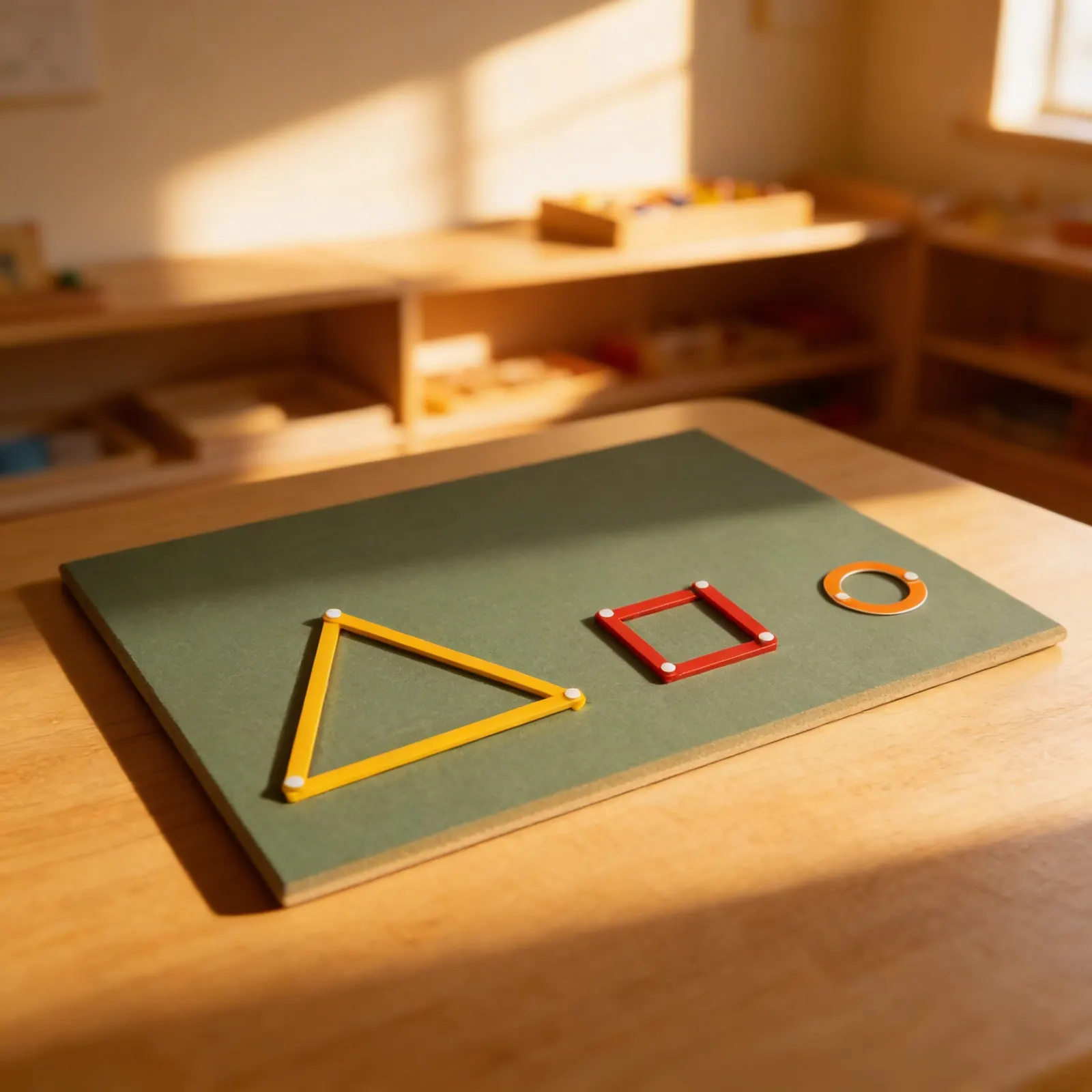
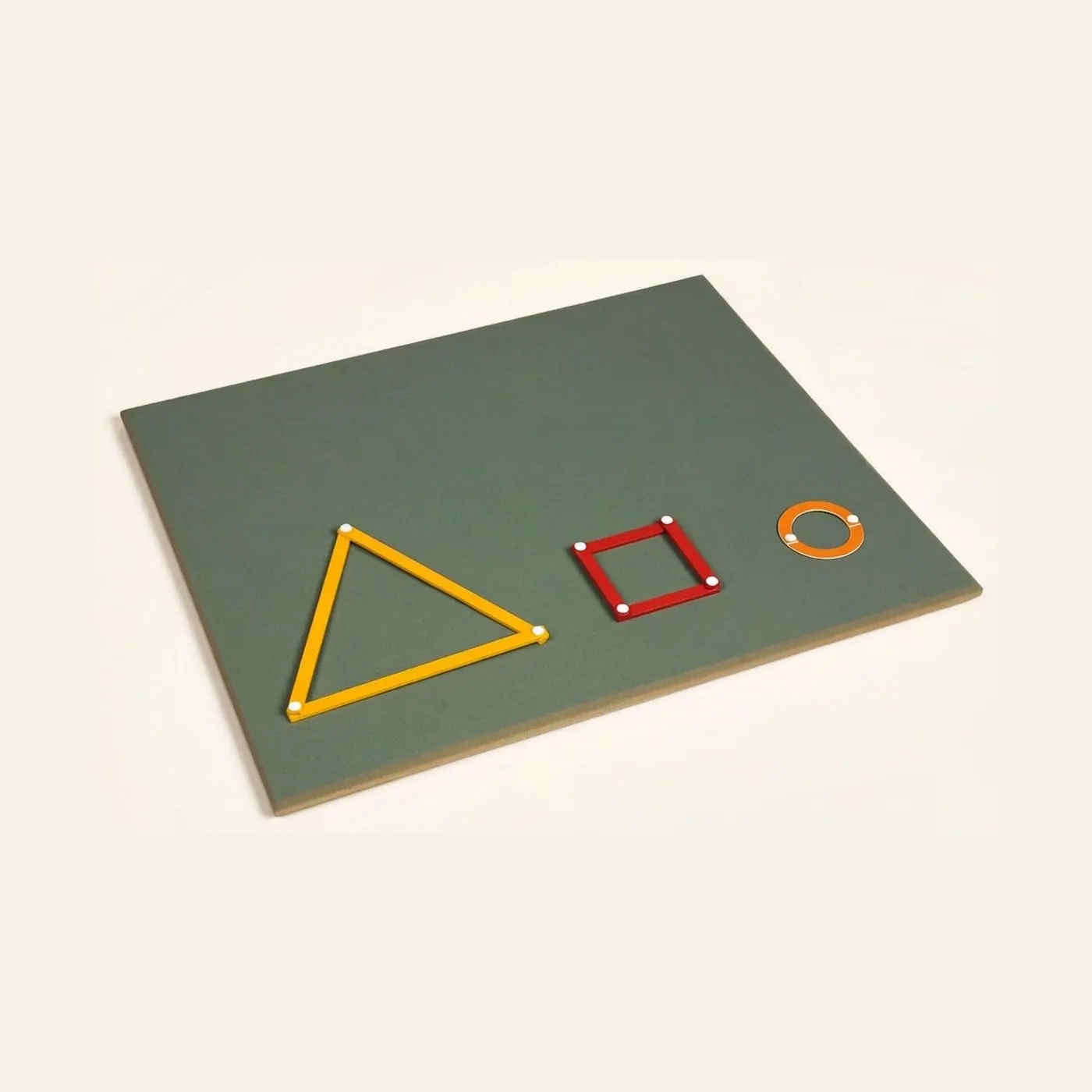
A large working board in self healing material, made for the geometric stick material. The sticks are pinned into the board to build angles, triangles and polygons, and self healing is what makes that repeatable: the surface closes behind every pin, so the board does not slowly turn into a field of holes that stop holding. A big board matters because the constructions get large, and a shape that runs off the edge cannot be measured. Wood with non toxic paint, for ages 6 to 12.
“Education is a natural process spontaneously carried out by the human individual, and is acquired not by listening to words but by experiences upon the environment.”
The Large Working Board for Geometric Stick Material embodies Maria Montessori's principle of 'education of the senses' extended into the elementary years. Unlike early childhood where sensorial exploration is primarily for refinement of perception, elementary children use sensorial materials as tools for intellectual discovery.
- Understanding relationships between line segments and geometric shapes
- Developing spatial reasoning through construction and deconstruction of forms
- Discovering geometric properties like angles, sides, and symmetry
- Building foundation for advanced geometry concepts including polygons and tessellations
Read More
This material bridges concrete manipulation with abstract geometric reasoning, supporting the elementary child's passage to abstraction. The board provides a prepared environment for independent exploration of geometric relationships, allowing children to discover mathematical laws through their own activity. The color-coding and structured presentation respect the child's need for order while encouraging creative investigation, aligning with Montessori's vision of the elementary child as a reasoning explorer seeking to understand the universe through mathematical relationships.
How to present it
Follow the Montessori method of presentation for optimal child development.
Place the board on a table or rug. Arrange colored sticks in separate containers by length and color. Ensure adequate workspace around the board. Have additional sticks available for extended work.
- 1
Introduce the board's three basic shapes, tracing each with fingers while naming them
Use precise mathematical language: 'equilateral triangle,' 'square,' 'circle' - 2
Demonstrate removing sticks from one shape and reconstructing it beside the board
Move slowly and deliberately, emphasizing the relationship between parts and whole - 3
Explore creating new shapes using combinations of sticks from different figures
Ask guiding questions like 'What happens when we use two sides from the square?' - 4
Challenge child to create specific polygons using available sticks
Start with familiar shapes like rectangles before moving to pentagons or hexagons - 5
Document discoveries by tracing created shapes on paper
This creates a personal geometry reference book for future work
Every Child Is a Little Creator

Heritage
Since 1929

In classrooms
Around the world

European brands
Nienhuis, GAM, Educo

AMI approved
To the association standard
Large Working Board: For Geometric Stick Material Construction
