
List Of Factors Tables
The first photo is the maker's own. The other shots are illustrative.
Inv. no. NIE-560100
- Maker
- Nienhuis Montessori, since 1929
- Approval
- AMI
- Material
- Printed cardstock
- Finish
- Matte print surface
- EAN
- 8719924029852
Final price incl. VAT. Delivery €5.90, €109.10 to go for free delivery.
Advice, warranty and returns are handled by us.
Why it costs €39.90
Behind the price of the original are things you can check yourself.
AMI approval
The material is approved by the Association Montessori Internationale (AMI). Nienhuis has made Montessori materials since 1929.
A verifiable original
The EAN 8719924029852 is on the box. It is the maker's number, not ours.
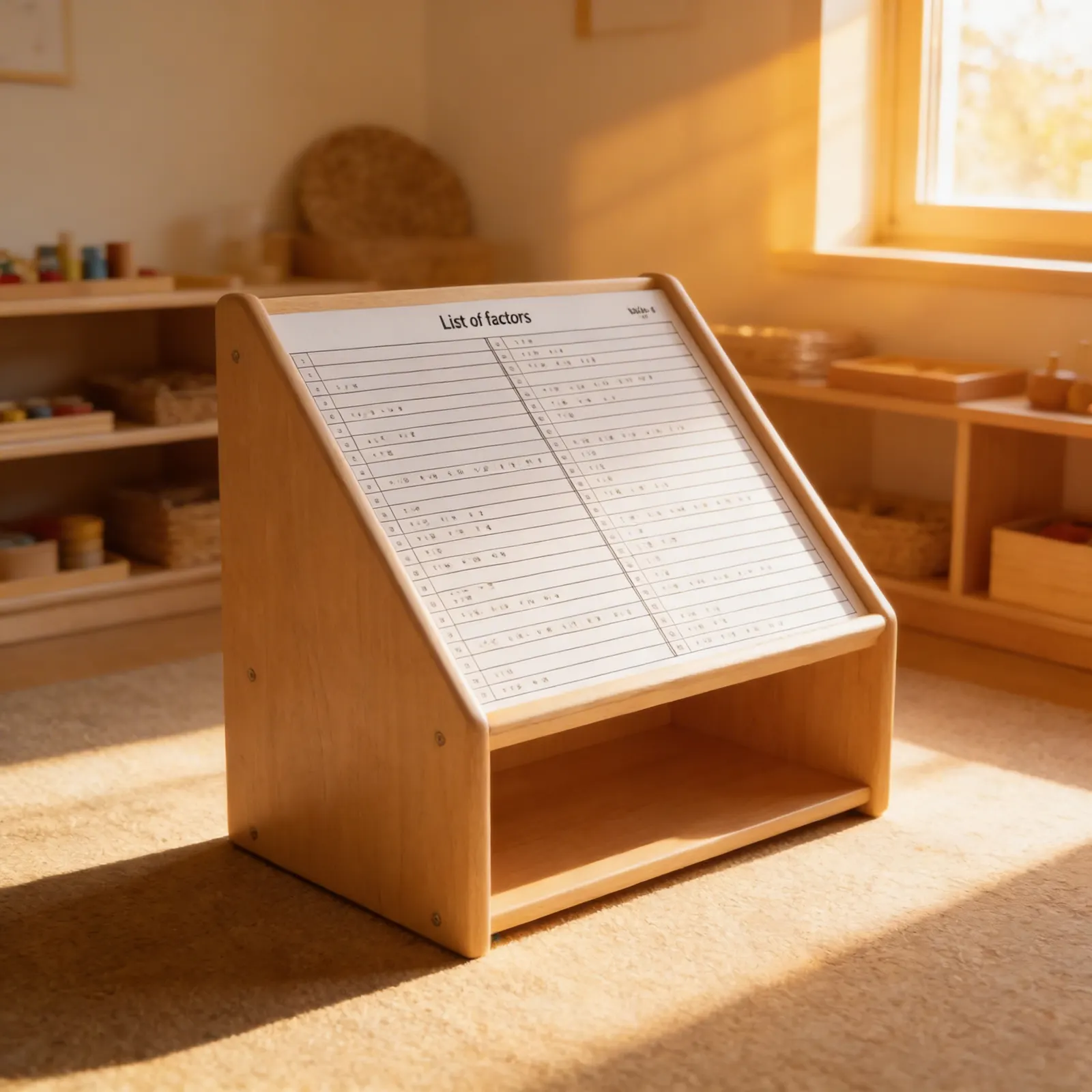
List Of Factors Tables in a child's hands
Two pads of seventy five sheets for listing factors, one covering one to fifty and one fifty one to a hundred, printed in black, with control charts included. Factors are the reverse question to multiples and much the harder one: instead of counting up from a number, the child has to test what divides into it. Doing that for every number to a hundred is how prime numbers stop being a definition and become the ones where the list ran out. Cardstock and paper, for ages 6 to 12.
Mathematical Abstraction
Supports transition from concrete materials to abstract number relationships through systematic table study.
Pattern Recognition
Grid format reveals multiplication patterns and factor relationships for deeper mathematical understanding.
Independent Reference
Enables self-directed verification and exploration of multiplication facts during mathematical work.
Memory Development
Regular use supports memorization of essential multiplication facts through visual reference.
How to present it
Place the factor tables in a designated mathematics area where children can easily access them. Ensure good lighting and a flat work surface. Have paper and pencil available for children to record discoveries.
- 1Introduce the tables by showing how to read the grid format, demonstrating with a familiar number like 12
- 2Invite the child to explore patterns, such as which numbers appear most frequently across all tables
- 3Show how to use the tables to find all factors of a given number by locating it throughout the grids
- 4Demonstrate finding common factors by comparing the factor lists of two different numbers
- 5Challenge children to identify prime numbers by finding those that appear in only two tables
3 tips for parents
- Use everyday situations to connect factor knowledge, such as arranging items in equal groups
- Play factor games during car rides by calling out numbers and finding their factors together
- Connect factor understanding to real-world applications like organizing collections or sharing equally

If you are not sure it suits your child, we answer in person.
Norbert Kovalčín, founder of Faborino · write to him
There is no review here yet. We will ask you for one after you buy. Write the first review
What's in the Box
- Factor Table Sheets: Approx. 3 reference cards
- Grid Format: Numbered rows and columns
Size and material
| Packaging | 28 × 22 × 2 cm |
| Material | Printed cardstock |
| Finish | Matte print surface |
| Recommended Age | 6-12 years |
Care
| Cleaning | Wipe with dry cloth only |
| Storage | Keep flat in dry location |
Frequently Asked Questions
What age group is this List of Factors Tables designed for?
This material is specifically designed for elementary students ages 6-12, aligning with the Montessori elementary curriculum for mathematical abstraction and memorization work.
How do these factor tables support independent learning?
The clear grid format allows children to independently explore multiplication relationships and number patterns without adult assistance, fostering self-directed discovery and verification of their work.
What mathematical concepts do these tables help children understand?
These reference sheets help children explore factors, multiples, prime numbers, composite numbers, and the relationships between multiplication and division through visual patterns.
Are these tables durable enough for daily classroom use?
Yes, these printed reference cards are designed as classroom furniture-grade materials, built to withstand regular handling by multiple students throughout the school year.
How do these factor tables complement other Montessori math materials?
They serve as a bridge between concrete manipulatives and abstract mathematical thinking, supporting work with multiplication boards, bead chains, and other elementary mathematics materials.
Product safety
Manufacturer: Nienhuis Montessori, Anders Celsiusstraat 15, 7442 PB Nijverdal, Netherlands
List Of Factors Tables