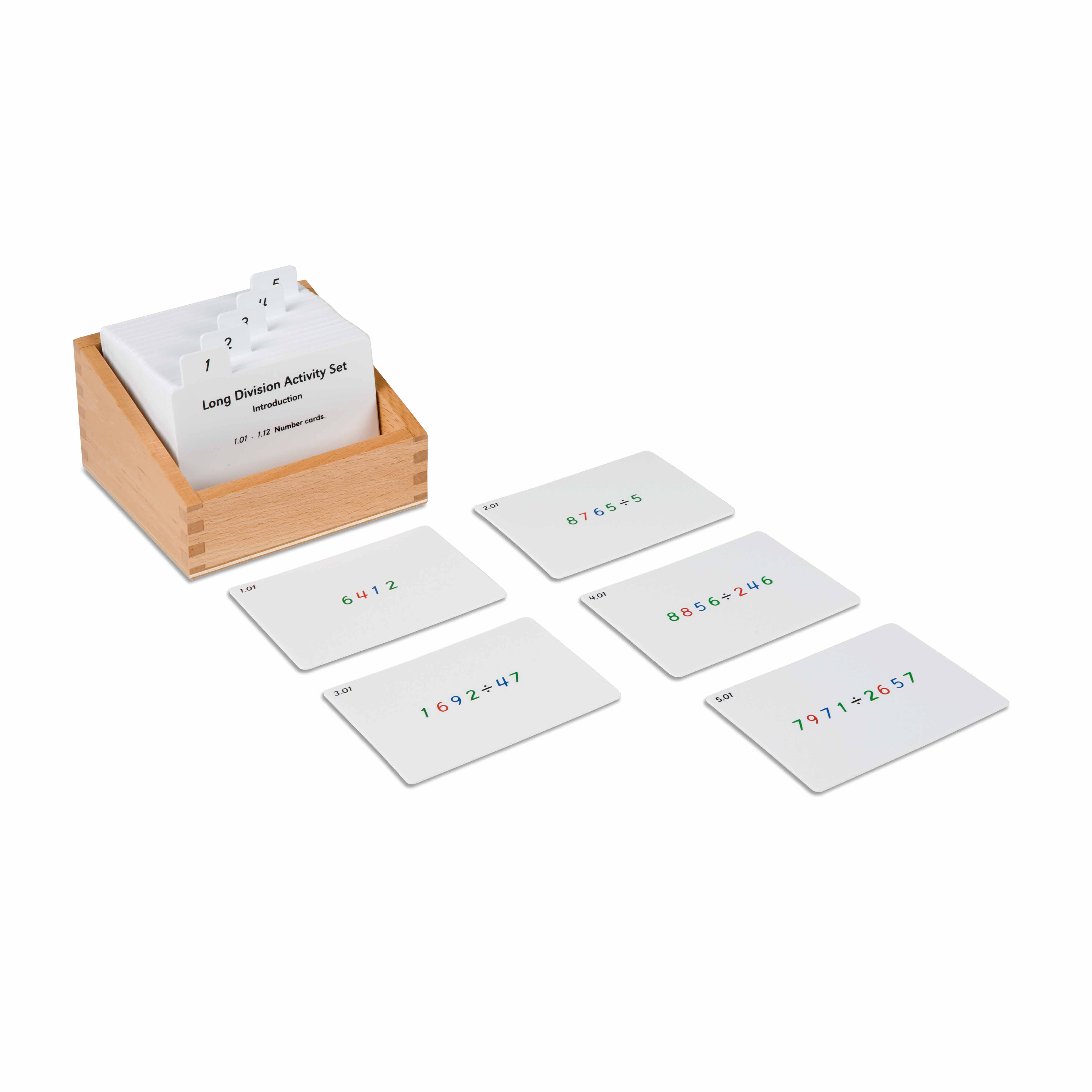
The Long Division Activity Set is a Mathematics Montessori material designed for children aged 3-6, crafted by Nienhuis Montessori to AMI standards.
This Long Division Activity Set provides concrete practice with division concepts through organized equation cards and numbered dividers. The angled wooden storage box allows children to independently select and work through division problems systematically, building understanding of how numbers can be divided equally. Each color-coded equation card helps visualize the relationship between dividend, divisor, and quotient.
“Children display a universal love of mathematics, which is par excellence the science of precision, order, and intelligence.”— Maria MontessoriThe Discovery of the Child
“The greatest sign of success for a teacher is to be able to say, 'The children are now working as if I did not exist.'”
— Maria Montessori, The Absorbent Mind
The Long Division Activity Set introduces mathematical abstraction through carefully sequenced equation cards that bridge concrete manipulation and abstract understanding. Each color-coded card in the wooden storage box presents division as a process of equal distribution, allowing children to discover how larger quantities separate into smaller, equal groups. The angled storage design encourages systematic exploration, as children naturally progress from simple divisions to more complex equations. By working with these equation cards independently, young mathematicians develop an intuitive grasp of division relationships before formal arithmetic instruction begins. The visual organization of dividend, divisor, and quotient on each card creates a mental map of division's structure. This progression from handling physical equation cards to understanding abstract number relationships exemplifies Montessori's concrete-to-abstract learning pathway, where mathematical concepts emerge through repeated, purposeful interaction with precisely designed materials.
Each order includes everything needed for proper presentation and long-term use.
Follow the Montessori method of presentation for optimal child development.
Select one color-coded section of equation cards from the storage box
Lay out the equation card and read the dividend (number being divided)
Identify the divisor and think about creating that many equal groups
Work through the division mentally or with manipulatives to find the quotient
Return completed cards to their section before selecting new ones
Every material is carefully selected for durability, safety, and authentic Montessori experience.
The solid wooden storage box with precise finger joints demonstrates quality craftsmanship while teaching children to care for mathematical materials with respect.
Each material supports multiple areas of child development simultaneously.
Builds concrete understanding of division concepts through visual and tactile exploration of number relationships.
Numbered dividers help children organize and approach division problems in a logical, systematic manner.
Color-coded cards bridge the gap between concrete manipulatives and abstract division operations.
Self-correcting format allows children to check their work and build confidence in mathematical problem-solving.
Designed for child-sized hands
Professional tips from AMI-trained guides to maximize the educational value of this material.
“Present equation cards only after children have worked extensively with golden bead material for concrete division experiences”
Observe which color-coded sections children gravitate toward to assess their computational comfort level
Create a division facts booklet where children can record equations they've mastered from the cards
Use the storage box organization as a visual progress tracker, marking sections as children complete them
Everything you need to know about this material.
This material is designed for children who have already worked extensively with multiplication and have a solid understanding of the decimal system. Most 3-year-olds would benefit from prerequisite materials like the golden beads and multiplication board first.
The hands-on manipulatives and color-coding allow children to physically work through division problems, making abstract concepts concrete. The systematic organization helps children discover patterns and relationships independently rather than memorizing procedures.
The dividers physically separate quantities into equal groups, allowing children to see division as the process of sharing equally. This concrete representation helps children understand that division is the inverse of multiplication.
The set typically includes division equations starting with simple facts (dividing by 1 and 2) and progressing to more complex problems. The exact range depends on the specific set, but it's designed to build systematically from concrete to abstract understanding.
Yes, with proper presentation and supervision. Parents should familiarize themselves with the Montessori approach to division and ensure the child has mastered prerequisite skills in multiplication and place value before introducing this advanced material.
Can't find what you're looking for?
Contact Our Experts
Share your experience with this material and help other educators and parents.


