
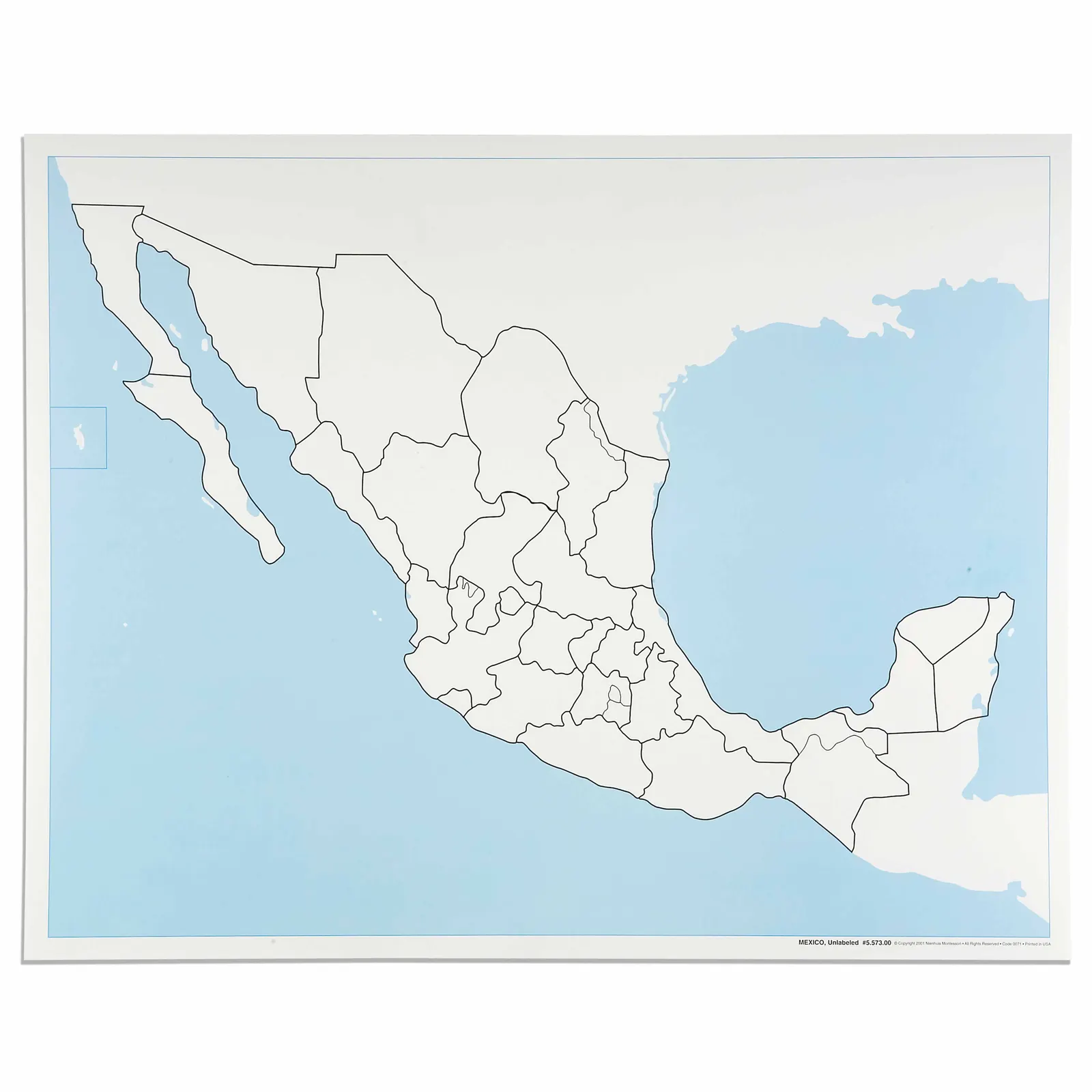
Mexico Control Map: Unlabeled
Made by Nienhuis Montessori · shipped by Heutink International (Netherlands) About the maker
Mexico Control Map, Unlabeled shows the country's outline on laminated paper with no printed names, so a child aged three to six can study pure shape and border first. Used alongside a wooden puzzle map, it becomes the reference the child checks their work against before any word enters the lesson, training the eye for geographic form that later makes reading country names much easier. The laminate surface takes daily handling in a classroom or at home, and the map lies flat for calm, independent, repeated work.
“The greatest sign of success for a teacher is to be able to say, 'The children are now working as if I did not exist.'”
The Mexico Control Map introduces young children to cartographic abstraction through a concrete, manipulable surface.
- Develops spatial awareness through tracing state boundaries and coastlines
- Builds fine motor control while coloring within defined geographic regions
- Strengthens visual discrimination by identifying unique state shapes
- Establishes geographic vocabulary through labeling activities
Read More
This unlabeled map presents Mexico's political divisions as a blank canvas, inviting children to construct their own understanding of geographic boundaries through tracing and coloring activities. The laminated surface of the control map allows repeated exploration, essential for the three-to-six-year-old child who learns through repetition and refinement of movement. By presenting only state boundaries without names, the map respects the child's need to build knowledge from sensorial experience to abstract understanding. The control map's clear delineation of the Gulf of California and Gulf of Mexico provides natural landmarks that orient spatial reasoning. This geography material bridges the child's concrete experiences with abstract political concepts, preparing the mathematical mind that seeks to classify and organize the world. The unlabeled format honors the Montessori principle that children construct knowledge actively rather than receiving it passively.
How to present it
Follow the Montessori method of presentation for optimal child development.
Place the control map on a work mat with colored pencils, tracing paper, and blank labels. Position a globe nearby for geographic context.
- 1
Invite the child to trace the outline of Mexico on tracing paper
Start with the complete border before moving to internal state divisions - 2
Demonstrate coloring one state, staying within boundaries
Choose contrasting colors for adjacent states to highlight divisions - 3
Show how to create labels for states using separate paper strips
Write labels in lowercase letters for reading practice - 4
Place labels on corresponding states, checking with a labeled reference
Start with distinctive shapes like Baja California - 5
Encourage pin placement for capitals or cities of interest
Use different colored pins for different types of locations
Every Child Is a Little Creator

Heritage
Since 1929

In classrooms
Around the world

European brands
Nienhuis, GAM, Educo

AMI approved
To the association standard
Mexico Control Map: Unlabeled
