
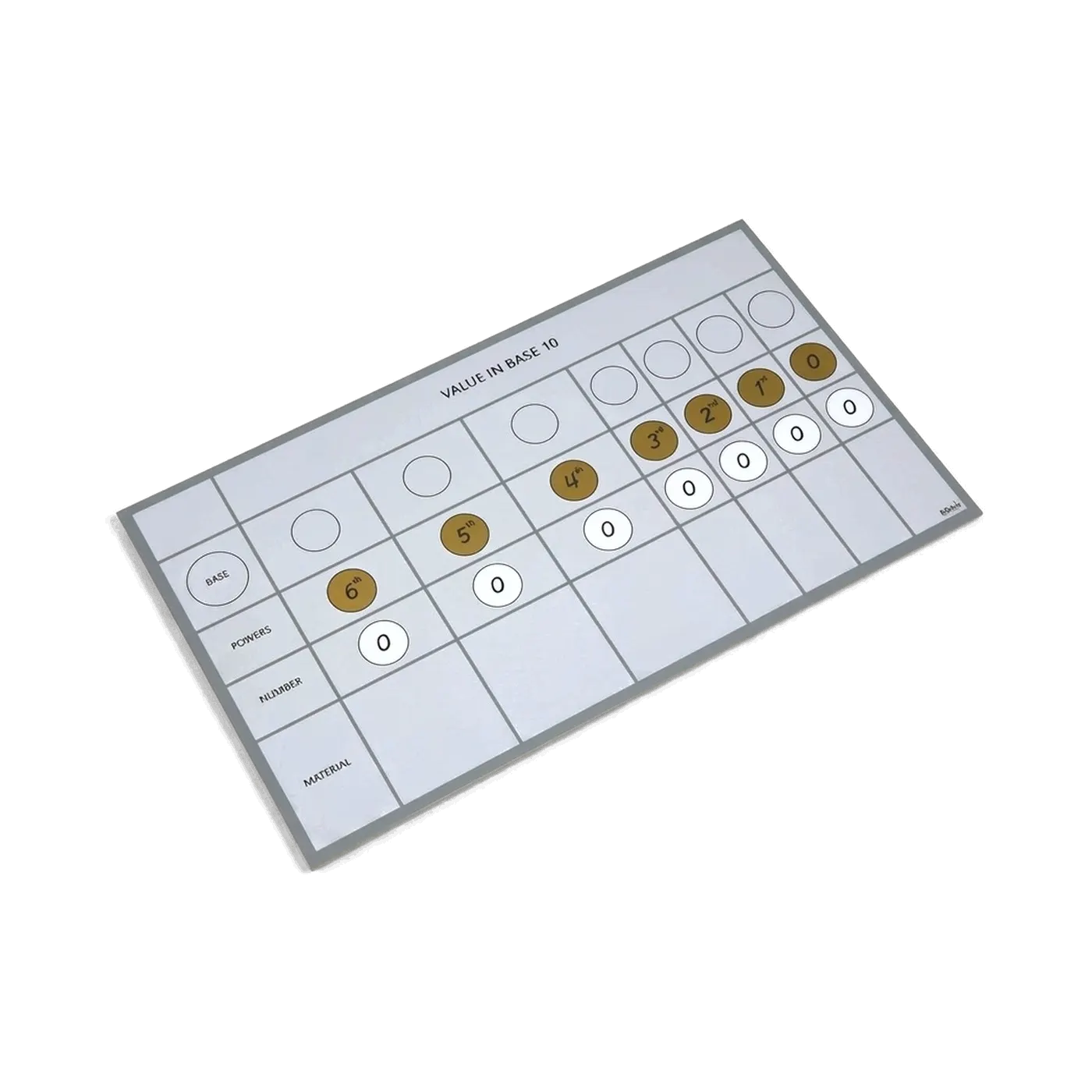
 Back 21/05/2027
Multibase Material
The first photo is the maker's own. The other shots are illustrative.
Inv. no. NIE-027000
- Maker
- Nienhuis Montessori, since 1929
- Approval
- AMI
- Blocks
- Solid wood with color finish
- Storage Box
- Natural wood construction
- EAN
- 8719924012052
€399.90
Final price incl. VAT. Free delivery.
✓ In Stock. Delivery in 5 to 9 working days.
1
30 daysto return
Advicebefore and after
Invoicefor companies
Advice, warranty and returns are handled by us.
The original
Why it costs €399.90
Behind the price of the original are things you can check yourself.
AMI approval
The material is approved by the Association Montessori Internationale (AMI). Nienhuis has made Montessori materials since 1929.
A verifiable original
The EAN 8719924012052 is on the box. It is the maker's number, not ours.
What the child does
Multibase Material in a child's hands
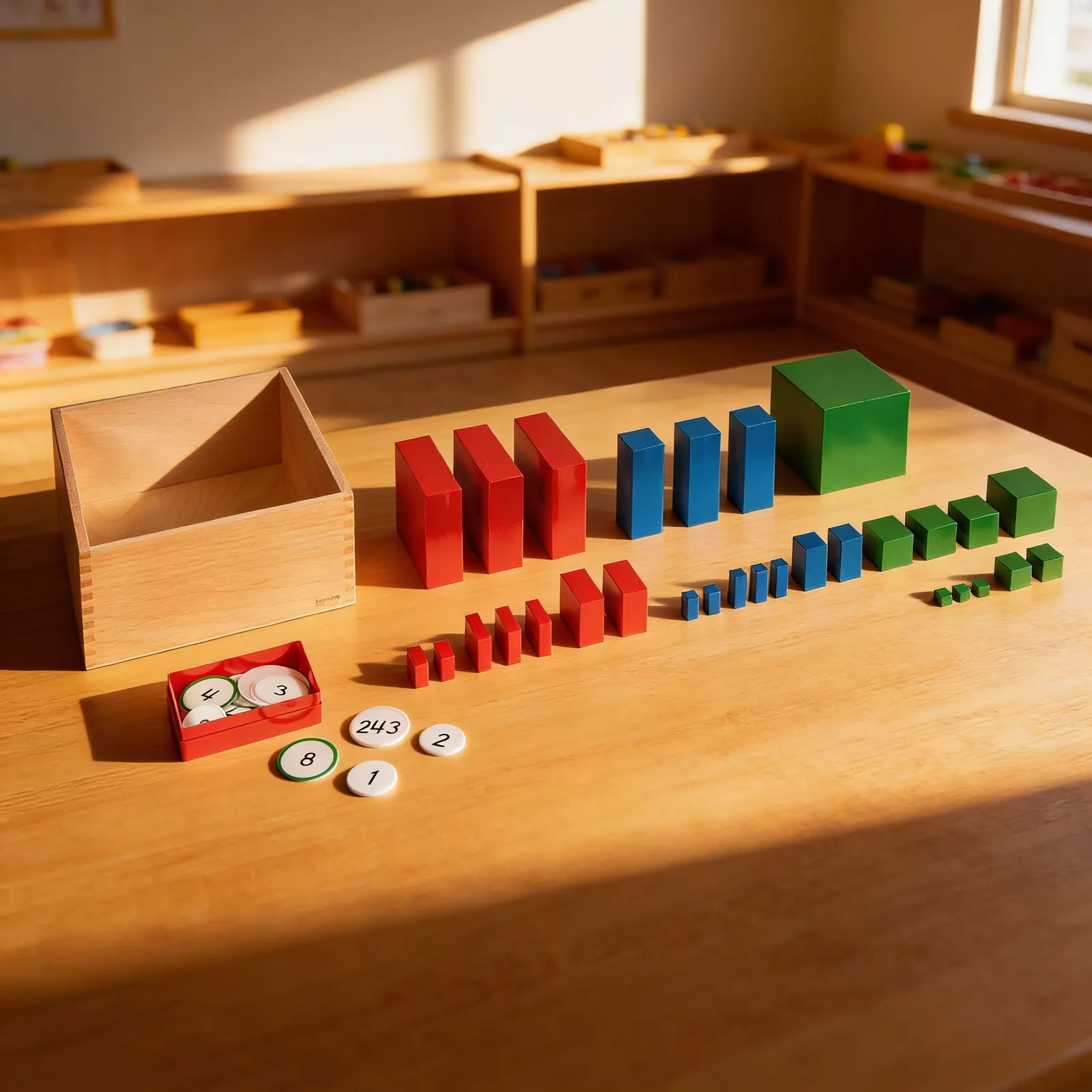
The Multibase Material is a comprehensive mathematical manipulative that enables children to physically explore place value concepts through graduated wooden blocks representing units, tens, hundreds, and thousands. This essential mathematics material includes a wooden storage box with organized compartments and accompanying number cards, supporting concrete understanding of mathematical operations and the decimal system through hands-on manipulation.
Place Value Understanding
Physical manipulation of proportionally-sized blocks creates concrete understanding of units, tens, hundreds, and thousands.
Mathematical Operations
Enables hands-on exploration of addition, subtraction, multiplication, and division through material manipulation.
Abstract Thinking
Bridges concrete materials to abstract mathematical concepts through visual and tactile experiences.
Problem-Solving Skills
Number cards with equations encourage independent exploration and verification of mathematical solutions.
Activity Guide
How to present it
Place the wooden storage box on a large work mat. Remove all blocks and arrange by category: unit cubes in one area, ten-rods in another, hundred-squares, and thousand-cubes separately. Place number cards in order nearby.
- 1Introduce each block type by inviting the child to hold and compare them, noting how ten units equal one ten-rod
- 2Build a four-digit number like 2,346 using the appropriate blocks and match with number cards
- 3Practice exchanges: trade ten unit cubes for one ten-rod, demonstrating regrouping physically
- 4Perform addition by combining two quantities of blocks, then counting the result
- 5Explore subtraction by removing blocks from a larger quantity
3 tips for parents
- Practice skip counting at home (by 10s, 100s) to reinforce patterns discovered with the blocks
- When helping with homework, reference the physical blocks experience: 'Remember how the ten-rod felt?'
- Avoid rushing to written algorithms; the concrete work with blocks builds essential understanding
From the same makerBack 21/05/2027Nienhuis
Accessories
Back 21/05/2027Why it is in our selection
If you are not sure it suits your child, we answer in person.
Norbert Kovalčín, founder of Faborino · write to him
There is no review here yet. We will ask you for one after you buy. Write the first review
Details
What's in the Box
- Unit Cubes: Small wooden blocks representing ones
- Ten Bars: Wooden bars representing tens
- Hundred Squares: Flat wooden squares representing hundreds
- Thousand Cube: Large wooden cube representing thousand
- Number Cards: Equation and number cards for exercises
- Storage Box: Wooden box with dividers for organization
Size and material
| Packaging | 24 × 21 × 12 cm |
| Blocks | Solid wood with color finish |
| Storage Box | Natural wood construction |
| Number Cards | Cardboard with protective coating |
| Recommended Age | 6-12 years |
Care
Wipe wooden pieces with slightly damp cloth, dry immediately
Frequently Asked Questions
What mathematical concepts does the Multibase Material teach?
The Multibase Material teaches place value, base-ten system understanding, addition, subtraction, multiplication, division, regrouping (carrying and borrowing), and decimal system concepts. It provides a concrete, visual representation of abstract mathematical operations, making complex concepts accessible to children ages 6-12.
What exactly is included in the Multibase Material set?
The complete set includes wooden unit cubes (ones), ten-bars (tens), hundred-squares (hundreds), and thousand-cubes, all precisely crafted to show proportional relationships. It comes with a wooden storage box with organized compartments and accompanying number cards for labeling and mathematical exercises.
How does this material support different learning levels?
The Multibase Material grows with the child, starting with simple counting and place value recognition for younger students, progressing to complex operations like multi-digit multiplication and division for older children. The concrete manipulatives allow children to physically experience mathematical concepts before moving to abstract work.
Why is the Multibase Material so expensive compared to plastic alternatives?
the price reflects the precision craftsmanship required for exact proportional relationships between pieces, high-quality hardwood construction for durability, and the comprehensive nature of the set. The material is designed to last decades in classroom use while maintaining its educational integrity and tactile appeal.
How do teachers typically introduce the Multibase Material?
Teachers begin by allowing children to explore the proportional relationships between units, tens, hundreds, and thousands. Initial lessons focus on building numbers and understanding place value, then progress to dynamic addition and subtraction with exchanging, and eventually to multiplication and division operations using the concrete materials.
Product safety
Manufacturer: Nienhuis Montessori, Anders Celsiusstraat 15, 7442 PB Nijverdal, Netherlands
Multibase Material
€399.90