
Multiplication Bead Bar Layout Box: Individual Nylon Beads
Made by Nienhuis Montessori · shipped by Heutink International (Netherlands) About the maker
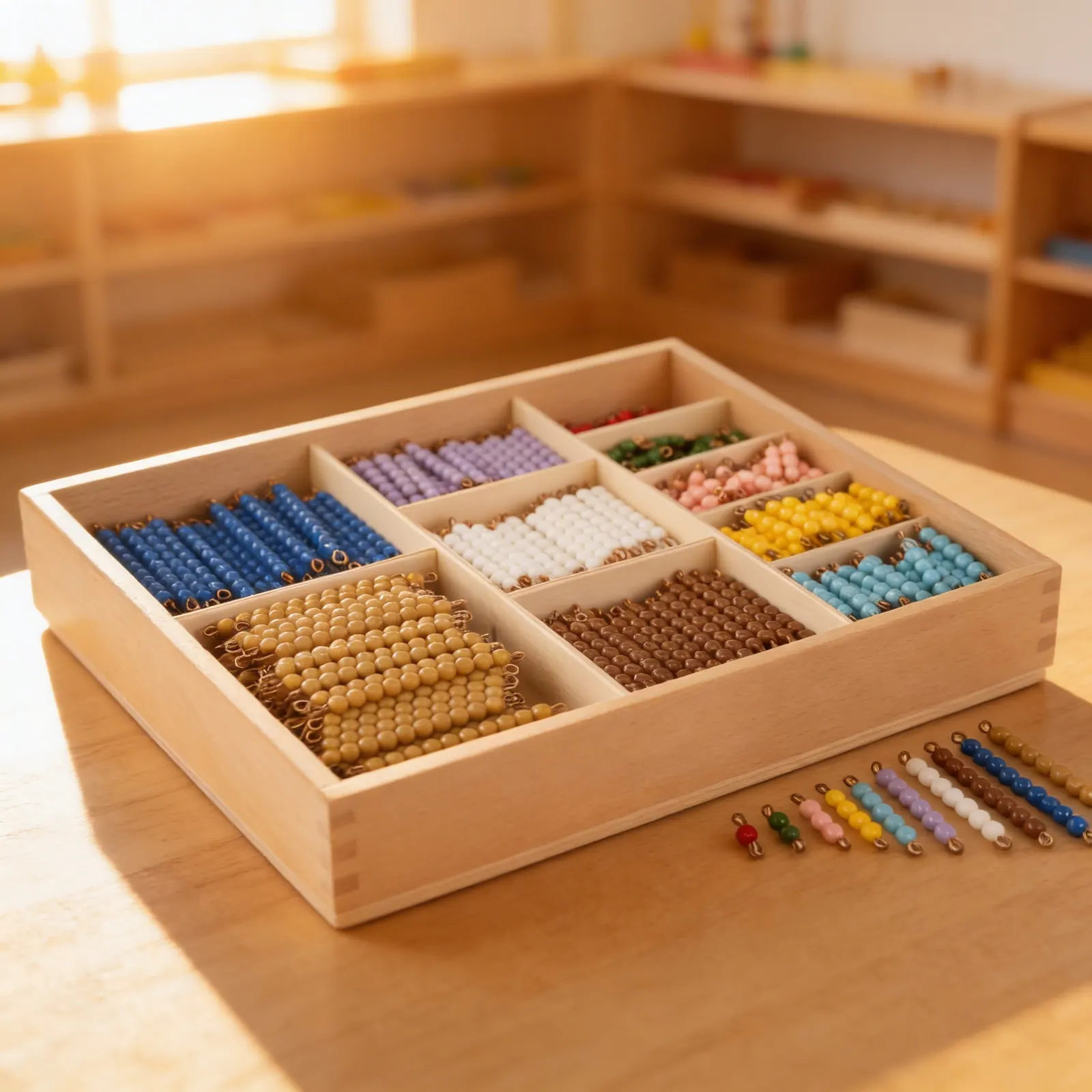
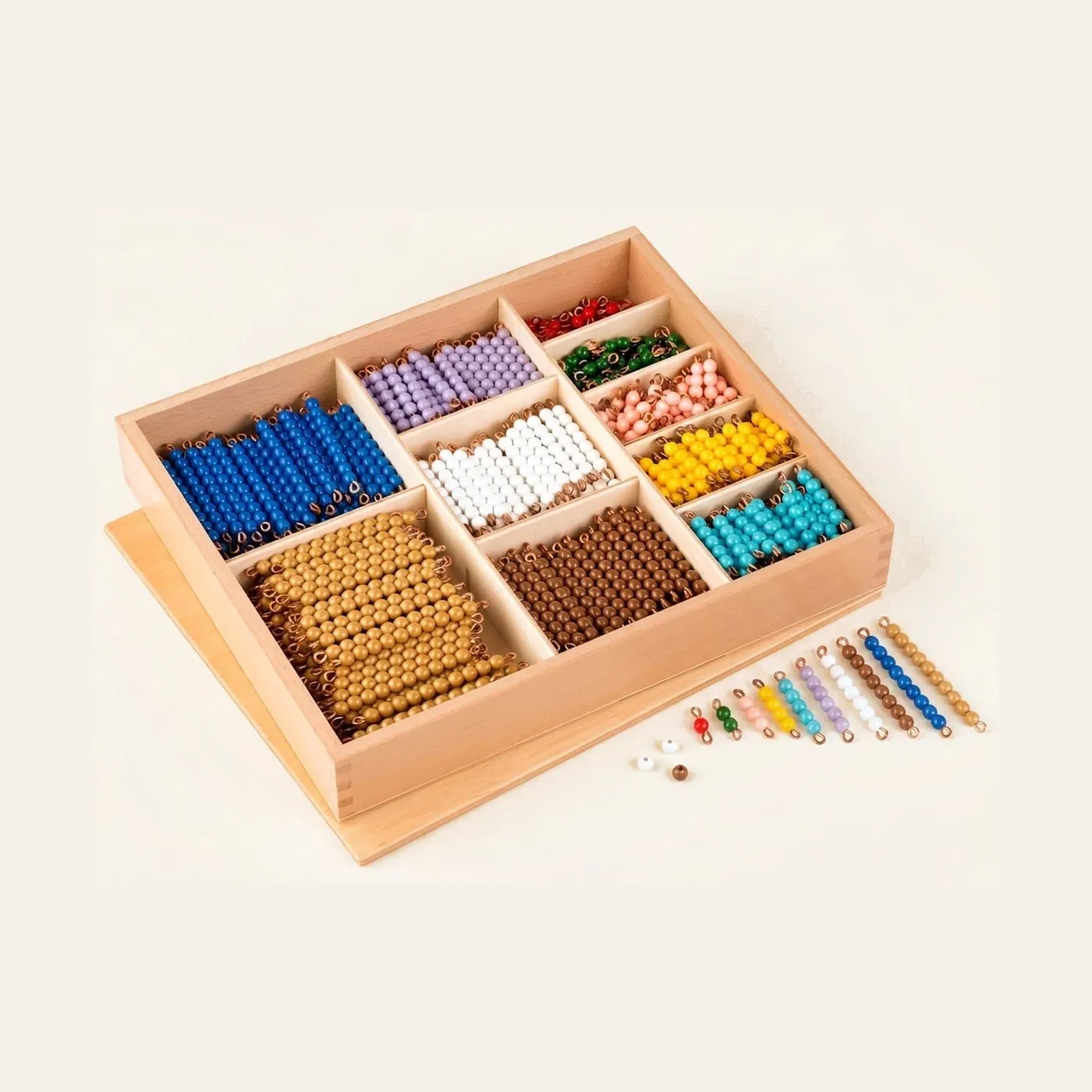
A layout box holding exactly the bead bars needed to build every multiplication table from one times one to ten times ten, with the product laid out beside it. The child builds seven rows of eight, counts the whole, and then builds eight rows of seven and finds the same number arrived at from the other direction. That is commutativity discovered rather than announced. Nylon bars stand up to the daily handling this material gets in a working classroom. Nylon beads on wire in a compartmented wooden box, for ages 6 to 12.
“The child is both a hope and a promise for mankind.”
The Multiplication Bead Bar Layout Box embodies Maria Montessori's principle of concrete to abstract learning, allowing children to physically manipulate quantities before internalizing mathematical concepts. This material honors the mathematical mind's need for order and precision while providing sensorial experiences that create lasting impressions. The color-coded bead bars serve as a bridge between the concrete representation of quantity and the abstract concept of multiplication, enabling children to discover mathematical patterns independently.
- Master multiplication facts through sensorial memory and repeated practice
- Understand the commutative property of multiplication through visual arrangement
- Develop systematic thinking and organizational skills through precise bead bar placement
- Build foundation for algebraic thinking through pattern recognition
Read More
Through repeated manipulation, children develop a deep understanding of multiplication as repeated addition, while the organized layout satisfies their inherent need for order and classification during the second plane of development.
How to present it
Follow the Montessori method of presentation for optimal child development.
Place the Multiplication Bead Bar Layout Box on a large work mat. Ensure all bead bars are properly sorted in their compartments (1-10). Have a felt-lined tray available for transporting selected bead bars.
- 1
Begin with simple multiplication: Select three 4-bars to demonstrate 3×4
Always arrange bead bars horizontally, maintaining consistent spacing between each bar - 2
Count the total beads by touching each one, emphasizing the repeated groups of four
Use a three-period lesson to introduce vocabulary: 'This is three taken four times' - 3
Rearrange the same beads as four 3-bars to show 4×3, demonstrating commutativity
Allow the child to discover that the total remains the same - 4
Invite the child to create their own multiplication layouts using different combinations
Start with smaller numbers (2-5) before progressing to larger multiplicands - 5
Record the equation on paper after building each layout
Connect the concrete work to abstract symbols only after thorough manipulation
Every Child Is a Little Creator

Heritage
Since 1929

In classrooms
Around the world

European brands
Nienhuis, GAM, Educo

AMI approved
To the association standard
Multiplication Bead Bar Layout Box: Individual Nylon Beads
