
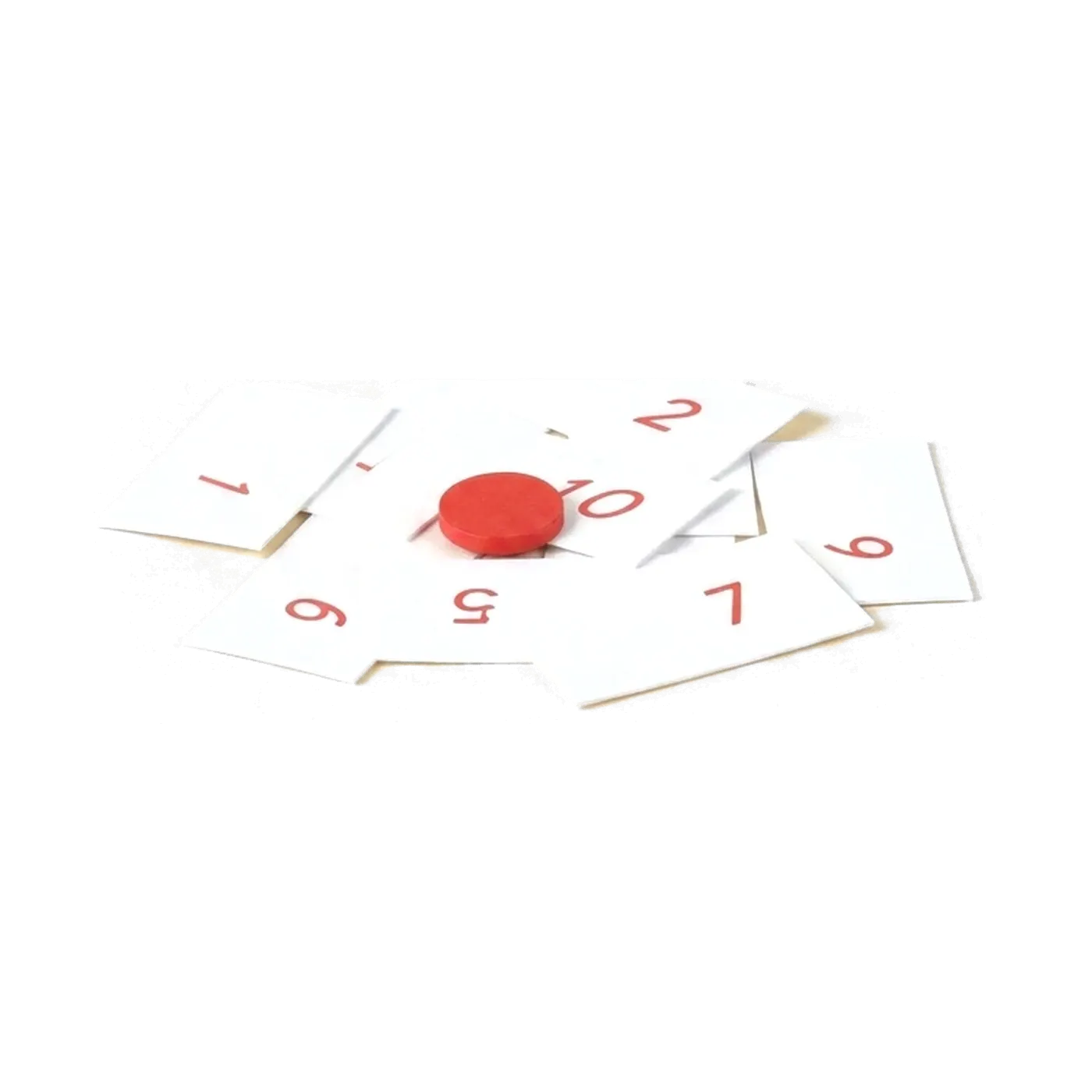
Multiplication Board (Nienhuis)
The first photo is the maker's own. The other shots are illustrative.
Inv. no. NIE-008700
- Maker
- Nienhuis Montessori, since 1929
- Approval
- AMI
- Board
- Natural wood
- Beads
- Plastic counting beads
- EAN
- 8719924005177
€38.90
Final price incl. VAT. Delivery €5.90, €110.10 to go for free delivery.
✓ In Stock. Delivery in 5 to 9 working days.
1
30 daysto return
Advicebefore and after
Invoicefor companies
Advice, warranty and returns are handled by us.
The original
Why it costs €38.90
Behind the price of the original are things you can check yourself.
AMI approval
The material is approved by the Association Montessori Internationale (AMI). Nienhuis has made Montessori materials since 1929.
A verifiable original
The EAN 8719924005177 is on the box. It is the maker's number, not ours.
What the child does
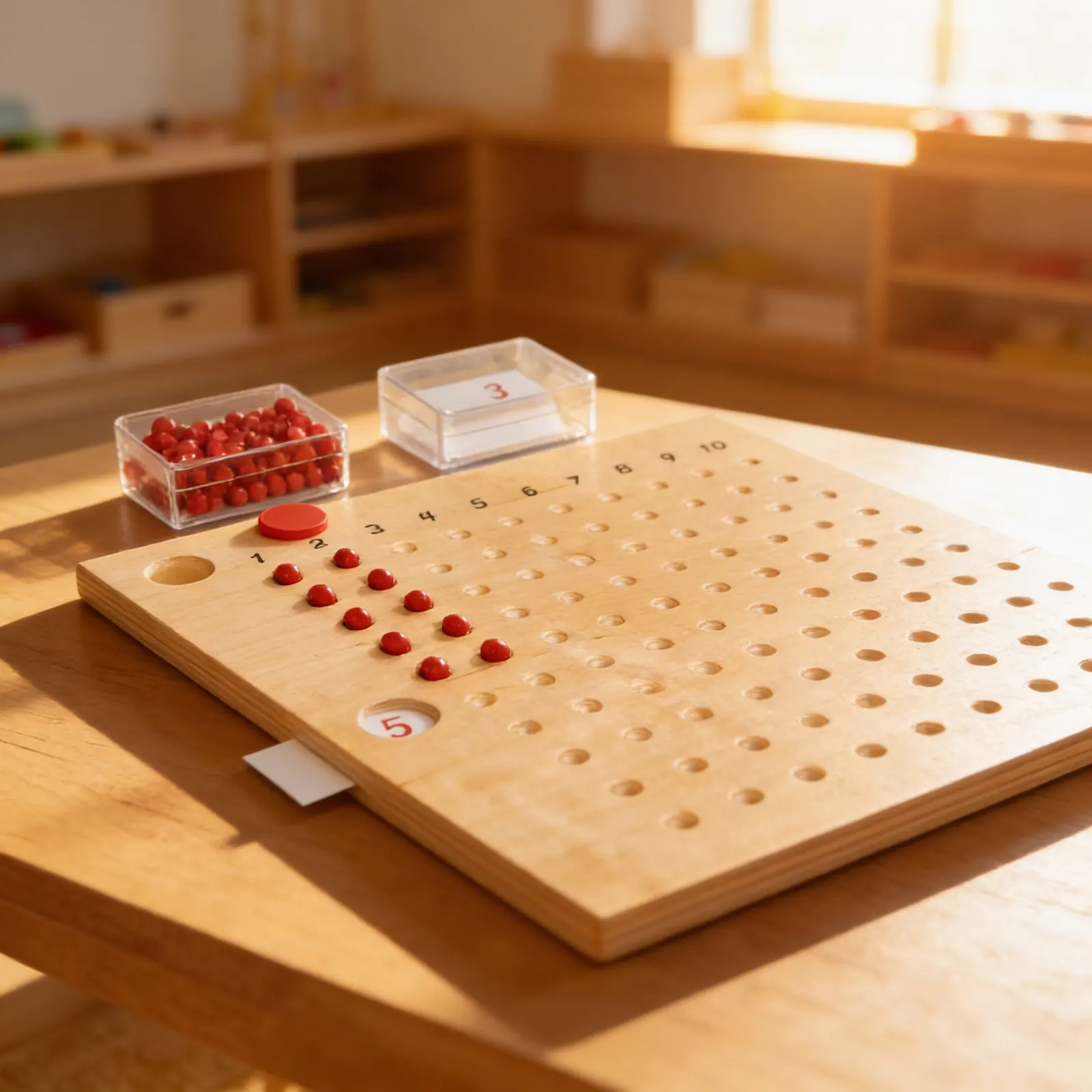
Multiplication Board (Nienhuis) in a child's hands
The multiplication board, for working the tables from one times one through ten times ten. It is the material where a table is built rather than recited: the multiplicand is set once, a marker moves along to say which multiple is wanted, and the beads are laid out that many times. Seeing seven laid out four times, taking up four times the room, is what stops seven times four being a sound with no size attached to it. Wood with plastic, for ages 3 to 6.
Multiplication Mastery
Children physically construct multiplication facts by placing beads in rows, building concrete understanding before moving to abstraction.
Pattern Recognition
The visual grid layout reveals mathematical patterns and relationships, supporting discovery of multiplication properties.
Fine Motor Precision
Placing small beads in specific holes refines pincer grasp and hand-eye coordination essential for writing.
Concentration Development
Systematic bead placement for complete multiplication tables builds sustained focus and attention to detail.
Activity Guide
How to present it
Place the Multiplication Board on a mat with red beads in their storage compartment. Position the numbered disc at column 1. Have equation slips ready (e.g., 3 × 4).
- 1Select an equation slip and identify the multiplier (first number) and multiplicand (second number)
- 2Place the numbered disc above the column matching the multiplicand
- 3Count out red beads equal to the multiplier and place one bead in each row of the selected column
- 4Count all placed beads to find the product, touching each bead as you count
- 5Record the complete equation and clear the board for the next problem
3 tips for parents
- Practice skip counting during daily activities before introducing the multiplication board
- Allow extended time for board exploration without rushing to memorization
- Connect multiplication to real situations: 'If we have 3 bags with 4 apples each...'
From the same makerNienhuis
Spare parts
Why it is in our selection
If you are not sure it suits your child, we answer in person.
Norbert Kovalčín, founder of Faborino · write to him
There is no review here yet. We will ask you for one after you buy. Write the first review
Details
What's in the Box
- Wooden multiplication board: 30×30 cm with numbered grid
- Red counting beads: Approx. 100 pieces
- Storage boxes: 2 plastic compartments
Size and material
| Packaging | 26 × 26 × 5 cm |
| Board | Natural wood |
| Beads | Plastic counting beads |
| Storage | Plastic compartments |
| Recommended Age | 3-6 years |
Care
Wipe board with slightly damp cloth, dry immediately
Frequently Asked Questions
Is this multiplication board suitable for 3-year-olds, or should I wait until my child is older?
While labeled for ages 3-6, most children benefit from this material starting around age 4-5 when they've mastered addition concepts. Younger children can use it for counting and pattern work, but multiplication understanding typically develops after a solid foundation in addition and skip counting.
How does the multiplication board work with the red beads?
Children place red beads on the grid to physically build multiplication problems. For example, to show 3×4, they place 4 beads in each of the first 3 columns, creating a visual representation of repeated addition. This concrete manipulation helps children understand that multiplication is repeated addition before moving to abstract concepts.
What's included with the board and how is it stored?
The set includes the wooden 10×10 grid board, 100 red counting beads, and built-in storage compartments. The board typically has a recessed area or compartment to store the beads when not in use, keeping all materials organized and preventing loss of pieces.
What mathematical concepts can children learn beyond basic multiplication?
Children discover patterns in multiplication tables, commutative property (3×4 = 4×3), skip counting, factors, and the relationship between multiplication and division. The visual grid also helps identify square numbers and prepares children for understanding area concepts in geometry.
Should children memorize multiplication facts or just understand the concept?
The Montessori approach emphasizes understanding before memorization. This board helps children physically experience multiplication patterns and relationships. Once they truly understand the concept through repeated hands-on work, memorization of facts comes naturally and meaningfully, rather than through rote learning.
Product safety
Manufacturer: Nienhuis Montessori, Anders Celsiusstraat 15, 7442 PB Nijverdal, Netherlands
Multiplication Board (Nienhuis)
€38.90