
Multiplication Working Charts (Nienhuis)
The first photo is the maker's own. The other shots are illustrative.
Inv. no. NIE-0142C4
- Maker
- Nienhuis Montessori, since 1929
- Approval
- AMI
- Charts
- Laminated paper/cardstock
- Tiles
- Solid wood
- EAN
- 8719924007485
Final price incl. VAT. Delivery €5.90, €39.10 to go for free delivery.
Advice, warranty and returns are handled by us.
Why it costs €109.90
Behind the price of the original are things you can check yourself.
AMI approval
The material is approved by the Association Montessori Internationale (AMI). Nienhuis has made Montessori materials since 1929.
A verifiable original
The EAN 8719924007485 is on the box. It is the maker's number, not ours.
Multiplication Working Charts (Nienhuis) in a child's hands
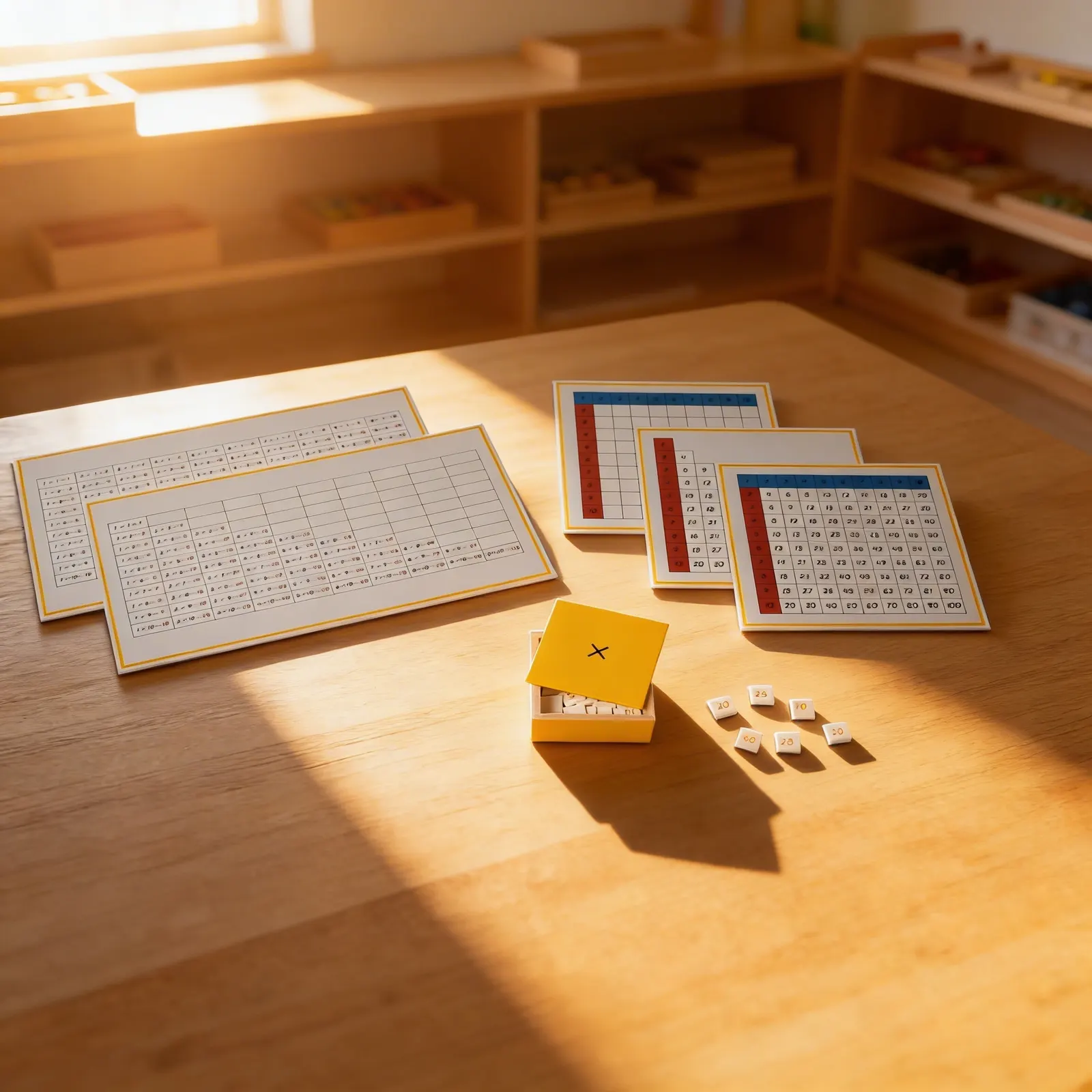
Two control charts, three working charts and a box of wooden product chips for the multiplication tables from one times one to ten times ten. Three working charts rather than one lets a child move through progressively less support: the first gives more away, the last gives almost nothing, and by then the facts are held rather than read. Chips instead of writing keep every attempt reversible. Laminated paper with wood, for ages 3 to 6.
Multiplication Mastery
Systematic practice leads to memorization of multiplication facts through repeated concrete manipulation.
Pattern Recognition
Color-coded grids help children discover multiplication patterns and relationships between numbers.
Self-Correction
Control charts allow independent work and immediate feedback, building confidence and autonomy.
Abstract Thinking
Bridges the gap between concrete materials and abstract mathematical concepts through progressive exercises.
How to present it
Place Chart 1 on the work mat with the tile box containing all numbered answer tiles. Ensure tiles are organized numerically in compartments for easy selection.
- 1Begin with the 1x1 equation at the top left of Chart 1
- 2Search through the tile box to find the correct answer tile
- 3Place the answer tile in the empty square next to its equation
- 4Continue working systematically through each row
- 5When Chart 1 is complete, remove all tiles and progress to Chart 2
3 tips for parents
- Resist the urge to correct errors immediately - let your child discover mistakes through self-checking
- Practice skip counting at home (2, 4, 6, 8...) to support pattern recognition
- Celebrate completion of each chart rather than speed of memorization

If you are not sure it suits your child, we answer in person.
Norbert Kovalčín, founder of Faborino · write to him
There is no review here yet. We will ask you for one after you buy. Write the first review
What's in the Box
- Working Charts: Approx. 6-8 laminated multiplication grids
- Wooden Tiles: Complete set of numbered tiles
- Storage Box: Wooden box with compartment dividers
- Control Charts: Answer key charts for self-correction
Size and material
| Packaging | 43 × 21 × 6 cm |
| Charts | Laminated paper/cardstock |
| Tiles | Solid wood |
| Storage Box | Natural wood with compartments |
| Recommended Age | 3-6 years |
Care
Wipe charts with damp cloth; clean tiles with dry cloth
Frequently Asked Questions
At what age should children start using the Multiplication Working Charts?
While labeled for ages 3-6, these charts are typically introduced around age 5-6, after children have mastered addition and subtraction concepts and have worked with multiplication using concrete materials like the bead chains and multiplication bead board.
What materials are included in the Multiplication Working Charts set?
The set includes multiple working charts with grids for multiplication practice, wooden numbered tiles for placing answers, control charts for self-correction, and a wooden storage box. The charts progress from simple to complex multiplication facts.
How do these charts help children memorize multiplication facts?
Children physically place numbered tiles in the correct spaces on the charts, engaging tactile and visual learning. The repetitive practice combined with self-correction using control charts helps children internalize multiplication facts through hands-on manipulation rather than rote memorization.
What's the difference between the Multiplication Working Charts and the Multiplication Bead Board?
The Multiplication Bead Board introduces the concept of multiplication using concrete beads to show groups and quantities. The Working Charts are used after this initial understanding, focusing on practicing and memorizing multiplication facts through number tiles and systematic chart work.
How long does it typically take for a child to master all the multiplication facts using these charts?
Progress varies by child, but with regular practice (15-20 minutes daily), most children can master basic multiplication facts (1-10) within 3-6 months. The material allows children to work at their own pace, building confidence and fluency gradually.
Product safety
Manufacturer: Nienhuis Montessori, Anders Celsiusstraat 15, 7442 PB Nijverdal, Netherlands
Multiplication Working Charts (Nienhuis)