
Number RodsTen Graduated Wooden Rods with Red & Blue Sections
The first photos are the maker's own. The other shots are illustrative.
Inv. no. NIE-002700
- Maker
- Nienhuis Montessori, since 1929
- Approval
- AMI
- Wood
- Solid beechwood, kiln-dried
- Finish
- Lacquer with red and blue paint
- EAN
- 8719924001421
Final price incl. VAT. Free delivery.
Advice, warranty and returns are handled by us.
Why it costs €195.90
Behind the price of the original are things you can check yourself.
AMI approval
The material is approved by the Association Montessori Internationale (AMI). Nienhuis has made Montessori materials since 1929.
A verifiable original
The EAN 8719924001421 is on the box. It is the maker's number, not ours.
Number Rods in a child's hands
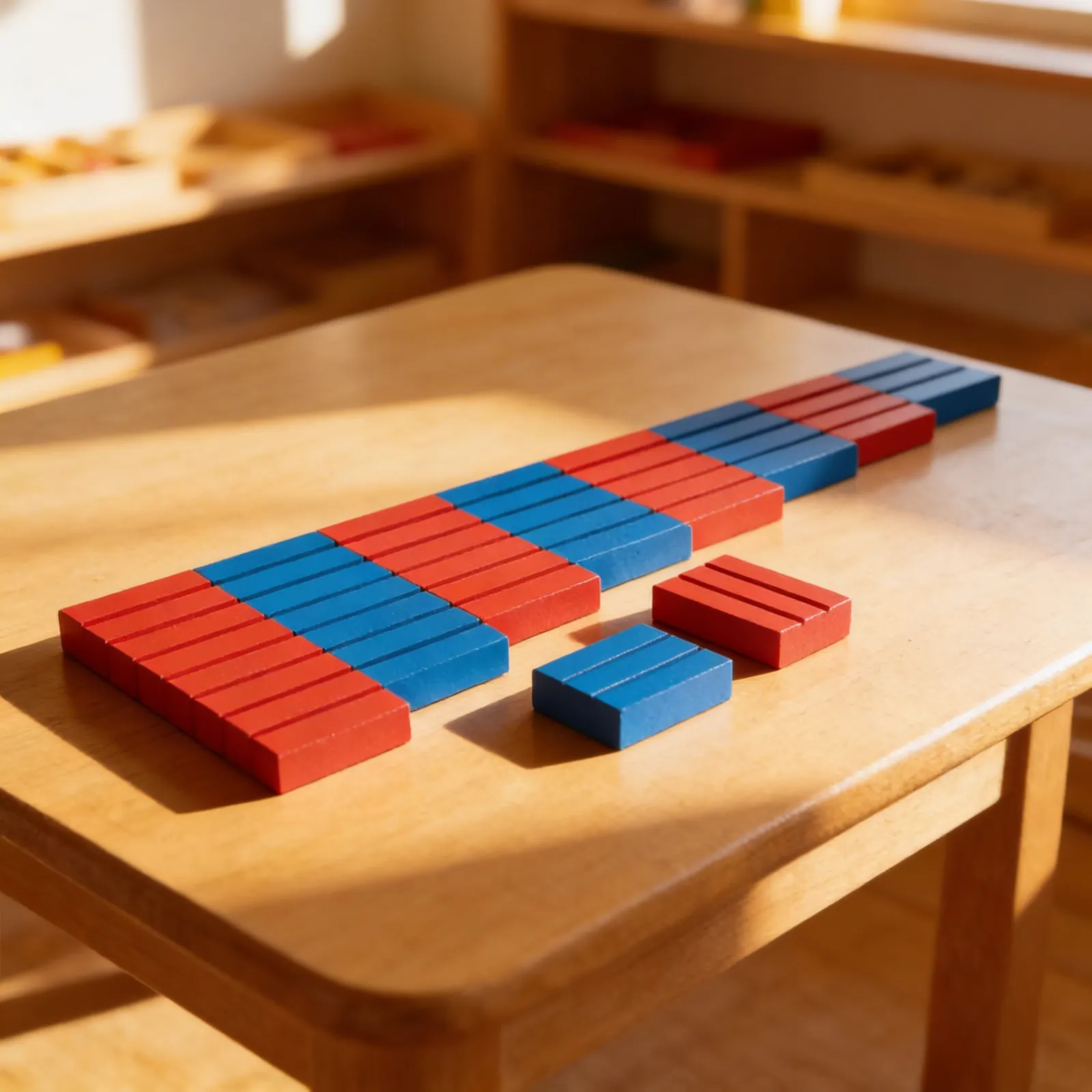
Ten rods that grow in equal steps, each divided into units by alternating red and blue sections, so a child can see that the seven rod is seven of something and not simply a longer stick. That is the whole difference between counting and quantity. Laying the rods in order builds the sequence of number, and putting the three rod against the seven to match the ten is where combinations of ten stop being a table to learn and become a thing that fits. Beechwood with red and blue paint, for ages 3 to 6.
Number Sense
Physical understanding of quantity, each number has a corresponding size
Ordering
Building rods in sequence develops understanding of numerical order
Comparison
Seeing that 7 is larger than 5 through direct physical comparison
Gross Motor
Carrying and arranging long rods develops coordination
How to present it
- 11
- 22
- 33
- 44
2 tips for parents
- Count real objects at home: 'How many spoons do we need for dinner?'
- Compare quantities: 'You have 3 crackers, your sister has 5, who has more?'

If you are not sure it suits your child, we answer in person.
Norbert Kovalčín, founder of Faborino · write to him
There is no review here yet. We will ask you for one after you buy. Write the first review
What's in the Box
- Number Rods: Set of 10, graduated 10-100 cm
Size and material
| Packaging | 106 × 9 × 6 cm |
| Wood | Solid beechwood, kiln-dried |
| Finish | Lacquer with red and blue paint |
| Recommended Age | 3.5-5 years |
| Montessori Level | Primary (Casa) |
Care
| Cleaning | Wipe with slightly damp cloth |
| Storage | Horizontal on shelf or in rod stand |
Frequently Asked Questions
How do Number Rods differ from Red Rods?
Number Rods are painted in alternating red and blue sections to represent quantities 1-10, while Red Rods are solid red and focus purely on length discrimination. Number Rods add the mathematical component of counting and number association to the sensorial length experience.
What mathematical concepts do Number Rods teach?
Children learn counting, number recognition, quantity comparison, addition, subtraction, and the concept of odd and even numbers. The rods provide a concrete, visual representation of numbers 1-10 and their relationships.
At what age should Number Rods be introduced?
Number Rods are typically introduced around age 3.5-4.5 years, after children have mastered the Red Rods and developed solid counting skills to at least 10. The child should understand one-to-one correspondence.
How should children handle the longer rods safely?
Children carry each rod horizontally with both hands, one at each end. Longer rods require careful navigation through the classroom. This deliberate movement develops spatial awareness and respect for materials and classmates.
What extensions can be done with Number Rods?
Extensions include addition and subtraction games using two rods together, making ten combinations, comparing rod lengths with number cards, and memory games where children find rods matching a given number from across the room.
Product safety
Manufacturer: Nienhuis Montessori, Anders Celsiusstraat 15, 7442 PB Nijverdal, Netherlands
Number Rods