
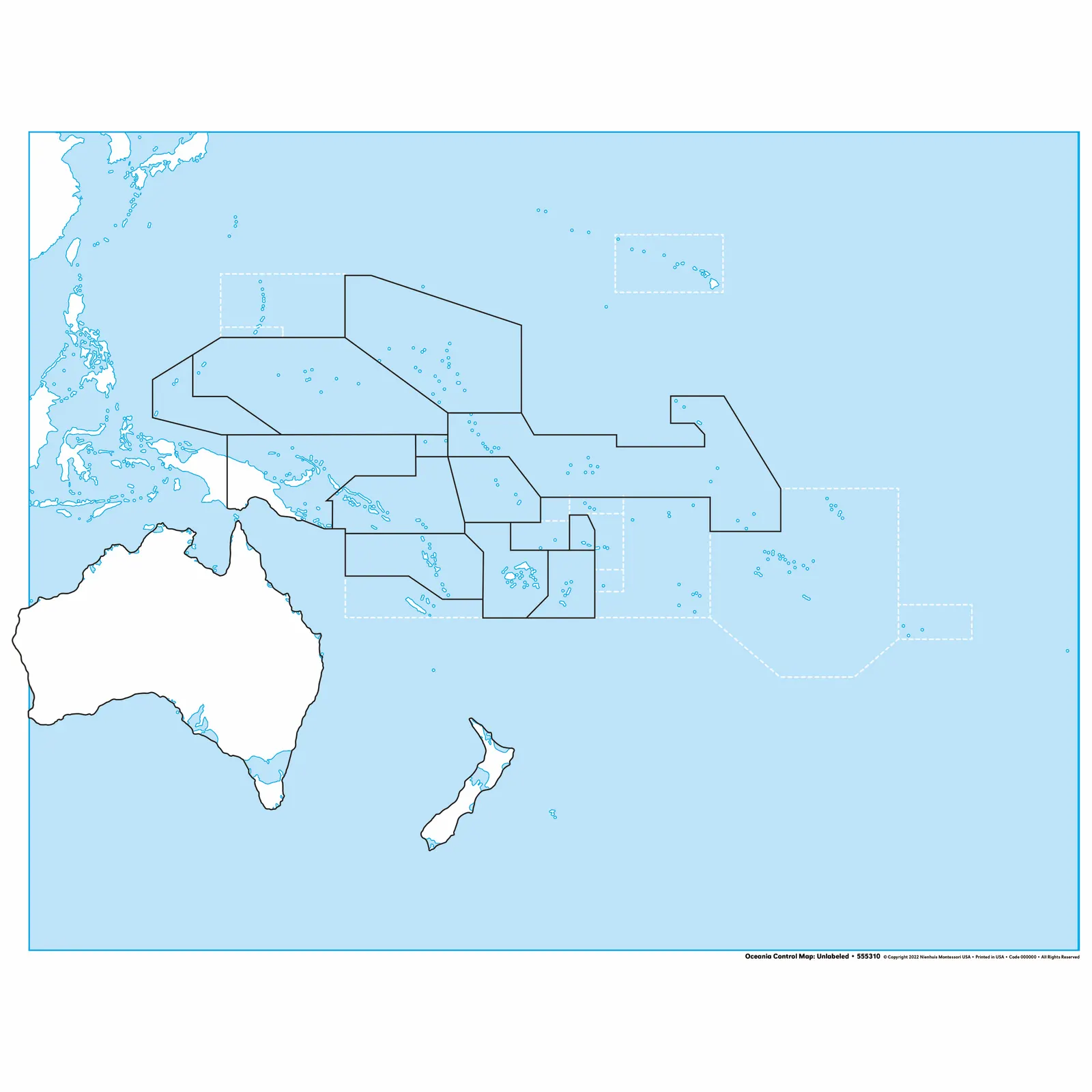
Oceania Control Map: Unlabeled
Made by Nienhuis Montessori · shipped by Heutink International (Netherlands) About the maker
Oceania Control Map, Unlabeled shows the region's islands and coastlines on laminated paper with no printed text, so a child aged three to six can focus first on shape and position alone. Used with the wooden puzzle map, it is the visual key the child checks their placement against before a single name is spoken in the lesson. This wordless, sensorial stage trains the eye and builds the visual memory that later makes the labeled map and its country names easy to learn. Laminate keeps the sheet flat and crisp through daily, repeated handling.
“The child is both a hope and a promise for mankind.”
The Oceania Control Map serves as a concrete geographical reference that transforms abstract concepts of distant lands into tangible, traceable shapes. By presenting unlabeled countries on blue ocean backgrounds, this laminated map allows children to focus purely on the distinctive outlines of Australia, New Zealand, and Pacific islands without the distraction of text.
- Develops visual discrimination of island and continental shapes
- Builds understanding of land and water relationships
- Strengthens spatial memory through repeated reference
- Enhances fine motor control through tracing activities
Read More
Each boundary line on the control map creates opportunities for visual discrimination as children match puzzle pieces or trace continental shapes. The map's clear divisions between land and water help three-to-six-year-olds build mental images of how islands and continents exist within vast oceans. This specific control map addresses the developmental need for order by providing a consistent reference point that children can return to repeatedly. The durable laminated surface withstands frequent handling as young geographers trace coastlines with their fingers, building muscle memory of each country's unique shape. By isolating the Oceania region, this map allows focused exploration of one continental area before expanding to global geography.
How to present it
Follow the Montessori method of presentation for optimal child development.
Place the control map on a work mat at the child's eye level. Have tracing paper, colored pencils, and the corresponding Oceania puzzle map nearby if available.
- 1
Invite the child to explore the map visually, pointing out the blue water and land shapes
Let the child discover Australia's distinctive shape naturally - 2
Demonstrate tracing the outline of one country with your finger, moving slowly along the boundary
Start with larger landmasses like Australia before moving to smaller islands - 3
Show how to place tracing paper over the map and trace one country's outline
Secure corners with small weights to prevent shifting - 4
Color the traced country and compare it to the control map
Use consistent colors that match your classroom's geography materials
Every Child Is a Little Creator

Heritage
Since 1929

In classrooms
Around the world

European brands
Nienhuis, GAM, Educo

AMI approved
To the association standard
Oceania Control Map: Unlabeled
