Oceans Control MapUnlabeled
The first photo is the maker's own. The other shots are illustrative.
Inv. no. NIE-557910
- Maker
- Nienhuis Montessori, since 1929
- Approval
- AMI
- Base Material
- Paper
- Surface
- Laminated coating
- EAN
- 8719924061265
Final price incl. VAT. Delivery €5.90, €128.10 to go for free delivery.
Advice, warranty and returns are handled by us.
Why it costs €20.90
Behind the price of the original are things you can check yourself.
AMI approval
The material is approved by the Association Montessori Internationale (AMI). Nienhuis has made Montessori materials since 1929.
A verifiable original
The EAN 8719924061265 is on the box. It is the maker's number, not ours.
Oceans Control Map in a child's hands
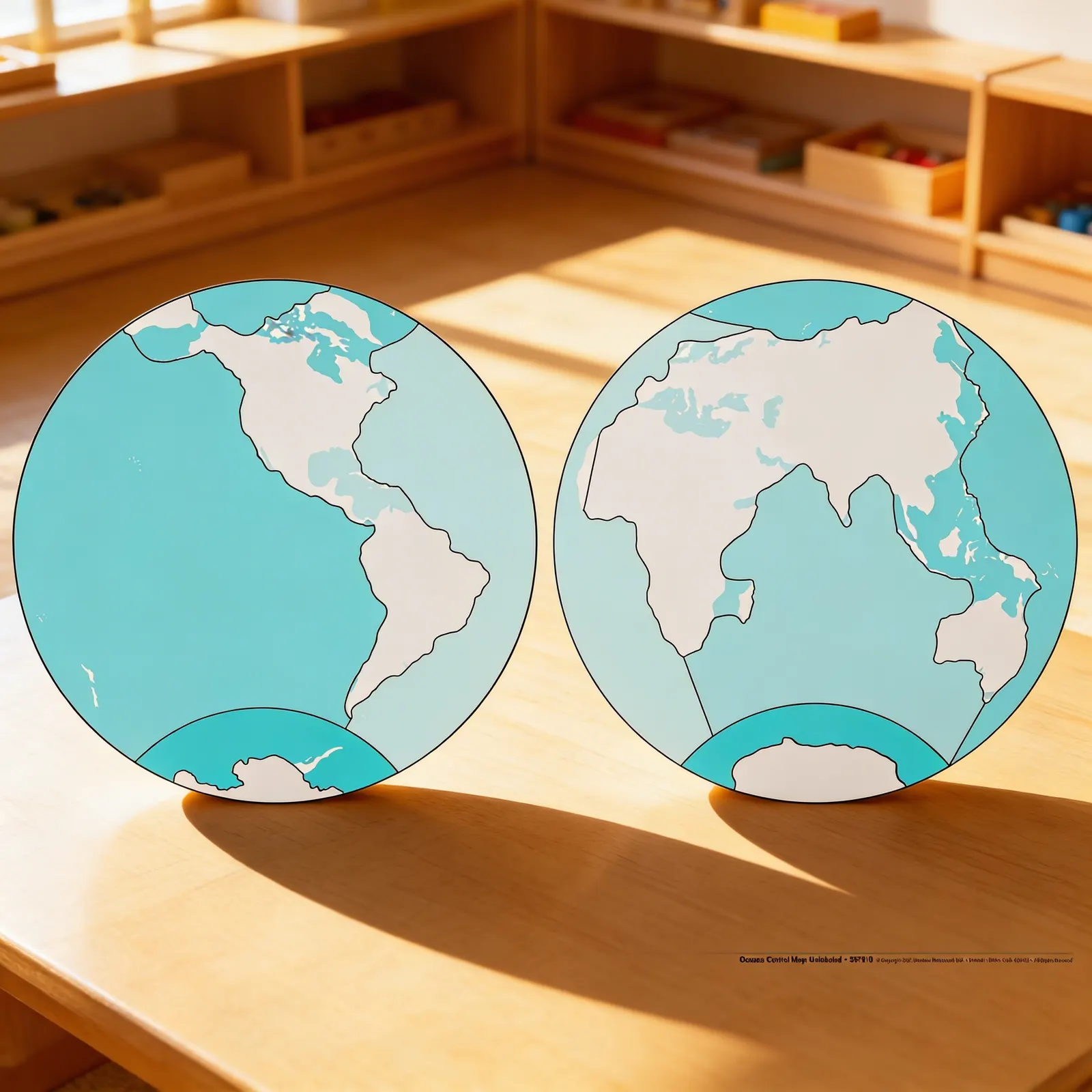
The Oceans Control Map: Unlabeled shows the world as two hemispheres, with the oceans in different shades of blue and the continents left white in outline. Antarctica sits at the bottom of both hemispheres, and no names are printed anywhere on the map. According to Nienhuis it is made of paper, in blue and white, and is meant for indoor use. The child can use the map to practise naming each ocean by its position and shade. For ages 3 to 6.
Geographic Awareness
Children develop understanding of Earth's oceans and continents through visual discrimination and spatial relationships.
Visual Discrimination
The high-contrast colors between water and land help children distinguish geographic boundaries and shapes.
Preparation for Nomenclature
Unlabeled format allows children to apply learned vocabulary and prepares them for more advanced geography work.
Independence and Self-Assessment
Children can work autonomously, checking their understanding of ocean and continent placement without adult guidance.
How to present it
Place the Oceans Control Map on a table or mat at child's eye level. Have the corresponding ocean labels in a separate container nearby. Ensure good lighting to distinguish between turquoise water and white land areas.
- 1Invite the child to trace the outline of each ocean with their finger, starting with the largest (Pacific)
- 2Point to each ocean and share its name using clear, precise language
- 3Play a finding game: 'Can you show me the Atlantic Ocean?'
- 4Once familiar with ocean shapes, introduce the separate ocean labels for matching
3 tips for parents
- Point out oceans when reading stories or looking at pictures of different countries
- During bath time, discuss how oceans connect different parts of the world
- Look for the same ocean shapes in different maps at home or in books

If you are not sure it suits your child, we answer in person.
Norbert Kovalčín, founder of Faborino · write to him
There is no review here yet. We will ask you for one after you buy. Write the first review
What's in the Box
- Oceans Control Map: Unlabeled, laminated
Size and material
| Packaging | 5 × 6 × 0 cm |
| Base Material | Paper |
| Surface | Laminated coating |
| Recommended Age | 3-6 years |
Care
Wipe with damp cloth; dry immediately
Frequently Asked Questions
What is the difference between labeled and unlabeled control maps?
Unlabeled control maps have no text, allowing children to focus purely on shapes, colors, and spatial relationships. This encourages independent learning as children match the map with labeled materials or use nomenclature cards to identify oceans and continents themselves.
How does this map support the Montessori approach to geography?
This map follows Montessori principles by isolating concepts (oceans vs. land), using distinct colors for visual discrimination, and allowing hands-on exploration. Children can trace boundaries, discuss water vs. land, and build concrete understanding before moving to abstract concepts.
What activities can children do with this unlabeled ocean map?
Children can trace ocean boundaries, match with labeled maps, place ocean name labels, sort ocean/continent cards, create their own maps, discuss ocean characteristics, and explore which continents border which oceans. It also pairs well with ocean animal sorting activities.
Why are the oceans turquoise and continents white on this map?
The contrasting turquoise and white colors create clear visual boundaries that help young children distinguish water from land. This color coding is consistent across Montessori geography materials, supporting the child's ability to recognize and categorize Earth's features.
What skills does this map help develop in 3-6 year olds?
This map develops spatial awareness, visual discrimination, geographic vocabulary, fine motor skills through tracing, memory through repetition, and global awareness. It also supports language development as children learn ocean names and prepares them for more complex geography studies.
Product safety
Manufacturer: Nienhuis Montessori, Anders Celsiusstraat 15, 7442 PB Nijverdal, Netherlands
Oceans Control Map