
Golden Bead Cube of 1000: Individual Nylon-Coated Beads
Made by Nienhuis Montessori · shipped by Heutink International (Netherlands) About the maker
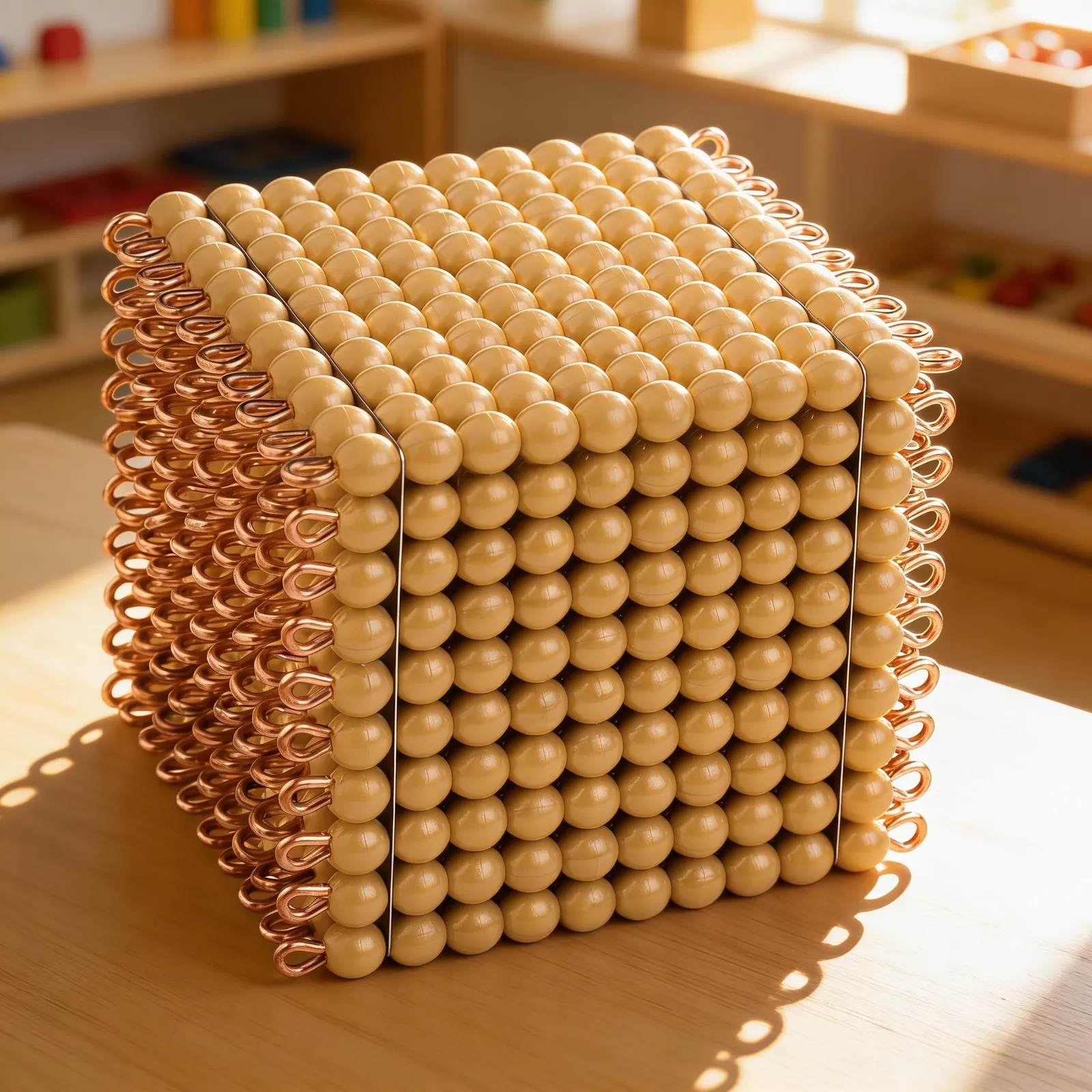
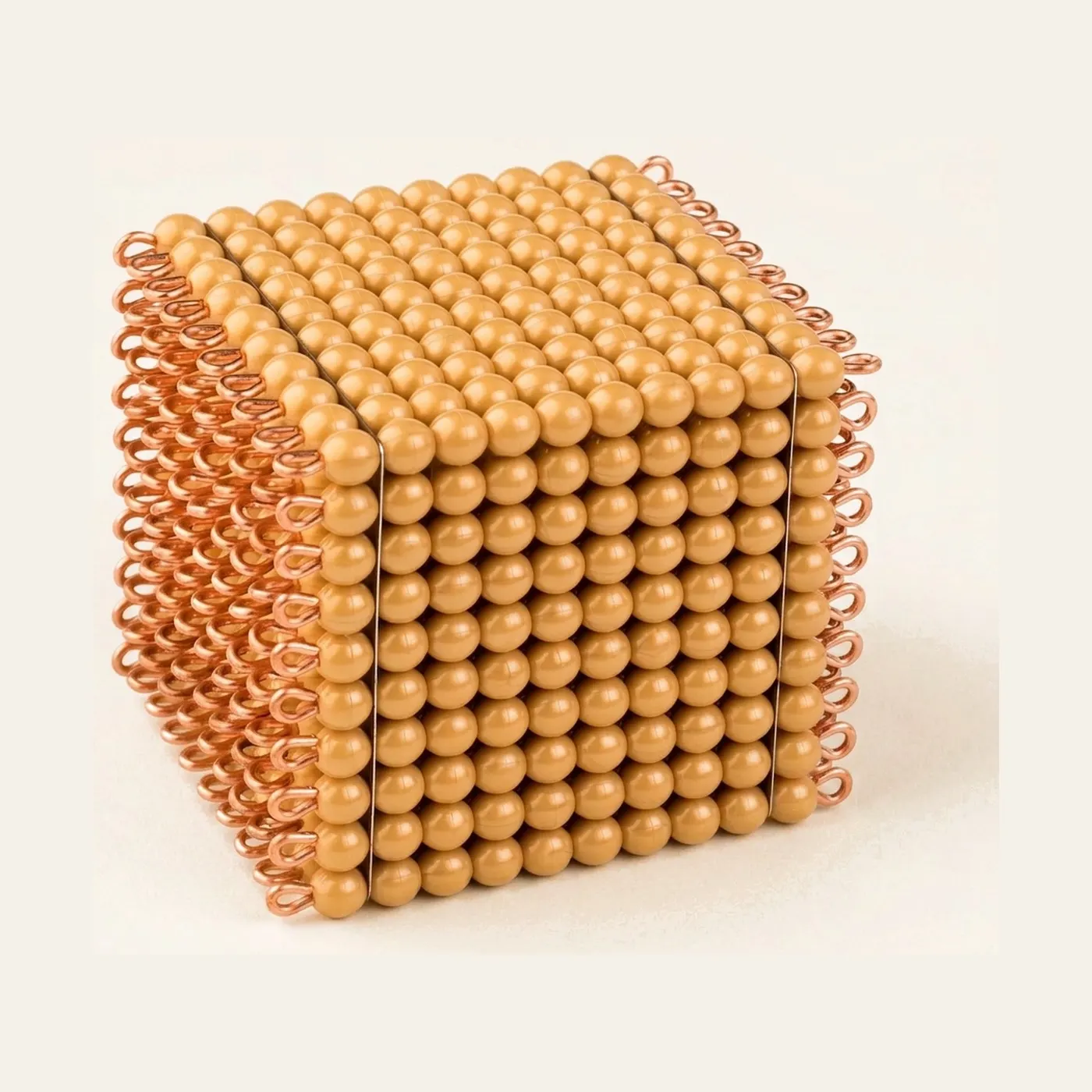
The thousand cube in nylon coated beads, sold on its own so a set can be repaired rather than replaced. The cube is the piece children carry most and drop most, being the only one heavy enough to feel like a weight, and it is also the one whose loss stops the whole decimal work: without it there is nothing to exchange ten hundreds for. Nylon coating survives the handling that a thousand cube gets. Golden plastic beads on nylon coated wire, for ages 3 to 6.
“The child is both a hope and a promise for mankind.”
The golden thousand cube embodies Dr. Montessori's principle of materialized abstractions, where abstract mathematical concepts become tangible experiences. Through this concrete material, children develop what Montessori called 'mathematical mind' - the human tendency to think in precise, ordered ways. The cube's weight and size provide sensorial feedback that creates lasting impressions of quantity, essential for understanding place value.
- Concrete understanding of 1000 as a unit composed of 10 hundreds or 100 tens
- Development of mathematical abstraction through sensorial experience
- Comprehension of the decimal system's hierarchical structure
- Preparation for four-digit operations and place value work
Read More
By physically handling 1000 as one unit, children internalize the hierarchical nature of the decimal system through their senses before moving to abstract operations. This material bridges the gap between concrete counting and abstract numerical thinking, following the child's natural progression from concrete to abstract understanding.
How to present it
Follow the Montessori method of presentation for optimal child development.
Place the thousand cube on a felt mat. Have the unit bead, ten-bar, and hundred square available for comparison. Ensure child has experience with building the hundred square.
- 1
Invite the child to carry the thousand cube with both hands to the mat
The weight provides important sensorial feedback about quantity - 2
Place the unit, ten, hundred, and thousand in sequence. Name each: 'This is one thousand'
Use minimal language, letting the material speak - 3
Count the layers: 'One hundred, two hundred... ten hundred make one thousand'
Count slowly, allowing the child to absorb the quantity - 4
Show how 10 hundred squares stack to form the cube
If available, use loose hundred squares to demonstrate - 5
Invite the child to explore the cube, counting edges and observing its perfect form
Allow ample time for sensorial exploration
Every Child Is a Little Creator

Heritage
Since 1929

In classrooms
Around the world

European brands
Nienhuis, GAM, Educo

AMI approved
To the association standard
Golden Bead Cube of 1000: Individual Nylon-Coated Beads
