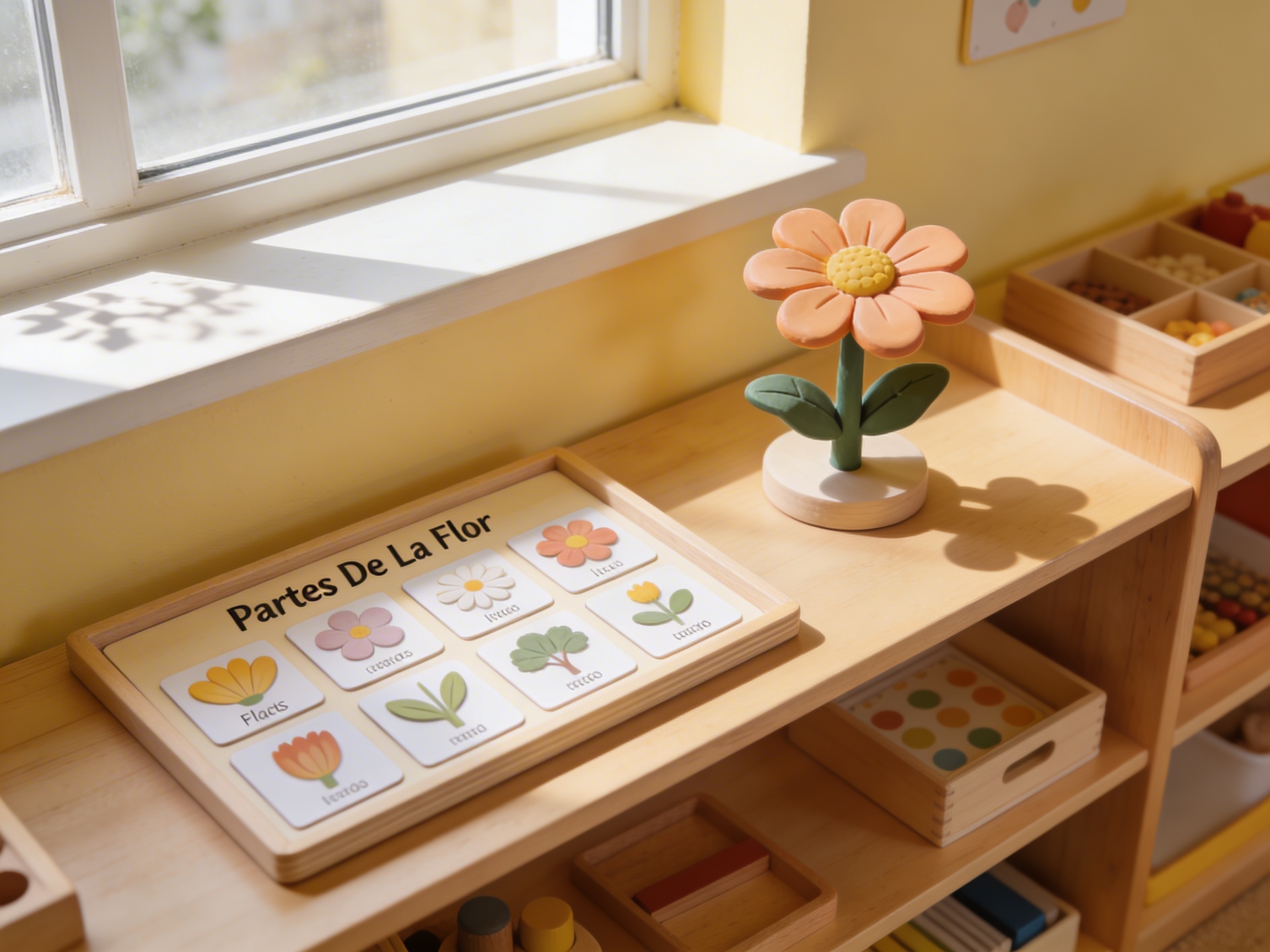
The Partes De La Flor is a Educational Materials Montessori material designed for children aged 3-6, crafted by Nienhuis Montessori to AMI standards.
These Spanish-language botanical cards introduce children to the fundamental parts of flowers through clear, detailed illustrations and precise vocabulary. Designed for the Montessori language and botany curriculum, each card pairs a botanical illustration with its corresponding Spanish label, supporting both scientific understanding and language development in the Casa dei Bambini environment.
“The child is both a hope and a promise for mankind.”— Maria MontessoriEducation and Peace
“The hands are the instruments of man's intelligence.”
— Maria Montessori, The Absorbent Mind
The Partes De La Flor cards fulfill the young child's need to classify and name their world through precise botanical vocabulary in Spanish. These matching cards capitalize on the sensitive period for language by presenting flower anatomy through clear illustrations paired with exact terminology. In the Casa dei Bambini, botanical nomenclature cards like Partes De La Flor bridge the child's sensorial exploration of real flowers with abstract scientific concepts. The cards' design—separating image from label—allows children to match visual representations with written words, exercising both discrimination and reading skills. This botanical material respects the child's capacity for complex learning by introducing scientific terms like 'estambre' and 'pistilo' rather than simplified vocabulary. The Spanish-language format of Partes De La Flor serves bilingual environments and honors the child's ability to absorb multiple languages during the early years. Through repeated matching work with these flower part cards, children internalize both botanical structures and their Spanish names, preparing them for advanced plant studies while strengthening their command of scientific language.
Each order includes everything needed for proper presentation and long-term use.
Follow the Montessori method of presentation for optimal child development.
Present one picture card, naming the flower part clearly in Spanish: 'Este es el pétalo'
Select the matching label card and place it below the picture, reading it aloud
Continue matching all picture cards with their labels, inviting the child to participate
Once all matches are complete, review by pointing to each part and having the child name it
Every material is carefully selected for durability, safety, and authentic Montessori experience.
Sourced from sustainably managed European forests. Beechwood is chosen for its exceptional durability, smooth grain, and natural warmth that invites touch.
Natural, unbleached cotton in child-friendly colors. The fabric provides the right amount of friction for developing fingers while being gentle on sensitive skin.
Water-based, child-safe finish that meets the strictest European safety standards. Designed to withstand years of daily use without chipping or peeling.
Each material supports multiple areas of child development simultaneously.
Builds Spanish botanical vocabulary through visual association and repetition.
Introduces basic plant anatomy concepts appropriate for the sensitive period for order and classification.
Develops observation skills through detailed botanical illustrations and matching activities.
Supports Spanish language learning and connects children to nature through scientific exploration.
Designed for child-sized hands
Professional tips from AMI-trained guides to maximize the educational value of this material.
“Present this material after children have explored real flowers in the classroom garden or nature walks”
Use consistent Spanish pronunciation and avoid code-switching during the lesson to maintain language clarity
Create a control chart showing all flower parts labeled for independent checking
Connect this work to practical life by having children arrange real flowers and identify the parts they've learned
Everything you need to know about this material.
These cards are designed for ages 3-6, aligning with the Casa dei Bambini environment. Children typically begin with matching activities around age 3, progressing to reading labels and learning botanical vocabulary as their Spanish language skills develop.
The set includes cards featuring the essential parts of a flower: pétalo (petal), estambre (stamen), pistilo (pistil), sépalo (sepal), tallo (stem), and hoja (leaf). Each part is clearly illustrated with its corresponding Spanish label.
Yes, these cards serve dual purposes - they can introduce Spanish vocabulary to any child while teaching botany concepts. The clear illustrations make them accessible for language learning, and they're excellent for bilingual environments or Spanish immersion programs.
These cards follow Montessori principles by isolating concepts, using realistic illustrations, and providing concrete vocabulary. They complement hands-on flower dissection activities and support the progression from concrete to abstract learning in botanical studies.
Children can use these for three-part card lessons, matching exercises, vocabulary building, and as reference materials during flower dissection. They also support drawing activities, Spanish reading practice, and can be combined with real flowers for nature study.
Can't find what you're looking for?
Contact Our Experts
Share your experience with this material and help other educators and parents.


